You’re going at the speed limit down a two-lane road when a car barrels out of a driveway on your right. You slam on the brakes, and within a fraction of a second of the impact an airbag inflates, saving you from serious injury or even death.
The airbag deploys thanks to an accelerometer — a sensor that detects sudden changes in velocity. Accelerometers keep rockets and airplanes on the correct flight path, provide navigation for self-driving cars, and rotate images so that they stay right-side up on cellphones and tablets, among other essential tasks.
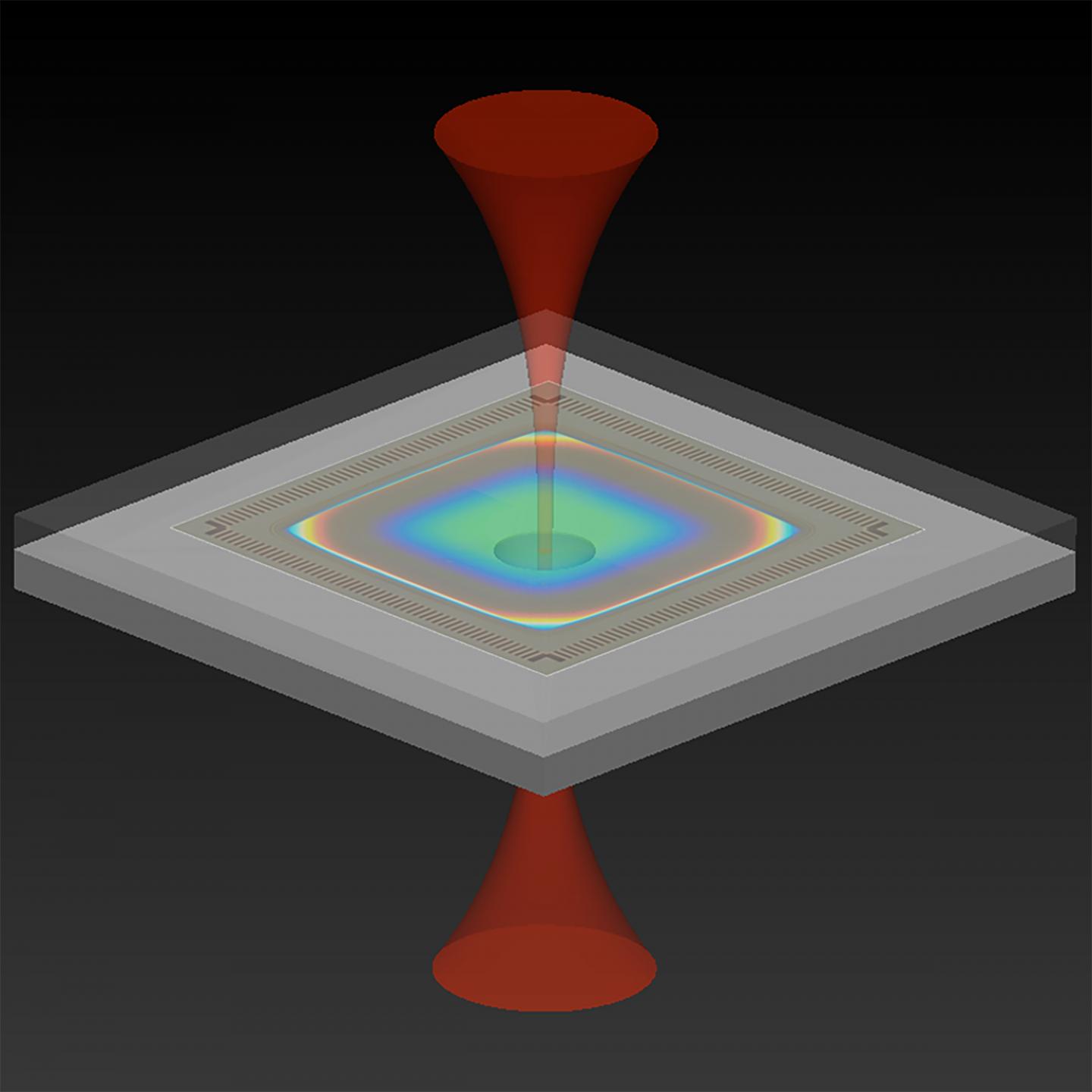
Addressing the increasing demand to accurately measure acceleration in smaller navigation systems and other devices, researchers at the National Institute of Standards and Technology (NIST) have developed an accelerometer a mere millimeter thick that uses laser light instead of mechanical strain to produce a signal.
Although a few other accelerometers also rely on light, the design of the NIST instrument makes the measuring process more straightforward, providing higher accuracy. It also operates over a greater range of frequencies and has been more rigorously tested than similar devices.
You’re going at the speed limit down a two-lane road when a car barrels out of a driveway on your right. You slam on the brakes, and within a fraction of a second of the impact an airbag inflates, saving you from serious injury or even death.
The airbag deploys thanks to an accelerometer — a sensor that detects sudden changes in velocity. Accelerometers keep rockets and airplanes on the correct flight path, provide navigation for self-driving cars, and rotate images so that they stay right-side up on cellphones and tablets, among other essential tasks.
Addressing the increasing demand to accurately measure acceleration in smaller navigation systems and other devices, researchers at the National Institute of Standards and Technology (NIST) have developed an accelerometer a mere millimeter thick that uses laser light instead of mechanical strain to produce a signal.
Although a few other accelerometers also rely on light, the design of the NIST instrument makes the measuring process more straightforward, providing higher accuracy. It also operates over a greater range of frequencies and has been more rigorously tested than similar devices.




Leave a Reply