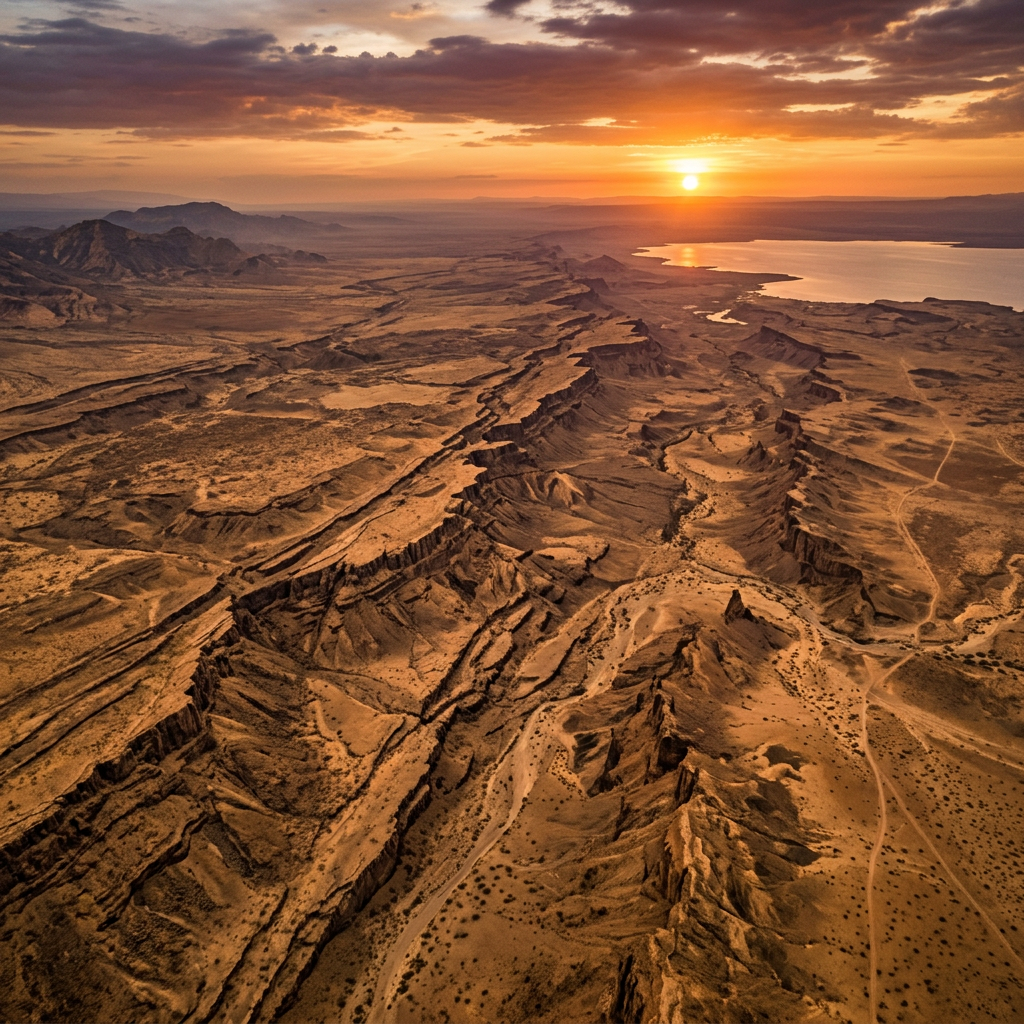
Eastern Africa’s Turkana Rift is both a hotbed for fossil discoveries of our earliest ancestors and a literal hotbed of volcanic activity caused by shifting tectonic plates. Now researchers have found that Earth’s underlying crust in the region has been significantly thinned, presaging Africa’s eventual breakup—and with that finding, the researchers offer a new perspective on how Turkana’s world-famous fossil record of human evolution came to be.
The findings were published in Nature Communications.
Scientists have long been fascinated by the Turkana Rift, a 500-kilometer-wide, low-lying region that spans Kenya and Ethiopia. This rift is part of the larger East African Rift System, which runs from the Afar Depression in northeastern Ethiopia to Mozambique in the south, with the African tectonic plate on one side and the Arabian and Somali plates on the other. At the Turkana Rift, the African and Somali plates are drifting apart at a rate of about 4.7 millimeters per year. In the process, known as rifting, Earth’s crust is stretched horizontally, causing it to buckle and fracture, thus releasing magma from deep below.

Not every rifting episode ends in continental breakup. The Turkana Rift, however, appears destined for that fate.
“We found that rifting in this zone is more advanced, and the crust is thinner, than anyone had recognized,” says study lead author Christian Rowan, a Ph.D. student at Columbia University’s Lamont-Doherty Earth Observatory, which is part of the Columbia Climate School. “Eastern Africa has progressed further in the rifting process than previously thought.”
Rowan and colleagues used a unique dataset of high-quality seismic measurements collected by industry partners and acquired in collaboration with the Turkana Basin Institute, a research organization founded by the late paleoanthropologist Richard Leakey to further the study of human evolution and its geological context in Kenya. By studying how acoustic waves used in the measurements were reflected by subsurface layers, then combining their interpretations with other deep subsurface imaging, the researchers visualized the structure of sediments and how deep the top of the crust is within the Turkana Rift.
Along the rift’s axis, the crust—the rocky outermost layer that rests atop Earth’s shifting mantle—is about 13 kilometers thick. That is significantly thinned compared to the more than 35-kilometer-thick crust farther from the rift’s center and is a telltale signature of a process called “necking.”
The name comes from the shape. Rowan likens the significant thinning of Earth’s crust being stretched by shifting tectonic plates to the “neck” of a piece of saltwater taffy pulled from each end—its middle is thinned and elongated even as the ends of the taffy remain unchanged. “The thinner the crust gets, the weaker it becomes, which helps promote continued rifting,” Rowan says. Eventually the crust breaks apart.
“We’ve reached that critical threshold” of crustal breakdown, says Anne Bécel, a geophysicist at Lamont and co-author of the study. “We think this is why it is more prone to separate.”
But this will play out in geological time, so “critical” is relative. The Turkana Rift started pulling apart about 45 million years ago, and the researchers estimate that necking began after an episode of widespread volcanic eruptions roughly 4 million years ago. It will take a few million more years before necking gives way to oceanization, the next stage in rifting, when magma will surge through the cracks and create a new seafloor for water that pours in from the Indian Ocean to the north.
The researchers also found evidence of an earlier period of rifting that did not culminate in continental breakup but left the crust weakened and thinned, thus contributing to the present rifting phase. “It challenges some of the more traditional ideas of how continents break apart,” says Rowan.
The Turkana Rift is the first identified active continental rift undergoing necking, making it important for the study of tectonic processes associated with this critical phase of continental separation. “In essence, we now have a front row seat to observe a critical rifting phase that had fundamentally shaped all rifted margins across the world” says co-author Folarin Kolawole, who is also with Lamont. Those rifting processes in turn connect to other Earth systems; understanding them helps scientists reconstruct past landscapes, vegetation and climate. “Then we can use that knowledge to understand what’s going to happen in our future, even on shorter time scales,” says Bécel.
Their findings also have implications in a very different domain: the study of human evolution. The Turkana Rift has yielded more than 1,200 hominin fossils spanning the last 4 million years. That’s one-third of all such fossils found in Africa, and many paleoanthropologists have argued that this scientific ‘Garden of Eden’ was a hotspot of evolution for humanity’s ancestors. Rowan and colleagues think their findings may suggest a different narrative.
Following widespread volcanism around 4 million years ago, necking initiated subsidence of the Turkana Rift, where fine-grained sediments favorable for fossil preservation rapidly accumulated. “The conditions were right to preserve a continuous fossil record,” says Rowan.
It’s possible, then, that the Turkana Rift was not uniquely important in the evolution and diversification of our hominin ancestors, but rather a place where conditions lent themselves to documenting them.
That is still only a hypothesis, “but other researchers can now use our results to explore those ideas,” says Rowan. “In addition, our results can be fed into tectonic models that are coupled with climate to really explore how shifting tectonics and climates influenced our evolution.”
Leave a Reply