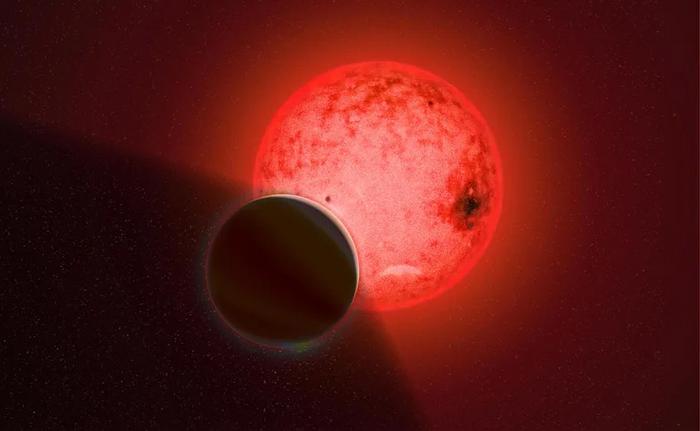
Observations of the highly unusual—sometimes called “forbidden”—exoplanet TOI-5205 b taken by JWST suggest the giant planet’s atmosphere has fewer heavier elements than its host star. These findings have implications for our understanding of the giant planet formation process that occurs early in a star’s lifespan.
Published this week by The Astronomical Journal, these findings represent the collaborative work of an international team of astronomers led by NASA Goddard Space Flight Center’s Caleb Cañas and including Carnegie Science’s Shubham Kanodia.
TOI 5205 b is a Jupiter-sized planet orbiting a star that is itself about four times the size of Jupiter and about 40 percent the mass of the Sun. When it passes in front of its host star—a phenomenon astronomers call a “transit”—the planet blocks about six percent of its light. By observing this transit with telescope instruments called spectrographs that split the light into its constituent colors, astronomers can try to decipher the planet’s atmospheric makeup and learn more about its history and relationship with its host star.

Planets are born from the rotating disk of gas and dust that surrounds a star in its youth. While it is commonly accepted that giant planets form in these cloudy disks that result from the birth of the host star, the existence of massive planets like TOI-5205b orbiting cool stars at close distances raises many questions about this process.
To shed more light on this, Kanodia, Cañas and Jessica Libby-Roberts of the University of Tampa are leading the largest JWST Cycle 2 exoplanet program, Red Dwarfs and the Seven Giants, which was designed to study unlikely worlds like TOI-5205 b—sometimes called GEMS (for giant exoplanets around M dwarf stars).
Back in 2023, Kanodia led the effort that confirmed TOI-5205 b’s existence, following up on information from NASA’s Transiting Exoplanet Survey Satellite (TESS), which first identified it as a planetary candidate. Now, he’s co-leading the team that made the first observations of its atmospheric composition.
Their observations of three transits of TOI5205-b revealed something that the astronomers couldn’t easily explain. They were surprised to see that the planet’s atmosphere has a lower concentration of heavy elements—relative to hydrogen—than a gas giant planet in our own Solar System like Jupiter. It even has a lower metallicity than its own host star. This makes it stand out among all the giant planets that have been studied to date.
Additionally, although less shocking, the transits revealed methane (CH₄) and hydrogen sulfide (H₂S) in TOI-5205-b’s atmosphere.
To contextualize their findings, team members Simon Muller and Ravit Helled at University of Zurich deployed sophisticated models of planetary interiors to predict that the entirety of TOI5205-b’s composition is about 100 times more metal rich than its atmosphere, as measured by the transits.
“We observed much lower metallicity than our models predicted for the planet’s bulk composition, which is calculated from measurements of a planet’s mass and radius. This suggests that its heavy elements migrated inward during formation and now its interior and atmosphere are not mixing,” Kanodia explained. “In summary, these results suggest a very carbon-rich, oxygen-poor planetary atmosphere.”
The research is part of the GEMS Survey, a program dedicated to studying transiting giant planets around M-dwarf stars to understand their formation, structure, and atmospheres. The research group also includes Carnegie astronomers Peter Gao, Johanna Teske, and Nicole Wallack, as well as recently departed Carnegie postdoctoral fellow Anjali Piette, now on faculty at University of Birmingham.
Other co-authors are: Jacob Lustig-Yaeger, Erin May, and Kevin Stevenson of the Applied Physics Laboratory at Johns Hopkins University; Shang-Min Tsai of the Academia Sinica Institute of Astronomy and Astrophysics; Dana Louie of Catholic University; Giannina Guzmán Caloca of the University of Maryland; Kevin Hardegree-Ullman of Caltech; Knicole Colón of the NASA Goddard Space Flight Center; Ian Czekala of University of St. Andrews; Megan Delamer and Suvrath Mahadevan of Penn State University; Andrea Lin and Te Han of the University of California Irvine; Joe Ninan of the Tata Institute of Fundamental Research; and Guðmundur Stefánsson of the University of Amsterdam.
The researchers worked together to correct for the effects that starspots on TOI-5205 b’s host star had on their data. Because the star is heavily spotted, it left an imprint on the data—brightening some wavelengths and masking potential signatures in the atmosphere. Wallack and Kanodia are now validating this method in a more-recent JWST project in the same planetary system, which will prove useful for future investigations of this and other planets around active stars.
IMAGE CREDIT: Katherine Cain, Carnegie Science.



Leave a Reply