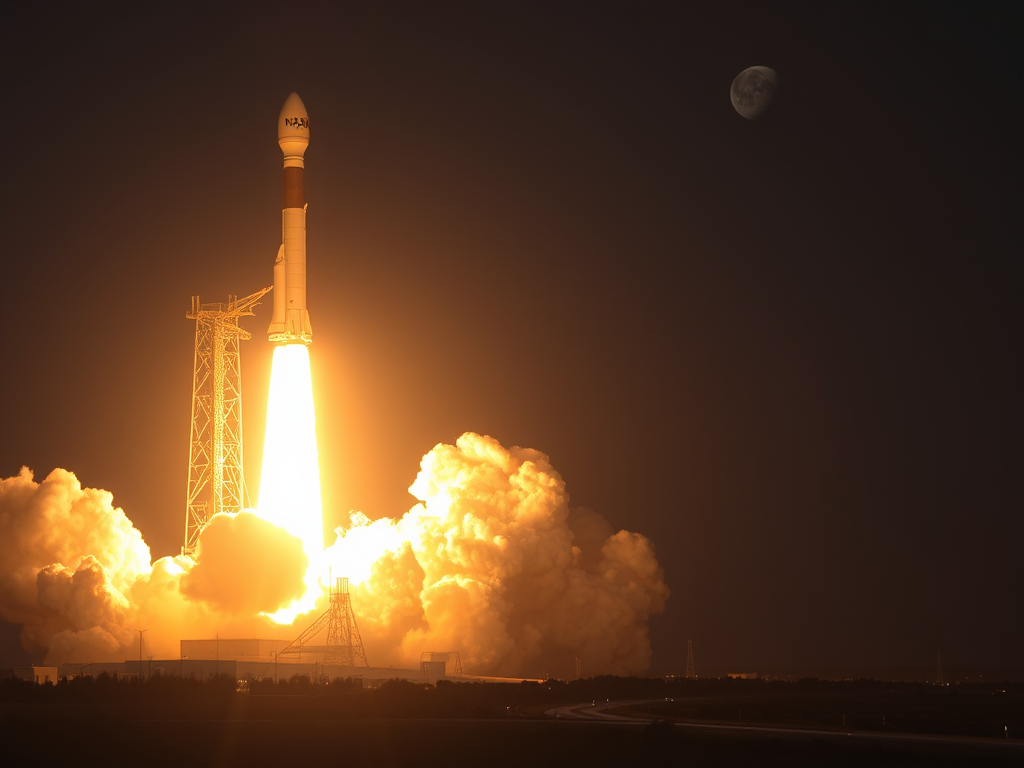
Artemis II Sends Humans Moonward Again: NASA’s Artemis II mission launched Wednesday evening from Florida, sending four astronauts on a lunar flyby that marks humanity’s return to deep-space crewed travel for the first time since Apollo 17 in 1972. Commanded by Reid Wiseman, the crew includes Victor Glover, Christina Koch, and Canadian astronaut Jeremy Hansen, making the mission notable for several firsts: the first Black man, first woman, and first non-American assigned to a moon mission. The flight will travel more than 695,000 miles and test the Orion spacecraft for future lunar landings and a sustained human presence on the moon. Though minor technical glitches arose before and after liftoff, the mission proceeded successfully, reviving the spectacle and ambition of Apollo-era exploration while underscoring renewed geopolitical urgency around lunar exploration. (New York Times)
Aegean Seafloor Turns Up a Long Maritime Timeline: One of the week’s more satisfying archaeology stories comes from the waters off Karpathos, where an international survey mapped a layered underwater landscape spanning from the late seventh century B.C. to the mid-nineteenth century A.D. The finds are not just isolated curiosities. Researchers identified four ancient shipwrecks, one modern wreck, traces of an ancient port, cargoes of amphoras, and more than 20 Byzantine-period anchors. What makes this notable is the density and chronological spread of the material. Rather than a single dramatic wreck, the seafloor appears to preserve a long record of movement, trade, anchorage, and coastal use in one corridor of the Aegean. It is the kind of survey that quietly expands a maritime map rather than rewriting it in one stroke. (archaeology.org)
Europe’s Last Neanderthals May Have Survived a Genetic Bottleneck: A new mitochondrial DNA study of 59 Neanderthals sharpens the story of their final millennia in Europe. Researchers found that multiple maternal lineages persisted until about 65,000 years ago, after which they were replaced by a single lineage traced to southwestern France. The implication is stark: a major disruption seems to have narrowed the Neanderthal population, likely as harsher climates and expanding glaciers hit northern groups especially hard. A smaller southwestern population may have survived and later spread, but with reduced diversity. That matters because low diversity can leave populations more vulnerable to environmental shocks and demographic instability. The study also offers a useful archaeological twist: isolated groups may have produced more cultural variation in tools and art precisely because they were not interacting much, even as their genetics were becoming more fragile. (archaeology.org)
Egyptian Scans Spot a Buried Structure Beneath Ancient Buto: Archaeology’s newest lesson in seeing before digging comes from Buto in Egypt’s Nile Delta, where researchers combined satellite radar with electrical resistivity tomography to probe deeply buried layers of an ancient city occupied from roughly 3800 B.C.E. into the early Islamic period. Beneath upper Roman and Ptolemaic debris, the scans identified a substantial structure three to six meters down, likely dating to the Saite period around 2,600 years ago. Researchers initially suspected a large tomb or shrine, then tested the prediction with a small excavation that uncovered mudbrick walls and religious artifacts where the instruments had indicated. The significance here is methodological as much as archaeological. Deep, waterlogged, repeatedly rebuilt urban sites are notoriously difficult to excavate. A workflow that narrows targets before major digging could save time, money, and damage across similarly layered sites. (Phys.org)

Ancient Dogs in Anatolia Look More Like Kin Than Tools: Two Nature papers highlighted this week push the early history of dogs into sharper focus through finds from central Anatolia. At Pınarbaşı, researchers identified dogs dated to 15,800 years ago, making them the earliest directly confirmed by nuclear DNA. These animals were not simply present near humans; they were carefully buried near human burials and appear to have shared a fish-heavy diet similar to the people around them. Genetic evidence also suggests that related dogs spread rapidly across Europe by at least 14,000 years ago. A later Anatolian site, Boncuklu, shows dogs buried directly with humans and tied to the beginnings of settled farming life. The story is not merely about domestication dates. It is about a relationship already socially meaningful, ritually marked, mobile across cultural boundaries, and possibly central to hunting, guarding, and herding alike. (Phys.org)
Pompeii’s Household Altars Smelled of Empire: A new Pompeii study asks an intimate question with global implications: what, exactly, were people burning in Roman household incense burners before Vesuvius sealed the city in ash? Researchers analyzing preserved residues found evidence not only of local plants but also imported aromatic substances from Africa or Asia. That is a small finding with a wide horizon. Domestic ritual, often imagined as local and ordinary, turns out to have been entangled with long-distance trade networks. In other words, the smell of devotion in a Pompeian home may have depended on supply chains stretching well beyond Italy. This helps collapse a familiar divide between “private religion” and “global economy.” Household worship was not sealed off from empire; it was scented by it. The study is a reminder that archaeology can recover not only structures and objects, but also the material traces of atmosphere, exchange, and habit. (Antiquity Journal)
Coral Architecture in the Pacific Gets a Sharper Clock: Dating old buildings is often messy, and dating coral architecture has been especially tricky. A new study highlighted this week applies uranium-thorium dating to historic coral structures in Mangareva, in the South Pacific, and in doing so opens a cleaner chronological window onto colonial and local building histories. Coral was the dominant construction material on the islands before wood became common in the late nineteenth century. The new dates suggest some household structures incorporated older coral, but not in the sweeping, centuries-long pattern of reuse some earlier theories had assumed. That matters because it refines the timeline of how missionization, local adaptation, and construction practice interacted after French Catholic missionaries arrived in the 1830s. More broadly, it shows how archaeometric precision can clarify colonial-era transformation without requiring large, destructive excavations. (Antiquity Journal)
Wooden Tools From China Add More Plants to the Human Menu: A Science report this week spotlights 300,000-year-old wooden digging tools from China that complicate the old caricature of early humans as primarily meat-driven big-game specialists. The tools, preserved well enough to show they were digging sticks, point to deliberate harvesting of underground plant foods. That sounds modest until you consider the broader implication: perishable technologies rarely survive, so whole chapters of hominin behavior are probably missing from stone-heavy archaeological narratives. These finds suggest planned foraging strategies, familiarity with local edible plants, and a technological repertoire centered on roots and tubers rather than just hunting. The story broadens the geography, too. Sophisticated early wooden tool use is not only a European tale. East Asian hominins were deploying specialized plant-extraction technology deep in the Pleistocene, and the archaeological record is only beginning to catch up. (Science)
DOE Sets an Aggressive Quantum Deadline: Outside archaeology, one of the week’s more consequential technology stories is the U.S. Department of Energy’s stated aim to build a fully functioning quantum computer capable of scientifically useful calculations within three years. Even researchers in the field appear to treat that timeline as ambitious, if not aspirational. Still, the announcement matters because it signals a shift from general enthusiasm to deadline-driven federal intent. The story is not just about one machine. It also involves a new prioritization of major research facilities, suggesting quantum is being elevated as infrastructure rather than left as a diffuse research frontier. Whether or not the three-year target proves realistic, it will shape expectations, funding decisions, and public narratives around what counts as “useful” quantum progress. In that sense, the policy timetable may matter nearly as much as the hardware. (Science)
AI Has Now Crossed Into Authorship: Scientific American’s piece on an AI-authored paper passing peer review lands on a genuine threshold moment. The paper in question was accepted for a workshop at ICLR 2025 after being produced by the “AI Scientist,” a system that can survey literature, generate hypotheses, design experiments, analyze results, and write a manuscript with no human author in the loop. Experts quoted in the story do not present the paper as brilliant. In some ways, its mediocrity is the point. A merely competent AI paper is enough to stress an already overloaded review system if such submissions become cheap and endless. The shift here is conceptual: AI is no longer just a laboratory assistant for narrow tasks. It is beginning to occupy the role of investigator and author. Science may soon face a volume problem disguised as an innovation story. (Scientific American)
A Sailing Expedition Turns the Southern Ocean Into a Low-Fuel Lab: NASA’s account of the PlanktoSpace expedition is a good reminder that innovation is sometimes logistical rather than flashy. During the 2026 austral summer, a team of 18 scientists, crew members, and passengers traveled 7,200 miles across the Southern Ocean aboard a sailing vessel, using only about as much fuel over 50 days as a conventional large research ship might burn in one day. The mission’s focus was the health of marine protected areas and, especially, plankton communities that help shape the color and productivity of ocean water. That ties directly to NASA’s PACE mission, which uses remote sensing to distinguish different phytoplankton. The expedition thus functioned both as field science and as calibration for satellite-era ocean observation. It is a small but suggestive model of lower-emission, data-rich research at sea. (NASA Science)


Leave a Reply