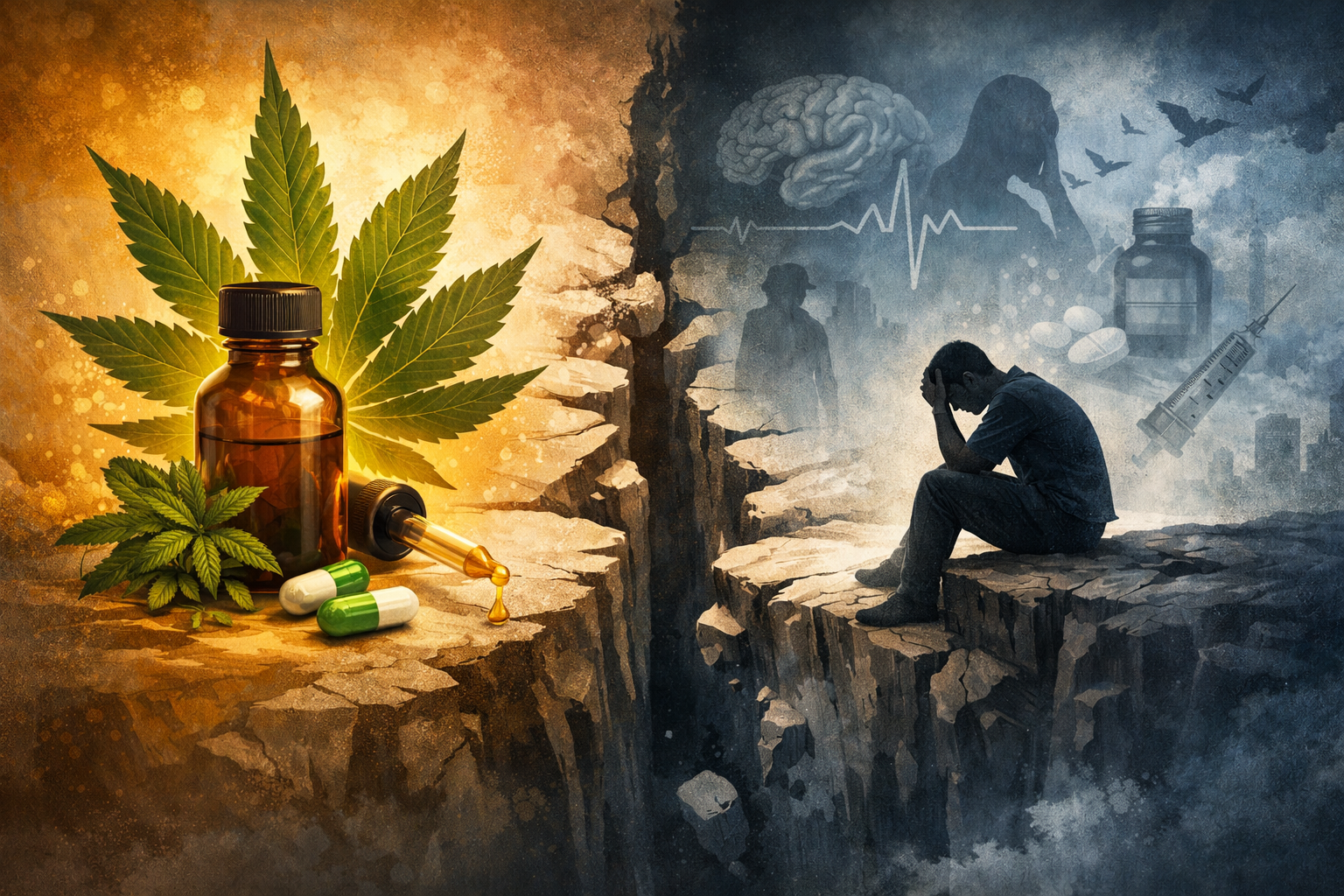
In an era when medical cannabis has been approved for conditions ranging from anxiety to PTSD to depression, a sobering new study has arrived to challenge the assumptions underpinning that expansion. Published March 16 in The Lancet Psychiatry, the largest-ever systematic review and meta-analysis of cannabinoids as treatments for mental health and substance use disorders found little evidence that they work for most of the conditions for which they are most commonly prescribed.
The study, led by Dr. Jack Wilson of the University of Sydney’s Matilda Centre for Research in Mental Health and Substance Use, examined 54 randomized controlled trials (RCTs) involving 2,477 participants conducted over 45 years, from 1980 to 2025. Its conclusions are striking in their breadth: cannabinoids showed no significant benefit for anxiety, depression, PTSD, psychotic disorders, OCD, bipolar disorder, ADHD, anorexia nervosa, opioid use disorder, or cocaine use disorder. For depression, the study found something even starker — there were no RCTs examining cannabis as a treatment at all.
The findings arrive at a moment of remarkable — and arguably reckless — enthusiasm for cannabis as medicine. In the United States and Canada, 27 percent of adults aged 16 to 65 have reported using cannabis for medical purposes, with roughly half citing mental health management as the reason.¹ In Australia, over one million prescription applications have been approved for cannabinoid medicines, with mental health disorders accounting for six of the ten most common indications. Global sales of CBD products alone have surged into the billions.
That gap between clinical practice and clinical evidence is precisely what makes this study significant. The authors note that regulators have largely approved cannabinoids based on the perception of a low-risk profile rather than robust evidence of effectiveness — a concern shared by bodies including the Royal Australian and New Zealand College of Psychiatrists and the American Medical Association.² Meanwhile, some of the most common reasons people seek out medicinal cannabis — sleep disorders, PTSD, anxiety, depression — are conditions for which the evidence is either sparse or absent.
“Though our paper didn’t specifically look at this,” said Dr. Wilson, “the routine use of medicinal cannabis could be doing more harm than good by worsening mental health outcomes, for example a greater risk of psychotic symptoms and developing cannabis use disorder, and delaying the use of more effective treatments.”
The study did identify some areas of cautious promise. A combination of cannabidiol (CBD) and delta-9-tetrahydrocannabinol (THC) modestly reduced cannabis withdrawal symptoms and weekly cannabis consumption in people with cannabis use disorder, suggesting a role analogous to methadone in opioid treatment — a pharmaceutical replacement that eases the transition away from the problematic substance.
“Similar to how methadone is used to treat opioid-use disorder,” Dr. Wilson explained, “cannabis medicines may form part of an effective treatment for those with a cannabis-use disorder. When administered alongside psychological therapy, an oral formulation of cannabis was shown to reduce cannabis smoking.”
Cannabinoids also showed significant reductions in tic severity among patients with Tourette’s syndrome, though only when CBD and THC were administered together. For insomnia, cannabinoids led to measurable increases in sleep time recorded by electronic device — the one outcome across the entire meta-analysis to achieve a “moderate certainty” rating under the GRADE evidence framework. Among children with autism spectrum disorder, cannabinoids showed a reduction in autistic traits, though the researchers flagged very low certainty in that result and noted that both contributing studies carried a high risk of bias.
Even these promising signals come with caveats. “The overall quality of evidence for these other conditions, such as autism and insomnia, was low,” Dr. Wilson said. “In the absence of robust medical or counselling support, the use of medicinal cannabis in these cases is rarely justified.”
One finding may genuinely surprise clinicians and patients alike: for people with cocaine use disorder, cannabinoids significantly increased cocaine cravings rather than reducing them. This means that cannabis medicines, which are sometimes conceptualized as broadly anxiolytic or craving-suppressing, can have the opposite effect depending on the substance involved.
“When medicinal cannabis was used to treat people with cocaine-use disorder, it increased their cravings,” Dr. Wilson warned. “This means it should not be considered for this purpose and may, in fact, worsen cocaine dependence.”
On the safety side, the picture is mixed. Cannabinoids were associated with significantly higher odds of all-cause adverse events compared to placebo — estimated at roughly one additional patient experiencing harm for every seven treated.
Common side effects included dry mouth, nausea, diarrhea, and dizziness. However, the analysis found no significant increase in serious adverse events or study withdrawals between cannabinoid and placebo groups, a result the authors acknowledge may partly explain regulatory permissiveness.
There are legitimate structural reasons to treat the study’s null findings with some humility. The quality of the existing evidence is poor across the board: 44 percent of included trials were rated as having a high risk of bias, and most GRADE assessments landed at “very low” or “low” certainty. Sample sizes were small, with a median of just 31.5 participants per trial. For some conditions, including depression, ADHD, and bipolar disorder, the research landscape is so thin that meaningful conclusions remain out of reach. As the authors write in the paper, “there is a crucial need for improved study design that includes larger and more representative participant samples.”
This is not the first systematic review to reach sobering conclusions. A 2019 meta-analysis, also published in The Lancet Psychiatry, found that significant benefits from cannabinoids were sparse, with only anxiety showing any reduction compared to placebo — and at low quality of evidence.³ Subsequent reviews reached similar conclusions through 2025. What distinguishes the new study is its scope: it is the most comprehensive synthesis of RCT evidence to date, covering the full range of mental health and substance use indications under a unified methodological framework.
The clinical implications are pointed. The study concludes that “the routine use of cannabinoids for the treatment of mental disorders and substance use disorders is currently rarely justified,” and urges that clinicians complete training on the risk-benefit profiles of these medicines. The authors also recommend greater regulatory oversight, particularly in settings where practitioners are financially incentivized to recommend cannabis products. At the same time, they raise a concern that extends well beyond regulatory housekeeping: that by turning to cannabis, patients may be delaying access to treatments with a stronger track record, such as cognitive behavioral therapy, which has demonstrated large effect sizes for depressive and anxiety disorders in meta-analyses of its own.⁴
What this study ultimately reveals is not that cannabinoids lack any medical value — their efficacy in epilepsy, multiple sclerosis-related spasticity, and certain pain conditions rests on a stronger evidentiary base. But as treatments for the mental health conditions most commonly cited by patients seeking prescriptions, the science has not kept pace with the market. Millions of people are using these products to manage their mental health. The evidence suggests, in most cases, they are doing so without a meaningful foundation.
Endnotes
- Leung J, Chan G, Stjepanović D, Chung JYC, Hall W, Hammond D. “Prevalence and self-reported reasons of cannabis use for medical purposes in USA and Canada.” Psychopharmacology. 2022;239:1509–19.
- Royal Australian and New Zealand College of Psychiatrists. “Therapeutic use of medicinal cannabis products.” March 2024. https://www.ranzcp.org
- Black N, Stockings E, Campbell G, et al. “Cannabinoids for the treatment of mental disorders and symptoms of mental disorders: a systematic review and meta-analysis.” Lancet Psychiatry. 2019;6:995–1010.
- Cuijpers P, Harrer M, Miguel C, et al. “Cognitive behavior therapy for mental disorders in adults: a unified series of meta-analyses.” JAMA Psychiatry. 2025;82:563–71.
- Wilson J, Dobson O, Langcake A, et al. “The efficacy and safety of cannabinoids for the treatment of mental disorders and substance use disorders: a systematic review and meta-analysis.” Lancet Psychiatry. Published online March 16, 2026. https://doi.org/10.1016/S2215-0366(26)00015-5
- EurekAlert! “No evidence to suggest medicinal cannabis is effective for depression, anxiety or PTSD: research.” University of Sydney, March 16, 2026. https://www.eurekalert.org/news-releases/1119717


Leave a Reply