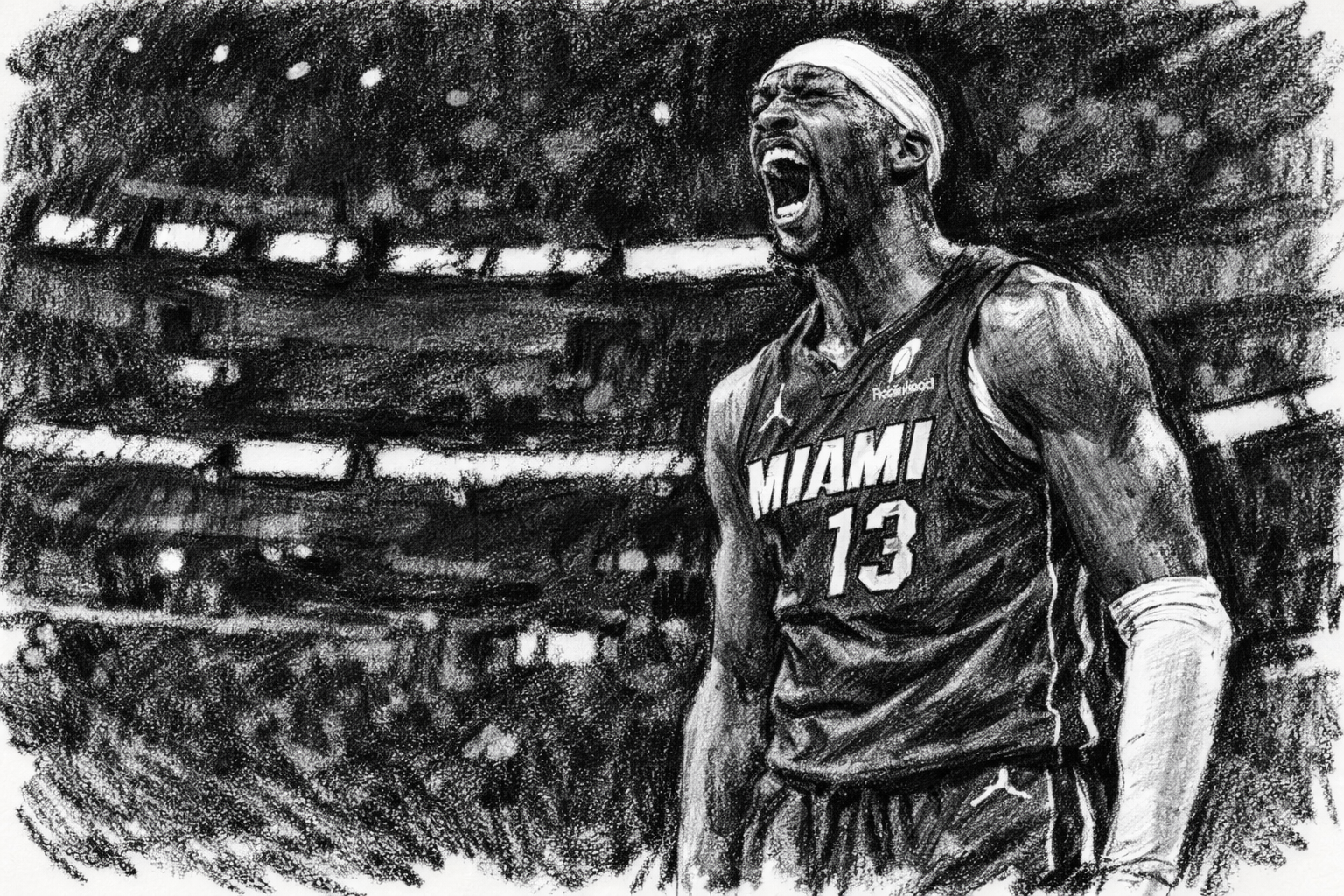
Check out this visualization of Bam Adebayo’s masterpiece.
On a night when the scoreboard read like a video game, Bam Adebayo authored one of the most statistically astonishing performances in basketball history: 83 points on 43 shots and 43 free throws. Beyond the spectacle of the scoring total, the game revived one of the NBA analytics community’s most enduring debates — how much offense should one player control?
The answer lives inside a single metric that has become central to modern basketball analysis: usage rate.
Usage rate estimates the percentage of a team’s offensive possessions that end with a specific player shooting, drawing free throws, or committing a turnover while he is on the floor. In simple terms, it measures how much of the offense runs through a single player. In Adebayo’s historic game, that share appears to have been extraordinary.
The components of Adebayo’s performance tell the story plainly. His 43 field-goal attempts, 43 free-throw attempts, and roughly 3–4 turnovers — played across approximately 40 minutes — add up to something staggering. Free throws count toward usage because drawing fouls consumes possessions, with the formula weighting them at 0.44 to account for multi-shot trips to the line. That means Adebayo personally ended roughly 43 possessions via shots, around 19 via free throws, and another 3–4 through turnovers — directly finishing somewhere in the neighborhood of 65 possessions in a single game.
A typical NBA game contains about 100–105 possessions per team. Accounting for bench time and possessions when he wasn’t on the court, Adebayo’s estimated usage rate likely approached 60 percent — an almost unheard-of level of offensive concentration. To put that in perspective, Kobe Bryant’s 81-point game in 2006 came in at roughly 45%, Luka Dončić’s 73-point explosion in 2024 clocked around 48%, and even James Harden’s most ball-dominant nights hovered near 50%. If the estimate holds, Adebayo’s game sits in a statistical outlier zone — a near-monopoly on possessions rarely seen in modern NBA offenses.
The Modern NBA’s Balancing Act
Usage rate has become a central axis of modern basketball strategy, and teams constantly juggle two competing truths: the best players should control the ball more often, yet over-concentrating offense makes teams predictable and inefficient.
In the early analytics era of the 2010s, superstar usage exploded. The league’s offense increasingly revolved around heliocentric stars — players who dominated possessions the way the sun dominates a solar system. James Harden’s Houston offenses, Russell Westbrook’s MVP season, and Luka Dončić’s tenure in Dallas all exemplified this philosophy. In some seasons, these stars posted usage rates above 35 percent — historically extreme numbers. But even those figures pale compared to the estimated usage Adebayo reached in his 83-point eruption.
One reason analysts track usage rate is because efficiency typically declines as usage rises. Every offense has a concept known as diminishing returns: the more frequently a player shoots, the harder the shots become. Defenses adjust, double teams arrive, and fatigue accumulates. This is why even historically dominant scorers often plateau in the mid-30 percent range over a full season.
The combination of very high usage and high efficiency is what separates historically great offensive seasons from merely high-volume scoring. Michael Jordan posted a 38% usage rate in 1987 alongside a 56% true shooting mark; James Harden reached 40% usage with 62% true shooting in 2019; Dončić last season hovered around 37% at 61% true shooting. Adebayo’s single-game usage spike worked because the context was unusual — the Heat leaned into mismatches, Washington struggled defensively, and the free-throw parade inflated scoring efficiency. But over an 82-game season, maintaining anything close to that usage would be almost impossible.
The Anti-Usage Movement
In recent years, some teams have begun moving away from heliocentric offense altogether. The Golden State Warriors dynasty provided the most influential example, spreading decision-making across multiple players rather than funneling every possession through a single superstar. Their philosophy prioritized ball movement over isolation, multiple threats over single dominance, and lower individual usage in service of higher team efficiency. The Warriors’ motion offense rarely produced players with usage rates above 32 percent — yet it consistently generated elite offensive ratings.
Similarly, the Denver Nuggets’ Nikola Jokić-led system distributes possessions through passing rather than shot dominance. Jokić controls the offense without necessarily dominating the usage statistic. This has sparked a growing analytics debate: is usage rate overrated?
Critics argue that usage rate oversimplifies offensive impact. The metric counts only possessions that end with a player’s action, but many valuable offensive contributions occur before the final shot — the gravity of elite shooters, screen setting, secondary playmaking, off-ball movement. Stephen Curry is the most famous example. His usage rate during peak seasons was often lower than other superstars, yet his off-ball gravity reshaped entire defenses. Analytics models such as offensive RAPTOR, EPM, and adjusted plus-minus attempt to capture these broader effects. Usage rate alone cannot.
When Extreme Usage Work
Despite the criticism, there are moments when extreme usage becomes the most rational strategy — specifically when one player holds a massive skill advantage, when the opposing defense cannot stop that advantage, and when the supporting options are simply less efficient. Adebayo’s historic game checked all three boxes. Washington’s interior defense struggled with his physicality, Miami repeatedly cleared space for isolations and post-ups, and the resulting free-throw avalanche turned each possession into a high-value opportunity. In those circumstances, funneling offense through one player is simply optimal decision-making. Analytics, after all, is not about balance for its own sake — it is about maximizing expected points per possession.
Adebayo’s performance is unlikely to trigger a league-wide shift toward 60 percent usage nights. But it does highlight the evolving complexity of basketball analytics. Usage rate remains a valuable metric because it answers a fundamental question — who is responsible for finishing possessions? — even as modern analytics increasingly recognizes that finishing possessions is only one piece of offensive value. The most effective offenses in today’s NBA combine high-usage stars with elite passers, spacing threats, and off-ball movement working in concert.
Adebayo’s night represented the extreme end of the usage spectrum, a statistical supernova where one player briefly consumed nearly every possession. It was spectacular. It was historic. And it reminded the analytics world that while numbers can explain the structure of basketball, sometimes the game still bends around a single unstoppable player.



Leave a Reply