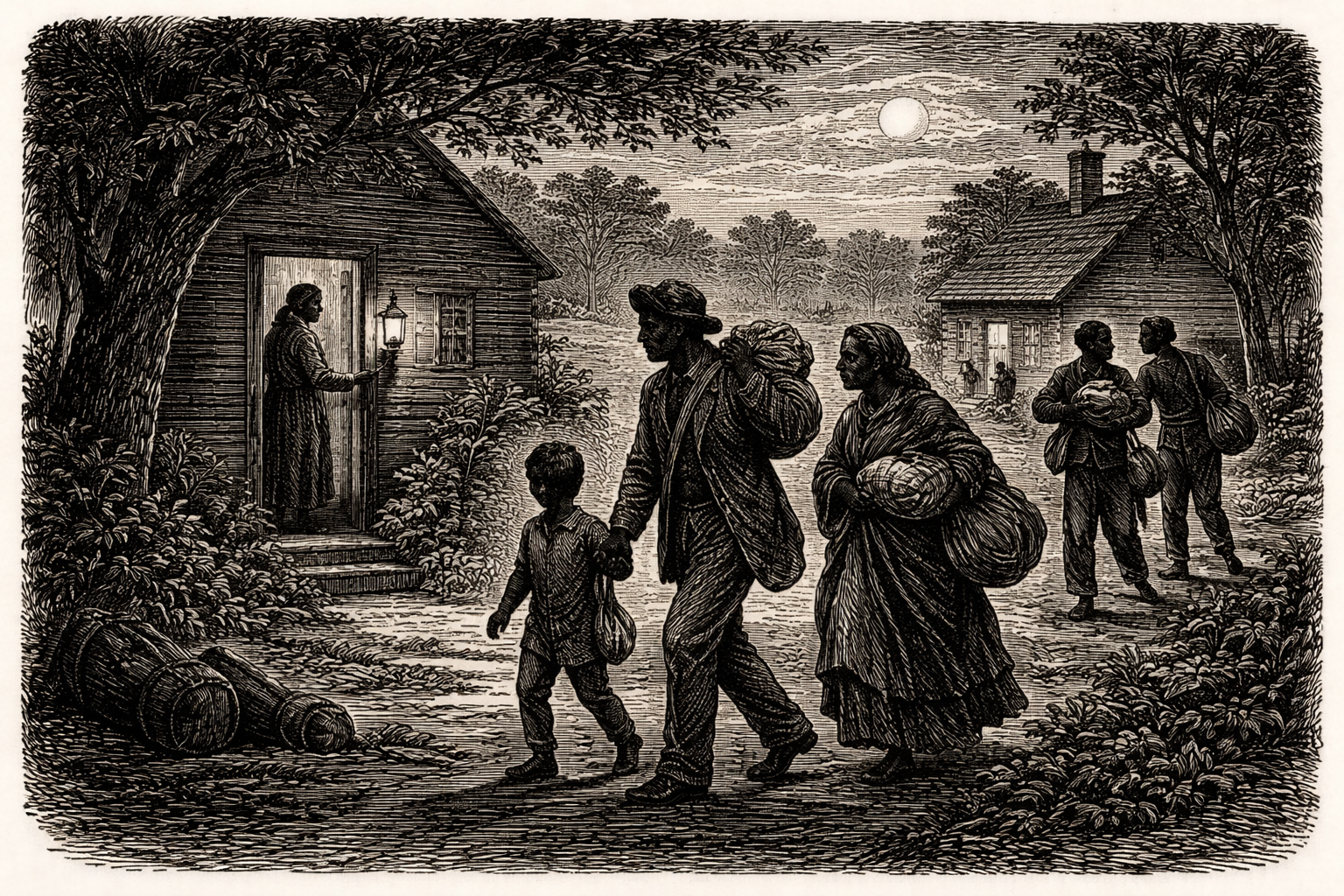
In Brooklyn, Weeksville stands as proof that a free Black community can survive the wreckage of time. Its houses remain. Its street grid can still be traced. Its schools, churches, and abolitionist networks are documented. Visitors can walk the reconstructed Hunterfly Road and stand where nineteenth-century residents built lives rooted in land ownership, literacy, and civic power. Alongside places like Sandy Ground on Staten Island and Seneca Village in Manhattan, Weeksville has become part of the recognized geography of early Black New York — studied, preserved, interpreted.
Newtown, by contrast, has nearly vanished. Once home to a free Black presence in what is now Elmhurst, Queens, its physical structures are gone, its landscape erased by development, its memory fragmented across census ledgers, church references, and scattered archival traces. There are no preserved houses to anchor the story. No reconstructed road to walk. No visible monument to signal that a community once stood there. Compared to Weeksville’s tangible survival, Newtown feels spectral — present in records but absent on the ground.
This conversation with Raymond Codrington of the Weeksville Heritage Center is part of the Ghosts of Newtown project, an effort to reconstruct and recover the lost Black history of Newtown. Weeksville offers not a direct parallel, but a living model — an example of what a nineteenth-century free Black community in New York could look like when land ownership, literacy, and institution-building converged. By understanding what Weeksville was — and what it preserved — we gain context for imagining what Newtown may have been before it disappeared.

How long has the Weeksville Heritage Center been here?
As a cultural institution, we’ve been here since 1971. The historic houses were landmarked in 1970, and in 1972 Weeksville was placed on the National Register of Historic Places. This particular building — the contemporary cultural center — was constructed and opened in 2014. So the preservation work began decades before the space we’re sitting in now existed.
Weeksville emerged in the 1830s as a free Black community. What strategies did the founders use to secure land, and how did property ownership function?
At that time in New York State, Black men were required to own at least $250 worth of property in order to vote. White men did not have the same requirement. So property ownership for Black men wasn’t just about having a home — it was directly tied to civic participation and full citizenship.
Black speculators purchased land and deliberately advertised its availability to other free Black people. This was intentional. They were building a social, cultural, and political bloc. Land ownership was central to the founding of Weeksville as a historic community.
People sometimes ask if Weeksville was some kind of experiment. It wasn’t. They knew exactly what they were doing. They wanted to build a free Black community. They wanted to be civically engaged. They wanted to create and sustain their own institutions. So there was a specific strategy: acquire land, sell it to other Black families, and build a self-sustaining community rooted in political agency.

The 1830s was a complicated time. Some residents may have been born enslaved; others born free. Were any of the founders formerly enslaved?
You can reasonably assume that not all of them were born into freedom. Weeksville has long been understood as an oasis — a safe space for Black people socially, culturally, politically, and economically.
After the Fugitive Slave Act of 1850, when there were real threats of free Black people being returned to slavery, people came here seeking refuge. The ideas of freedom and protection are central to Weeksville’s founding. So yes, it’s very likely that some residents had acquired their freedom and may previously have been enslaved.
How large was Weeksville geographically?
It covered roughly 450 to 500 acres. It stretched from Ralph Avenue to Troy Avenue, and from Fulton Street down to Eastern York Avenue. We’re currently on what would have been the southeastern edge of historic Weeksville.
It was fairly rural in the early years. You would have traveled by horse. Roads weren’t as developed. Much of the land was divided into farm plots.

Was it clustered, or dispersed?
A combination of both. Because it was farmland, homes were spread out across large plots. But there were also clusters of activity. There was commerce — churches, schools, an orphanage, a home for the aged. There are references to a cobbler — sometimes called a “boot black” — where you could repair or purchase shoes.
On this site alone, we have three surviving houses that sit right next to each other. Originally there were four, but one burned down. That cluster likely reflects what parts of Weeksville looked like — dispersed farmland across hundreds of acres, but also concentrated pockets of homes and commerce within a 10- to 15-block radius.
What did the architecture look like compared to downtown Brooklyn?
Very different. You don’t see grand brownstones or mansions here. The surviving houses are modest and varied. One is a single-story bungalow-style house. Two are two-story homes.
What’s particularly interesting is that they date from different periods — roughly 1860, 1900, and 1930. So you can actually see economic mobility over time. You see electricity and plumbing gradually enter the homes. You see how people lived differently across about seventy years. The houses provide a layered snapshot of both architectural evolution and socioeconomic diversity within the community.
At its height, how large was the population?
In the last quarter of the 19th century, it reached around 550 residents. But by the turn of the century, things began to change. The incorporation of Brooklyn into New York City and the completion of the Brooklyn Bridge made the borough more accessible. That accessibility reshaped the area.
By the 1940s, developments like Kingsborough Houses — built in 1941 — led to the leveling of much of historic Weeksville. That’s part of why these remaining houses are so important. They could easily have been demolished like the rest.

Why was Weeksville so attractive to free Black people, including those coming from the South?
In many ways, Weeksville represented the idea of a Black utopia. New York State abolished slavery in 1827. Within a decade, here was an autonomous, self-sustaining Black community in one of the most important cities in the country.
There were roughly 100 free Black communities across the United States at that time. But Weeksville offered the opportunity to build institutions, participate in civic life, own property, and engage politically — in New York City.
If you’re a free Black person in that era, the chance to be part of building something rooted in freedom, safety, and civic engagement is incredibly compelling. It offered the possibility of living as fully as one could under the circumstances.
What kinds of work sustained the community?
Many residents worked on the waterfront. James Weeks himself was a longshoreman or stevedore. Others were farmers, domestics, tailors, retail workers, meatpackers, and people involved in food preservation. It was a fairly diverse economic base for that period.

How did Weeksville connect to abolitionist networks?
It wasn’t officially a stop on the Underground Railroad, though that’s a common question. But residents were heavily involved in abolitionist and anti-slavery movements. They hosted meetings and conventions, welcomed speakers, and provided intellectual space for organizing.
Churches — like Berean and Zion — were central meeting places, along with social clubs, political clubs, homes, and halls. Weeksville functioned as both a physical refuge and an intellectual organizing space.
Were there documented connections to other free Black communities like Seneca Village or Sandy Ground?
We don’t have documented direct links to Seneca Village, though that doesn’t mean none existed. With Sandy Ground on Staten Island, historians there have told us that some descendants trace their lineage to Weeksville. But those connections are largely based on oral history rather than census documentation or written records.

Let’s talk about education. What role did schools play in Weeksville?
Colored School No. 2 is the most well known. It’s said to have been one of the first integrated schools. Literacy was extremely important in Weeksville.
We display banners from The Freedman’s Torchlight, which functioned both as a newspaper and as an educational tool. It contained news of the day but also the alphabet — a direct instructional resource. Weeksville had a school board, and some sources suggest literacy rates as high as 80 percent.
Dr. Susan McKinney, one of the first Black female doctors in New York State, was from Weeksville. William J. Wilson — an abolitionist writer and member of the Committee of Thirteen — was associated with Colored School No. 2.

How useful were census and property records in reconstructing Weeksville?
They’re very useful, though incomplete. Census records tell us who lived in certain homes and what their occupations were. Property records show ownership. We triangulate between census data, property records, and oral histories.
The 1930s house is the most documented because we’ve interviewed living descendants. Earlier households are harder to reconstruct. That’s where oral history becomes especially valuable.
Are there descendants still connected to Weeksville today?
We’ve interviewed descendants of the Williams-Blake family who lived in the 1930s house. One living descendant, now in her 80s, donated original fixtures — a chandelier, dishes, cutlery, artwork created by her grandfather.
We do have people who come forward and identify as descendants of Weeksville families. Proving those connections can be difficult because written documentation from that period is limited. Oral histories are crucial, but as an institution, we also have to acknowledge when something is not documented in writing.

How was Weeksville rediscovered in the 20th century?
The story goes that a professor at Pratt Institute was teaching an urban development class when a student mentioned Weeksville. The professor didn’t know about it and couldn’t locate it on a map.
He connected with a pilot. They flew over the area in a small plane and spotted houses arranged at an angle on a farm grid. That detail indicated they were older structures. From the air, they recognized that these were houses from historic Weeksville.
What followed was a large, community-led preservation effort. Residents donated time and money to stabilize and restore the houses. From 1968 into the 1980s, the focus was on preserving the structures and making them accessible as a living museum. The contemporary cultural center building opened in 2014.
It has always been a combination of committed individuals and sustained community effort.
How important was it that physical structures still existed?
It was huge. The houses are tangible links to the past. When people walk through them, history becomes real. You can feel it.
Even the landscape design reinforces that connection. Hunterfly Road — originally a Native American and Dutch trading route — was recreated on site. As you walk from grass to gravel, you symbolically move from the present into the 19th century. That physical continuity makes the story visible.

What lessons can other organizations learn from Weeksville’s preservation?
The most fundamental lesson is that people need to know what happened in these places. Preservation is expensive, labor-intensive, and specialized work. But if we don’t save our sites and tell our histories, either no one will, or they’ll be told inaccurately.
Weeksville shows that ordinary people can do extraordinary things. This is Brooklyn history. It’s Black history. It’s U.S. history.
This 1.5 acres in central Brooklyn is a jewel. It’s a beautiful story of a free Black community building institutions after slavery — and sustaining that memory.
The work is ongoing. It’s demanding. But it’s necessary. And it’s worth it.
INTERVIEWER: Marc Landas

Leave a Reply