
South Carolina Measles Outbreak Nears 1,000 Cases, With Children Hit Hardest
South Carolina’s measles outbreak grew by 12 cases in the latest health department update, reaching 962 total infections since October. The epicenter remains Spartanburg County. State officials say complications aren’t formally reportable, but they have learned of 20 hospitalizations involving both adults and children, plus additional cases needing medical care without admission. Most patients are young: 615 cases are among ages 5–17, and 253 are in children under 5. Vaccination status underscores the outbreak’s vulnerability: 893 cases are in unvaccinated residents, with 20 in partially vaccinated people, 26 in fully vaccinated people, and 23 unknown. CIDRAP also notes other US activity, including Florida reporting 68 cases this year (most tied to an Ave Maria University outbreak) and North Dakota confirming six cases. (CIDRAP)
If Your Mammoth Dates Look Fishy, Check for Whales
University of Alaska Fairbanks paleontologist Matthew Wooller and colleagues thought two vertebral growth plates from Dome Creek near Fairbanks were woolly mammoth—until radiocarbon dates suggested “mammoths” survived there as recently as ~2,800 and 1,900 years ago. Stable isotope results then raised red flags: the bones reflected a marine, protein-rich diet inconsistent with an inland mammoth. Ancient DNA solved the identity crisis, revealing the disks belonged to a North Pacific right whale and a minke whale. That discovery sparked a new mystery: how did two whale bones reach a site roughly 400 km from the coast? Explanations like wayward whales, carnivore transport, or human trade don’t fit neatly—especially for two species sharing the same skeletal element. The team now suspects a museum mix-up, potentially swapping in coastal bones collected the same day. (Ars Technica)
Elite Daggers and Crystal Pendant Mark a Bronze Age Mound Burial in Normandy
A burial pit dated to roughly 1900–1800 B.C. has been identified near Écouché-les-Vallées, close to the Orne River in northwestern France. Although acidic soils erased any human remains, the grave goods survived—and they read like a status statement. Archaeologists recovered 31 carefully standardized flint points, likely crafted by expert flintknappers as prestige objects rather than everyday weapons. Two bronze daggers anchor the assemblage: one with a blade about 12 inches long and traces of a leather sheath, and a smaller dagger with an approximately eight-inch blade and a basketry sheath, both probably riveted to wooden handles. A carved piece of rock crystal—possibly a pendant—adds a rare, high-value flourish. The burial was once capped by a mound and linked to the Armorican Tumulus Culture. (Archaeology Magazine)
Single Elephant Bone Could Be the First Archaeological Trace of Punic War “War Elephants” in Iberia
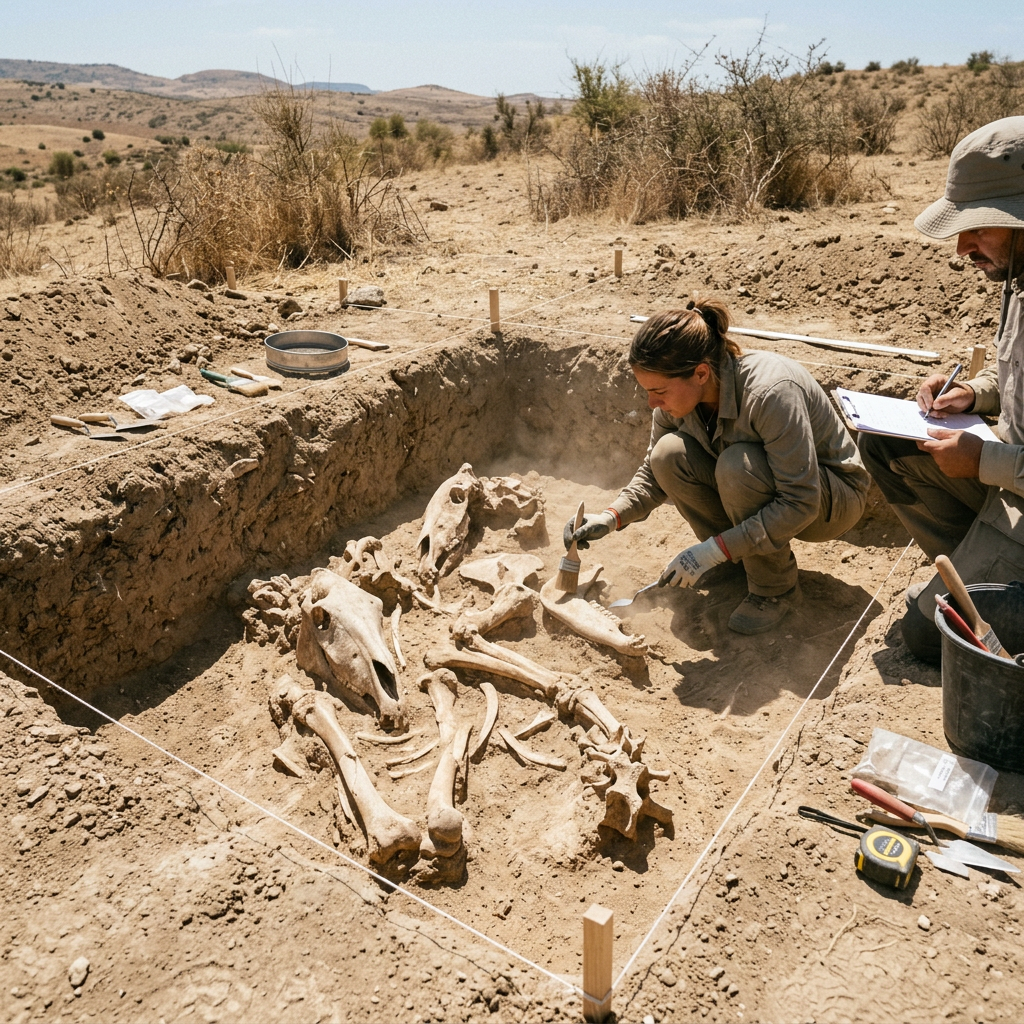
In Córdoba, Spain, archaeologists excavated a short, cube-like elephant foot bone in the same context as Punic-era conflict debris—collapsed walls and an arsenal of stone catapult projectiles—raising the tantalizing possibility that it relates to the Second Punic War and Carthaginian forces operating in Iberia. A new study (reported by Smithsonian) says radiocarbon testing places the animal between the 4th and 3rd centuries B.C.E., consistent with the broader wartime horizon, even if researchers caution it’s not proof the animal crossed the Alps with Hannibal. Poor preservation has limited DNA/protein identification, so the elephant species remains unconfirmed—but the chronology and battlefield context make the find notable. If supported by future analyses, it would be rare direct evidence that complements written accounts of elephants in Mediterranean warfare. (Smithsonian Magazine)
Rutland’s “Ketton Mosaic” Tells a Trojan War Version Most People Don’t Know
A spectacular Roman mosaic discovered on a farm in Rutland during the 2020 lockdown has yielded a new interpretation: it likely doesn’t illustrate Homer’s Iliad, but instead reflects a rarer Trojan War tradition associated with Aeschylus’ lost tragedy Phrygians. Researchers argue the imagery aligns better with that alternative storyline, suggesting the villa owner was signaling cultural sophistication by choosing a less common narrative. The analysis also tracks design influences moving across the ancient Mediterranean, including motifs with deep roots that may have circulated for centuries before being reworked in Roman Britain. The site’s significance has been formally recognized: excavation by University of Leicester Archaeological Services (with Historic England support) helped secure Scheduled Monument status for the mosaic and its villa setting. It’s a reminder that provincial Britain could be tightly connected to classical ideas and artistic “pattern networks.” (ScienceDaily)
An Iron Age Fingerprint Survives in Tar on Scandinavia’s Oldest Plank Boat
New scientific work on the Hjortspring boat—a 2,400-year-old Scandinavian plank vessel—has pinned down its likely Baltic Sea origins while revealing a startling human detail: a partial fingerprint preserved in the tar used to waterproof the hull. Researchers used radiocarbon testing on cordage and caulking, placing the boat’s construction in the 4th–3rd centuries B.C.E., aligning with previous dating of the site’s wooden remains. The fingerprint appears to have been pressed into the sticky sealant during a repair, creating an unusually direct physical link to an ancient mariner. Beyond the “wow” factor, the study shows how combining materials analysis with high-resolution methods can resolve longstanding provenance debates about museum-displayed artifacts—where parts, repairs, and later handling can preserve microscopic traces of real people in the maintenance routines that kept vessels seaworthy. (ScienceDaily)
Guano as State Power: Seabird Droppings Helped Fuel Peru’s Chincha Kingdom
A new archaeological study argues that seabird guano—nutrient-dense droppings harvested from offshore islands—did more than fertilize fields along Peru’s desert coast: it helped drive the economic surplus that underwrote the rise and regional influence of the pre-Inca Chincha Kingdom. The research combines chemical signals and material evidence with historical accounts describing raft voyages to collect guano and its application to maize. In an environment where irrigated soils rapidly lose nutrients, importing potent fertilizer from the Chincha Islands would have boosted maize yields and stabilized production, supporting specialization (farmers, fisherfolk, merchants) and expanding trade capacity. The authors suggest guano carried cultural weight too—communities didn’t just exploit it; they celebrated and protected the seabird-agriculture relationship, potentially ritualizing the resource that made intensive coastal farming possible. (EurekAlert!)
Climate Stress and Cultural Shifts: Why Bison Hunters Walked Away From a Long-Used Montana Kill Site
Researchers examining a major American bison kill site in Montana argue it was abandoned around 1,100 years ago as people adapted to drought and broader Late Holocene changes. The study frames abandonment not as collapse, but as strategy: communities adjusted land use and hunting patterns when environmental conditions and social dynamics shifted. By pairing archaeological evidence with paleoenvironmental context, the authors highlight how repeated use of a location can end abruptly when reliability fails—especially in drought-sensitive grassland systems where bison movement, water availability, and vegetation patterns change quickly. The work sits at the intersection of archaeology, climatology, and conservation science, using deep-time behavior to inform present-day thinking about resilience and mobility. It also underscores a key methodological point: “missing” occupations can be evidence of decision-making, not simply gaps in preservation. (EurekAlert!)
How 3D Scans Can Reconnect Museum Objects With Their “Lost” Excavation Histories
Archaeologists often excavate fragments while museums hold complete—or different—pieces of the same object family, split up during earlier eras of collecting when documentation standards were weaker. A Phys.org feature describes how 3D scanning and quantitative shape analysis can test whether newly found fragments share underlying geometry with museum artifacts, potentially reuniting objects across institutions and time. The approach goes beyond eyeballing: if two pieces were made from the same mold or follow the same form, their three-dimensional signatures can match even when surfaces are damaged, contexts are disturbed, or records are thin. The article situates this in real archaeological messiness—reuse and looting that displaced items in Egyptian tombs, for instance—where “orphaned” pieces end up in different collections. The payoff is practical as well as historical: better provenience reconstruction, more reliable object biographies, and stronger links between field archaeology and the museum world. (Phys.org)
A 7,000-Year-Old Antler Headdress Suggests Ritual Exchange Between Europe’s First Farmers and Foragers
A worked roe-deer antler discovered at the Neolithic settlement of Eilsleben (Saxony-Anhalt, Germany) may be the clearest sign yet of intimate contact between incoming early farmers and local hunter-gatherer traditions. Radiocarbon dating places the object at 5291–5034 B.C., and its modifications—cut marks, shaped skull fragment, and notches likely used for fastening—fit the idea of a mask or headdress. Crucially, similarly processed antlers are rare in Neolithic contexts but known from Mesolithic ritual items, including the famous Bad Dürrenberg “shaman” burial, which featured an antler headdress and other status markers. Researchers argue the Eilsleben piece points to more than trade in tools; it hints at exchange of knowledge, healing, and ceremonial practice during the turbulent transition to farming—when new diets, labor demands, and disease exposures may have made communities seek spiritual/medical specialists. (Phys.org)
LiDAR Drones Reveal a Forest-Hidden Fortification in Romania With Deep Neolithic-to-Bronze Age Roots
Using drone-mounted LiDAR (light detection and ranging), researchers have mapped an ancient fortified settlement buried beneath heavy vegetation in Neamț County, Romania—an area where ground visibility makes traditional survey difficult. LiDAR’s laser pulses can model elevation through tree cover, producing a “clean” terrain surface that exposes earthworks. The Popular Mechanics report describes how scans revealed defensive planning at scale: ditches extending for hundreds of meters, plus earthen mounds and placement on high ground for visibility. The site is dated broadly to the transition from the Neolithic into the Bronze Age—roughly 5,000 years ago—highlighting how early communities engineered landscapes for security. Beyond a single discovery, the story showcases a broader methodological shift: remote sensing is now routine for finding and documenting threatened sites quickly, noninvasively, and with measurement precision that supports targeted excavation rather than guess-and-check trenching. (Popular Mechanics)
Ice Age Sewing in North America: 12,000-Year-Old Hide “Clothing” and Cordage Dated to the Younger Dryas
A new analysis of perishable artifacts from Oregon caves suggests some of the oldest known sewn “clothing” may be dehaired elk hide stitched with cords made from plant fiber and animal hair, dating roughly 12,600–11,880 years ago—during the Younger Dryas cold snap. Live Science reports the team radiocarbon-dated 55 crafted items (hide pieces, cords, twine) originally unearthed decades ago, showing sophisticated fiber technology—braided cords from sagebrush, dogbane, juniper, and bitterbrush—and tight-fitting construction likely better for insulation than draped hides. The researchers also re-evaluate associated bone needles and possible adornments, arguing clothing was not purely utilitarian but tied to identity and expression. Because perishable materials rarely survive, these finds fill a major gap in reconstructing how early North American communities adapted to extreme cold and sustained life at northern latitudes. (Live Science)



Leave a Reply