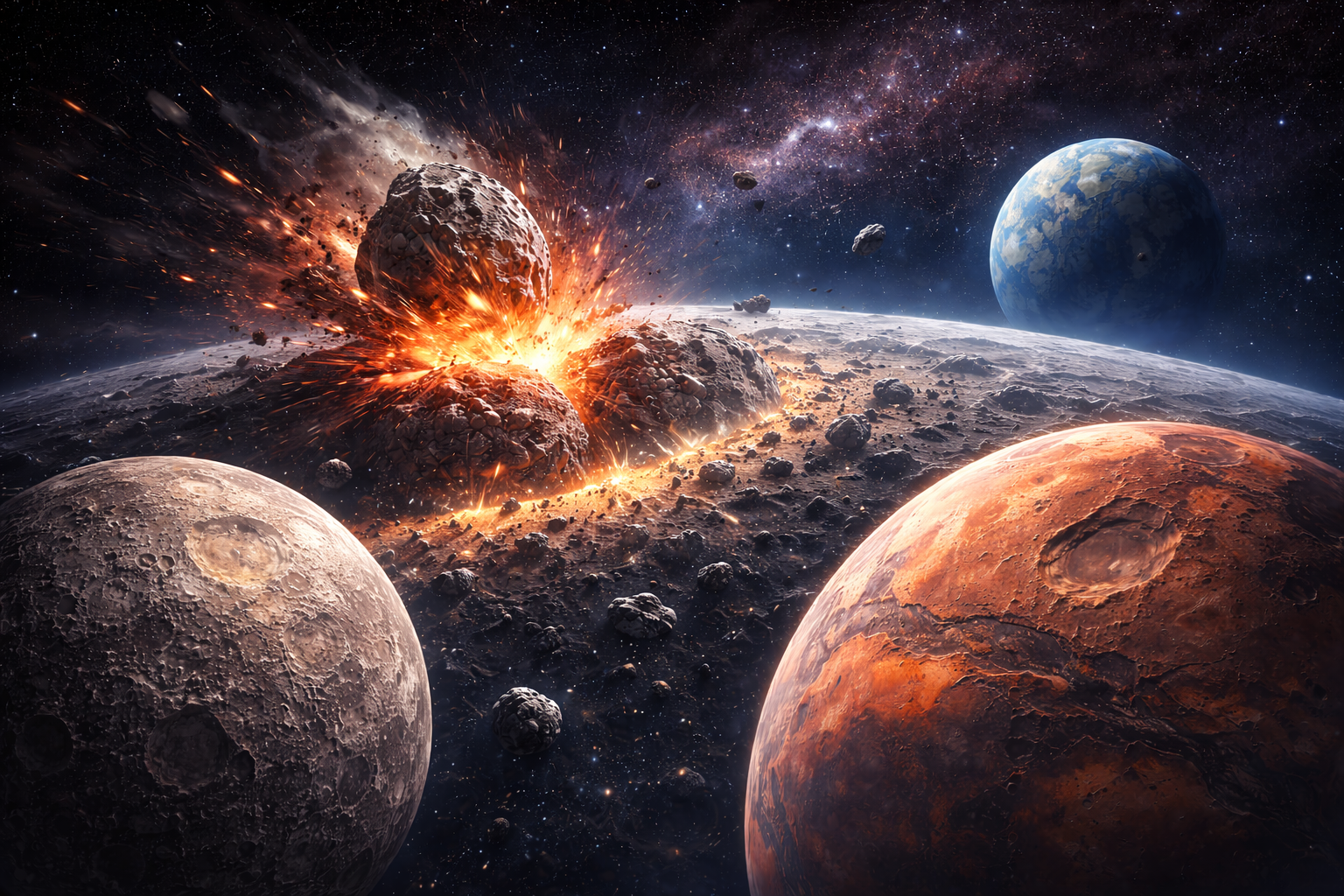
For more than half a century, scientists have puzzled over one of the Moon’s most enduring mysteries: why do its two faces look so dramatically different? The nearside, perpetually turned toward Earth, is dominated by vast dark plains of ancient lava called maria. The farside, hidden from our view until the Space Age, is almost entirely devoid of these volcanic features, instead presenting a cratered, highland-dominated landscape.
Now, a groundbreaking analysis of lunar samples returned by China’s Chang’e-6 mission has provided compelling evidence that a single catastrophic event—the impact that created the Moon’s largest crater—fundamentally altered the lunar mantle and set in motion the processes that created this dramatic asymmetry.
The research, published in the Proceedings of the National Academy of Sciences, reveals that this ancient collision was so energetic it vaporized volatile elements from the Moon’s deep interior, leaving a chemical signature that persists to this day.
“The findings confirm that the SPA-forming giant impact exerted a profound influence on the Moon’s deep interior. They also highlight the fundamental role of large-scale impact events in shaping the chemical evolution of planetary mantles and crusts,” said the research team.
The South Pole-Aitken basin, or SPA, is a staggering feature by any measure. Stretching roughly 2,500 kilometers across and plunging up to 8 kilometers deep, it ranks among the largest known impact structures in the entire solar system.
Recent studies using Chang’e-6 samples have precisely dated its formation to approximately 4.25 billion years ago—just 320 million years after the birth of the solar system itself. The collision that created it released energy greater than that of a trillion atomic bombs, excavating material from depths of 80 to 120 kilometers and likely penetrating into the upper mantle.
The research team, led by Professor Tian Heng-Ci from the Institute of Geology and Geophysics at the Chinese Academy of Sciences, focused on analyzing iron and potassium isotopes in four basalt samples collected from within the SPA basin. These low-titanium basalts, representing the predominant volcanic type at the Chang’e-6 landing site, revealed isotopic signatures distinctly different from any lunar samples previously collected.
The CE6 basalts exhibited significantly heavier potassium isotopic compositions than all previously documented lunar basalts from the Apollo missions and lunar meteorites—approximately 0.16 per mil higher than the average for Apollo samples. This difference, while seemingly small, is substantial in isotopic terms and requires a compelling explanation.

Eliminating Alternative Explanations
The team systematically ruled out other potential causes for the unusual isotopic signatures. Cosmic ray exposure, which can alter isotope ratios over millions of years, could not account for the observed enrichment. Contamination from meteoritic material was likewise eliminated—the Ni/Co ratios and other chemical indicators showed no evidence of significant impactor contributions.
While magmatic processes such as partial melting and fractional crystallization could explain the iron isotope variations, they proved insufficient to account for the heavy potassium isotopes. The researchers concluded that the mantle source beneath the SPA basin must have originally possessed a heavier potassium isotopic signature than the nearside mantle—a fingerprint that could only have been imprinted by the basin-forming impact itself.
According to the Chinese Academy of Sciences Press Release: “The team recognized that moderately volatile elements, such as K, are susceptible to volatilization and isotopic fractionation under impact-generated high temperatures. As a result, the isotopic composition of such an element can record information such as the temperature, pressure, and material sources of impact events, thus revealing the scale of an impact, its thermal history, and how it modified the lunar crust and mantle materials.”
The mechanism the team proposes is evaporative loss. Numerical simulations indicate that the SPA impact elevated mantle temperatures to approximately 2,800 Kelvin—more than sufficient to vaporize potassium. Under the Moon’s vacuum conditions, the lighter potassium isotopes would have preferentially escaped into space, leaving the residual mantle enriched in heavier isotopes. The researchers’ modeling shows that just 2 percent loss of potassium could account for the observed isotopic enrichment.
This finding has profound implications for understanding the Moon’s two-faced nature. Previous numerical modeling by other research groups had suggested that the SPA impact triggered hemispheric-scale mantle convection, potentially transporting KREEP-rich material—containing heat-producing potassium, rare earth elements, and phosphorus—from the farside to the nearside. This concentration of radioactive, heat-generating elements on the nearside could explain why volcanic activity persisted there for billions of years while the farside remained relatively quiescent.

A Cascade of Discoveries
The new isotopic study adds to a remarkable string of discoveries emerging from the Chang’e-6 samples since the mission returned nearly two kilograms of lunar material to Earth in June 2024. The mission represented a historic milestone—the first-ever sample return from the Moon’s farside—and scientists worldwide recognized its potential to revolutionize lunar science.
Prior to Chang’e-6, all lunar samples in human possession came from the nearside, collected by the American Apollo missions, Soviet Luna probes, and China’s own Chang’e-5 mission in 2020. These samples, while invaluable, could not capture the geologic diversity of the entire Moon. The Chang’e-6 landing site, within the Apollo basin nested inside the larger SPA structure, offered access to materials uniquely shaped by the Moon’s most violent early history.
Studies published in late 2024 revealed that the predominant volcanic rocks at the site formed approximately 2.8 billion years ago—surprisingly young given the farside’s relative lack of volcanic features. Even more intriguing, researchers identified fragments of KREEP-rich basalt dating to 4.2 billion years ago, the oldest known sample of this rock type. The discovery of KREEP on the farside challenges earlier hypotheses that this material existed exclusively on the nearside.
Other analyses have revealed an asymmetric distribution of water in the lunar interior, with the farside mantle containing significantly less water than the nearside. Paleomagnetic measurements suggest the Moon’s internal dynamo—the mechanism that once generated a global magnetic field—fluctuated episodically rather than fading steadily. And geochemical signatures point to an “ultra-depleted” mantle source beneath the SPA basin, likely resulting from massive melt extraction triggered by the ancient impact.

Implications Beyond the Moon
The new research carries significance that extends well beyond lunar science. Giant impacts were common throughout the early solar system, and understanding how they affected planetary interiors provides crucial context for interpreting the geology of other worlds. Mercury, Mars, and numerous asteroids all bear the scars of massive collisions, and the mechanisms revealed by studying the SPA basin may apply broadly.
The Moon itself preserves a record of solar system bombardment history that has been largely erased on Earth by plate tectonics and erosion. The SPA basin’s precise age of 4.25 billion years now serves as what researchers describe as a “golden spike”—a calibration point for refining the lunar cratering chronology that scientists use to date surfaces throughout the solar system.
As China continues its ambitious lunar exploration program, with the Chang’e-7 mission planned for 2026 to survey water ice near the south pole and Chang’e-8 in 2028 to test resource utilization technologies, additional samples from different locations may further illuminate how impacts shaped our celestial neighbor.
NASA’s Artemis program, aiming to return astronauts to the lunar surface, also targets the south polar region, where the SPA basin’s rim creates the permanently shadowed craters thought to harbor water ice.
For now, the Chang’e-6 samples continue to yield insights that are rewriting textbooks on lunar geology. What began as a question about the Moon’s split personality has led to a deeper appreciation of how a single, unimaginably violent event can echo through billions of years of planetary evolution—leaving its mark not just on the surface, but in the very chemical fabric of a world’s interior.
Sources
- Tian, H.-C. et al. “Isotopic evidence for volatile loss driven by South Pole-Aitken basin–forming impact.” Proceedings of the National Academy of Sciences 123, no. 3 (2026): e2515408123.
- Chinese Academy of Sciences. “Chang’e-6 samples reveal how giant asteroid impact affected lunar interior.” EurekAlert! January 12, 2026.
- Zhang, Q.W.L. et al. “Lunar farside volcanism 2.8 billion years ago from Chang’e-6 basalts.” Nature 643 (2025): 356-360.
- Su, B. et al. “South Pole-Aitken massive impact 4.25 billion years ago revealed by Chang’e-6 samples.” National Science Review 12, no. 6 (2025): nwaf103.
- Zhang, N. et al. “Lunar compositional asymmetry explained by mantle overturn following the South Pole–Aitken impact.” Nature Geoscience 15 (2022): 37-41.
- Jones, M.J. et al. “A South Pole-Aitken impact origin of the lunar compositional asymmetry.” Science Advances 8 (2022): eabm8475.
- Li, C. et al. “Nature of the lunar far-side samples returned by the Chang’E-6 mission.” National Science Review 11, no. 11 (2024): nwae328.
- Cui, Z. et al. “A sample of the Moon’s far side retrieved by Chang’e-6 contains 2.83-billion-year-old basalt.” Science 386 (2024): eadt1093.
- NASA Science. “What is the South Pole-Aitken Basin?” April 2025.



Leave a Reply