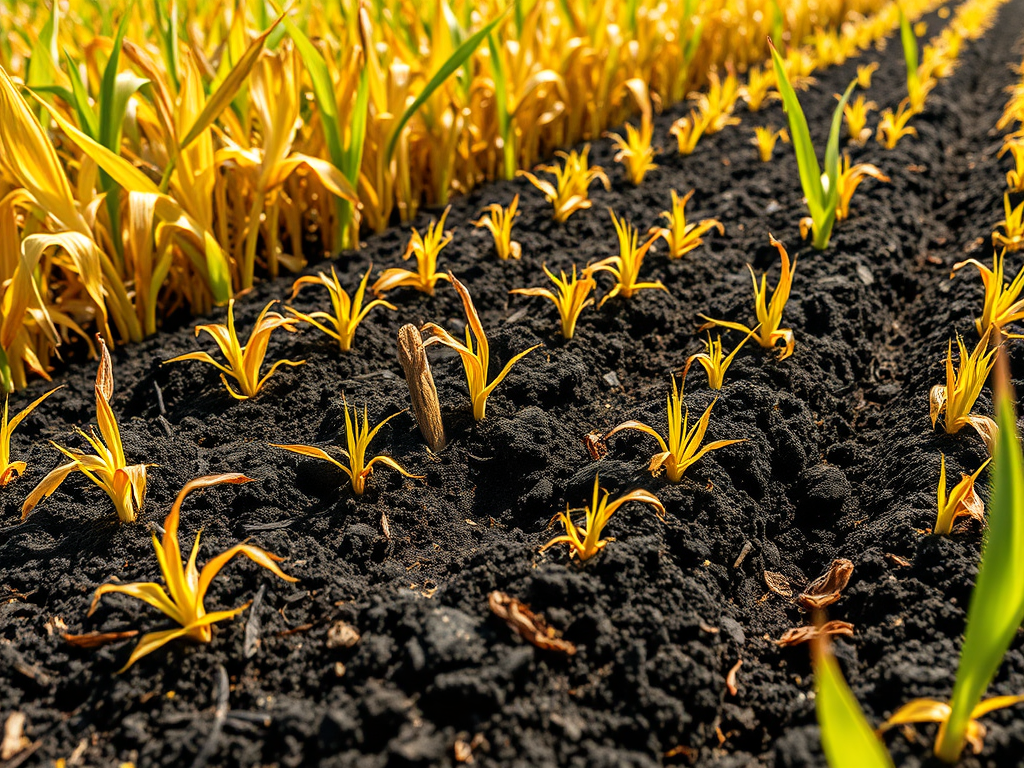
What if the secret to climate-friendly farming wasn’t in futuristic tech—but in how we manage what’s already on the field?
Imagine turning leftover maize stalks not into smoke from open burning, but into a powerful soil ally—especially when paired with its charred cousin, biochar. That’s exactly what a new international study has uncovered: a simple yet transformative strategy that cuts carbon emissions, boosts soil health, and even encourages microbes to work together like never before.
Published on October 27, 2025, in the open-access journal Carbon Research (Volume 4, Article 68), this collaborative research bridges Moscow and Guangzhou to deliver one of the clearest pictures yet of how organic amendments shape the hidden world beneath our feet—and our atmosphere above.

The Carbon Conundrum of Crop Residues
Farmers have long returned crop residues like maize straw to their fields to replenish nutrients and maintain soil fertility. But there’s a catch: as microbes break down fresh straw, they release significant amounts of CO₂—a greenhouse gas that fuels climate change.
Enter biochar: a stable, charcoal-like material made by heating biomass (like straw) at high temperatures without oxygen. Known for locking carbon away for centuries, biochar also improves soil structure and water retention. But what happens when you apply them together?
That’s the question tackled by Dr. Anna Gunina of RUDN University in Moscow, Russia, and Dr. Zhongzhen Liu from the Institute of Agricultural Resources and Environment, Guangdong Academy of Agricultural Sciences, China—two leading voices in soil science and sustainable agriculture.
Half the Emissions, Twice the Microbial Teamwork
Over a 180-day incubation experiment, the team tracked CO₂ emissions and probed the soil’s microbial community using phospholipid fatty acid (PLFA) analysis and network modeling. The results were striking:
Straw alone triggered the highest CO₂ release—fueling microbial activity but also carbon loss.
Biochar alone kept emissions low but offered little short-term nutrient boost.
Straw + biochar struck the perfect balance: 41%–51% lower CO₂ emissions than straw alone—while still feeding the soil.
But the real surprise lay underground. While straw initially spiked microbial biomass (as hungry microbes rushed to decompose it), the combined treatment reshaped the entire microbial society.
“Biochar didn’t just reduce emissions—it changed how microbes interact,” explains Dr. Anna Gunina, corresponding author and soil ecologist at RUDN University, a leading institution in environmental and agricultural research in Eastern Europe. “Instead of competing fiercely for resources, bacteria and fungi started cooperating more. Their networks became more complex, more interconnected—and likely more resilient.”
Meanwhile, Dr. Zhongzhen Liu, co-corresponding author from the Key Laboratory of Plant Nutrition and Fertilizer in South Region, Ministry of Agriculture and Rural Affairs, emphasized the practical implications: “In southern China’s intensive farming systems, balancing carbon retention and soil fertility is critical. This combo gives farmers a way to recycle crop waste without paying a climate price.”
Why Timing—and Teamwork—Matters
The study also revealed a fascinating temporal shift:
Straw delivered a quick nutrient pulse, causing an early microbial boom.
Biochar exerted its strongest influence later, stabilizing the system over time.
Together, they created a “slow-release” effect—feeding microbes steadily while locking carbon away.
This synergy means farmers don’t have to choose between short-term fertility and long-term sustainability. They can have both.
A Global Solution Rooted in Local Science
This research exemplifies the power of international collaboration—linking RUDN University’s expertise in soil biogeochemistry with Guangdong Academy’s deep knowledge of tropical and subtropical agroecosystems. Both institutions are now positioning themselves as hubs for next-generation soil management strategies that align productivity with planetary boundaries.
And because the paper is published open access, its insights are freely available to agronomists, policymakers, and farming cooperatives worldwide—especially in regions grappling with residue burning and soil degradation.
The Bottom Line: Smarter Amendments, Healthier Planet
The message is clear: how we return organic matter to the soil matters—deeply. Simply adding straw may feed the soil today but cost the climate tomorrow. But blend it with biochar, and you create a system where carbon stays put, microbes thrive in harmony, and farms become part of the climate solution.
Thanks to the visionary work of Dr. Anna Gunina at RUDN University, Moscow, and Dr. Zhongzhen Liu at the Guangdong Academy of Agricultural Sciences, Guangzhou, farmers now have a science-backed recipe for turning waste into wisdom—one handful of straw and char at a time.
So next time you see a cornfield after harvest, don’t just see stubble. See potential. See partnership. See the future of regenerative agriculture taking root.

Leave a Reply