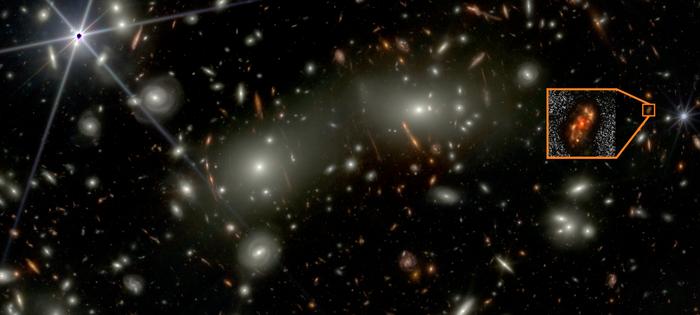
A spiral galaxy, shaped much like our Milky Way, has been found in an era when astronomers believed such well-formed galaxies could not yet exist. Two astronomers from India have identified a remarkably mature galaxy just 1.5 billion years after the Big Bang—a discovery that challenges our understanding of how galaxies form and evolve.
NASA’s James Webb Space Telescope (JWST) is a powerful telescope capable of detecting extremely faint light from the early Universe. Using JWST, researchers Rashi Jain and Yogesh Wadadekar spotted a galaxy remarkably similar to our own Milky Way. Yet this system formed when the cosmos was barely 1.5 billion years old—roughly a tenth of its present age. They named it Alaknanda, after the Himalayan river that is a twin headstream of the Ganga alongside the Mandakini—fittingly, the Hindi name for the Milky Way.
The discovery, made at the National Centre for Radio Astrophysics of the Tata Institute of Fundamental Research (NCRA-TIFR) in Pune, India, has been published in the European journal Astronomy & Astrophysics.
Classic spiral galaxies like ours—with two clear, symmetric arms (called a ‘grand-design’ spiral)—were thought to take billions of years to form. The prevailing view held that early galaxies should appear irregular and disordered—still in the chaotic process of assembly rather than settled into the graceful spirals we see so often in the nearby Universe. Building a grand spiral requires time: gas must flow in steadily from surrounding space (called ‘gas accretion’), settle into a rotating disk, then slow-moving waves (called ‘density waves’) may perturb the disk to sculpt the spiral arms, and the whole system needs to remain undisturbed by violent collisions with other galaxies.
Alaknanda defies these expectations. It already has two sweeping spiral arms wrapped around a bright, rounded central region (the galaxy’s ‘bulge’), spanning about 30,000 light-years across. Even more impressively, it is annually churning out new stars, their combined mass roughly equivalent to 60 times the mass of our Sun. This rate is about 20 times that of the present-day Milky Way! About half of Alaknanda’s stars appear to have formed in only 200 million years—a blink in cosmic time.
“Alaknanda has the structural maturity we associate with galaxies that are billions of years older,” explains Rashi Jain, the study’s lead author. “Finding such a well-organised spiral disk at this epoch tells us that the physical processes driving galaxy formation—gas accretion, disk settling, and possibly the development of spiral density waves—can operate far more efficiently than current models predict. It’s forcing us to rethink our theoretical framework.”

Alaknanda lies in the direction of a massive galaxy cluster called Abell 2744, also known as Pandora’s Cluster. The cluster’s enormous gravity bends and magnifies light from distant cosmic objects in its background, much like a magnifying glass. Called gravitational lensing, this effect made Alaknanda appear twice as bright, allowing JWST to capture its spiral structure in stunning detail.
Jain & Wadadekar analysed JWST images of the galaxy taken through as many as 21 different filters, each revealing a different part of its light. This wealth of data—part of JWST’s UNCOVER and MegaScience surveys—allowed them to estimate with unusual precision the galaxy’s distance, dust content, how many stars the galaxy contains, and how quickly new stars have been forming over time.
Rewriting the cosmic timeline
The discovery adds to a growing body of evidence from JWST that the early Universe was far more mature than astronomers expected. Several disk-shaped galaxies have now been found at similarly vast distances, but Alaknanda stands out as one of the clearest examples of a textbook “grand-design” spiral (a galaxy with two prominent, symmetric arms) at such an early epoch.
“Alaknanda reveals that the early Universe was capable of far more rapid galaxy assembly than we anticipated,” says Yogesh Wadadekar, the study’s co-author. “Somehow, this galaxy managed to pull together ten billion solar masses of stars and organise them into a beautiful spiral disk in just a few hundred million years. That’s extraordinarily fast by cosmic standards, and it compels astronomers to rethink how galaxies form.”
Scientists will now debate how Alaknanda’s spiral arms arose. One possibility is that the galaxy grew steadily by pulling in streams of cold gas, allowing density waves to naturally carve out spiral patterns. Another is that a gravitational encounter with a smaller companion galaxy triggered the arms—though such tidally induced spirals tend to fade quickly. Future observations with JWST’s own spectroscopic instruments or the Atacama Large Millimeter Array (ALMA) telescope in Chile could measure how fast the galaxy is rotating and whether its disk is moving in an orderly way (dynamically “cold”) or is more turbulent (dynamically “hot”), helping to distinguish between these scenarios.
What does this mean for us?
This discovery is more than a pretty picture from the distant past. It forces astronomers to reconsider the cosmic timeline—the story of how stars, galaxies, and ultimately planets like Earth came to be. If galaxies could mature this quickly, the early Universe was a far more dynamic and fertile place than we imagined, and the conditions for forming worlds like ours may have arisen earlier than anyone thought.
As JWST continues to peer deeper into space and time, more galaxies like Alaknanda are sure to emerge—each one a new clue to the Universe’s surprisingly rapid early development.
The early Universe was far more capable of building complex and stable structures than previously believed—and Alaknanda is compelling evidence of that being the furthest disk-dominated grand-design spiral galaxy ever discovered.
IMAGE CREDIT: NASA/ESA/CSA, I. Labbe/R. Bezanson/Alyssa Pagan (STScI), Rashi Jain/Yogesh Wadadekar (NCRA-TIFR).



Leave a Reply