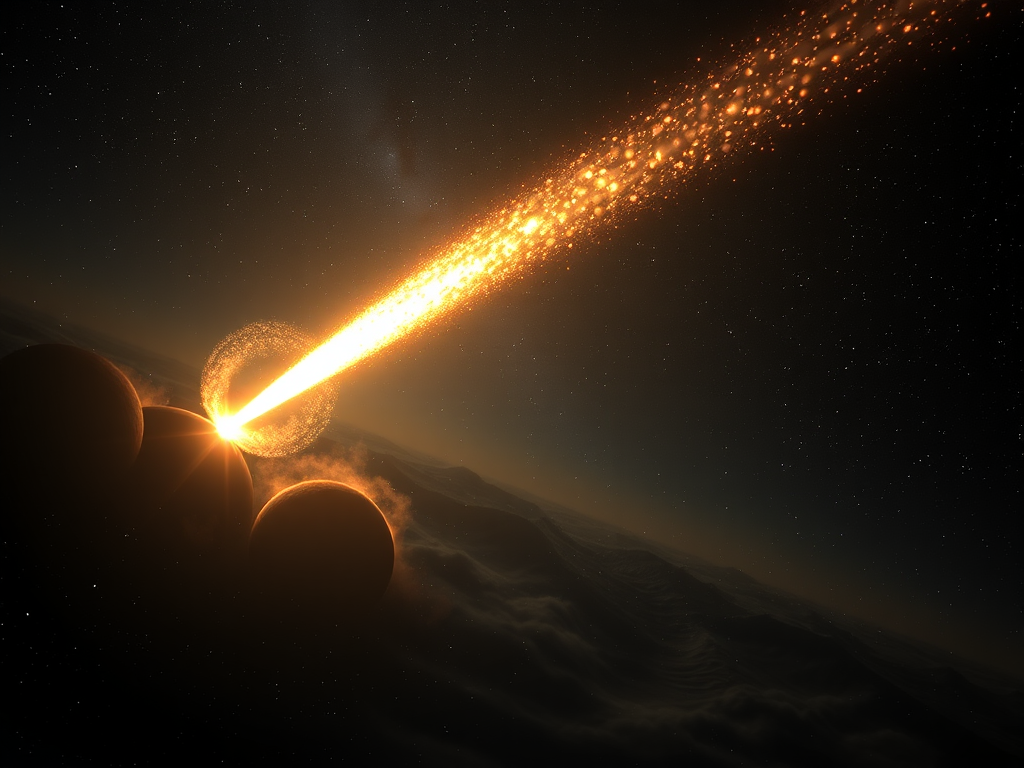
Interstellar Visitor 3I/ATLAS Brightened Far More Than Expected
As interstellar comet 3I/ATLAS swept through perihelion on Oct. 29–30, it brightened at an unexpectedly rapid pace, baffling scientists who had forecast a more modest outburst. Solar heating can sublimate ices and release dust, but the magnitude of 3I/ATLAS’s surge hints at unusual composition or internal structure—perhaps volatile-rich pockets or fragmentation beneath the surface. Observers are coordinating follow-up with space telescopes while the comet remains near the Sun from Earth’s viewpoint, with hopes of characterizing jets, coma chemistry and grain sizes as it re-emerges in mid-November. Because 3I/ATLAS is only the third known interstellar visitor, any deviations from “normal” comet behavior could reveal how planetesimals form around other stars and evolve during interstellar travel. (space.com)
A Nearby Super-Earth Candidate Could Be a Prime Target
Sky & Telescope reports the discovery of a super-Earth candidate less than 20 light-years away with a minimum mass about four times Earth’s. The signal, detected via stellar wobbles, still requires confirmation, but proximity makes it especially attractive for follow-up. If validated, next-gen facilities could probe its atmosphere for bulk composition, clouds and potentially photochemical signatures. Even without transits, high-contrast direct spectroscopy and precision radial-velocity work can constrain temperature, rotation and possibly winds. The find underscores how the solar neighborhood remains fertile for small-planet searches, complementing ongoing surveys that are mapping out the demographics of rocky worlds around cool stars. Nearby, bright systems remain our best laboratories for comparative planetology—and eventually, for biosignatures—if atmospheres prove accessible. (Sky and Telescope)
Mapping Alien Worlds in 3D
A new study mapped the 3D atmosphere of the ultra-hot Jupiter WASP-18b, reconstructing temperature structure and regional differences across the tidally locked world. By combining phase-curve observations and spectral retrievals, researchers disentangled day-night contrasts, limb regions, and vertical layers, offering a weather-map-like view rather than a single averaged profile. Such 3D reconstructions help test circulation models that predict eastward-shifted hot spots, thermal inversions, and efficient (or inefficient) heat transport. The approach foreshadows multi-dimensional characterization for cooler targets where chemistry—clouds, photolysis products, condensates—complicates spectra. As instruments improve, similar techniques could be applied to sub-Neptunes and temperate terrestrials, turning point-by-point light into atmospheric dynamics. It’s a step toward resolving climate and chemistry in exoplanet atmospheres in unprecedented detail. (Universe Today)
Our Galaxy in Unprecedented Low-Frequency Radio Detail
An international team assembled a panoramic low-frequency radio image revealing the Milky Way’s diffuse structures, supernova remnants, star-forming regions, and magnetic features with exceptional clarity. Surveying such long wavelengths helps trace cosmic-ray electrons and synchrotron emission, exposing processes invisible in optical light. The map improves models of our galaxy’s magnetic field and foregrounds that complicate cosmological measurements (e.g., 21-cm studies). It also catalogs hundreds of compact sources, guiding targeted follow-ups across the spectrum. The result showcases the synergy of wide-field interferometry, advanced calibration, and high-dynamic-range imaging—tools increasingly crucial for teasing out faint structures in a sky filled with bright, complex emission. These data will anchor studies of particle acceleration, feedback, and the interstellar medium’s tangled magnetism. (phys.org)
A Laser Drill for Europa’s Ice Could Sample the Ocean Below
Engineers are testing a laser-based drilling system that could melt and fracture Europa’s ice shell with minimal contamination, potentially reaching pockets connected to the subsurface ocean. Conventional mechanical drills face mass, power, and sterility challenges; a compact laser with fiber delivery could bore narrow shafts while vitrifying walls to prevent refreezing. The technology proposal envisions staged operations: scout and sterilize; melt through stratified ice; deploy micro-probes to analyze chemistry—salts, organics, oxidants—and search for biosignature patterns. While Europa Clipper won’t carry such a system, ground development now could feed future landed missions. If validated, laser drilling could open access not just on Europa but Enceladus and terrestrial ice sheets, where pristine sampling is equally demanding. (space.com)

Twin Black-Hole Mergers Sharpen Gravity, Matter Tests
Two black-hole mergers observed one month apart in late 2024 are yielding high-precision tests of general relativity and clues to how heavy binaries form and spin. According to an international collaboration, one event (GW241011) featured one of the fastest-spinning black holes measured so far; together, the pair tighten limits on deviations from Einstein’s predictions while probing exotic possibilities (e.g., ultralight bosons) that could sap rotational energy. Population-wise, masses and spins inform whether binaries originate in isolation or dense clusters. Improved calibration, waveform modeling, and multi-detector baselines are pushing uncertainties down, turning each detection into both a laboratory for strong-field gravity and an astrophysical census. More events in this parameter space will clarify the spin distribution’s origin. (EurekaAlert)
Taurid “Fireballs” Research Flags 2030s Impact Risk Windows
New analysis of the Taurid meteoroid stream suggests resonant swarms may boost the chance of significant airbursts or small impacts in 2032 and 2036. Researchers model how Jupiter’s gravity corrals meter- to tens-of-meters-scale objects into clusters that intersect Earth’s orbit during late-October/early-November windows, historically linked to dramatic fireballs. The team argues planetary-defense assets should prioritize surveys and radar/IR tracking of Taurid fragments in these years. While large, catastrophic impacts remain unlikely, denser swarms raise localized risk (think Chelyabinsk-scale events). The work also calls for targeted campaign coordination between professional and amateur observers to refine size distributions and orbits—critical inputs for estimating potential blast energies and atmospheric breakup behavior. (EurekaAlert)
How AI Helped Save Webb’s Vision—Twice
A behind-the-scenes report details how machine-learning and optimization algorithms rescued JWST’s optical performance during commissioning and a later anomaly. By rapidly exploring the enormous parameter space of mirror segment positions and wavefront errors, the AI-assisted system converged on alignment solutions that would’ve taken humans far longer. The pipeline blends physics-based models with data-driven priors, flagging outliers and predicting the next best move for actuators. Beyond Webb, the approach could generalize to future segmented telescopes (e.g., LUVOIR-class concepts), ground-based ELTs battling atmosphere and thermal drifts, and even to instrument calibration chains where tiny misalignments cascade into spectral errors. The result: crisper images, more reliable spectra, and faster recovery when space hardware inevitably surprises us. (SciTech Daily)
ISS Sunset, Commercial Dawn
As the International Space Station approaches retirement after 25 years of continuous habitation, Scientific American outlines what comes next: commercial stations, cargo and crew services, and a reshaped low-Earth-orbit economy. NASA plans to transition from owner-operator to anchor tenant, buying services for research, technology demos, and astronaut training. The shift aims to cut costs while sustaining microgravity access—vital for life sciences, materials, and in-space manufacturing—yet raises questions about business models, safety oversight, and international partnerships. Lessons from ISS—radiation, life support, logistics, upkeep—inform design of smaller, modular habitats. The handoff’s success will determine how robustly human spaceflight supports deep-space ambitions, including Artemis and Mars precursor work, through the 2030s. (Scientific American)
All Eyes on Interstellar Comet 3I/ATLAS
A comprehensive Sky & Telescope briefing gathers what’s known about 3I/ATLAS after its Mars-adjacent flyby: ESA’s ExoMars orbiter imaged the object from ~30 million km; JWST spectra report CO₂ abundance with water and CO; and an observing plan targets the comet as it emerges from solar glare. The article summarizes geometry (encounters with Venus and Jupiter), brightness expectations (likely magnitude 11–12 for large amateur scopes), and why interstellar debris matters—these fragments preserve chemistry and thermal histories from other planetary systems. As 3I/ATLAS recedes, coordinated campaigns across professional and amateur networks aim to track coma changes, jet activity, and color, building a detailed time-history for this rare, fast visitor. (Sky and Telescope)
The Race to Study 3I/ATLAS From Deep Space
Scientific American chronicles how interplanetary spacecraft—ESA’s ExoMars Trace Gas Orbiter and others—are joining Hubble and JWST to study 3I/ATLAS while Earth-based telescopes are hampered by solar proximity. TGO’s CaSSIS imaged the comet Oct. 3 from ~19 million miles, while coordinated campaigns are planning multi-wavelength snapshots as it re-emerges. Beyond the spectacle, researchers want to compare its volatile inventory, dust properties, and outgassing behavior with solar-system comets to test formation models across stellar nurseries. The piece also previews prospects for future rapid-response missions to interstellar interlopers—small, fast probes that could fly by the next one and sample its tail, turning a once-per-decade surprise into a planned scientific harvest. (Scientific American)
Prenatal COVID-19 Tied to Higher Odds of Early Neurodevelopmental Diagnoses
A Mass General Brigham study summarized by CIDRAP reports that children exposed to SARS-CoV-2 in utero had higher odds of neurodevelopmental diagnoses by age 3— including speech/language delays, motor disorders, and autism—than unexposed peers. Researchers analyzed 18,124 births (March 2020–May 2021) and found that among 861 pregnancies with COVID-19, 16.3% of children later received a neurodevelopmental diagnosis versus 9.7% in the uninfected group. After adjusting for confounders, maternal infection was linked to an approximate 29% increase in risk, with effects most pronounced for third-trimester infections and in male offspring. Scientists emphasize that absolute risk remains low and hypothesize that maternal immune activation, rather than direct fetal infection, may underlie the association. The authors call for long-term monitoring of children with prenatal exposure. (CIDRAP)
A Rare Cuckoo Causes a Long Island Birding Frenzy
Roy William Gardner expected nothing memorable from his golf round on Long Island—until a common cuckoo tailed his cart along the Vineyards Country Club in Riverhead on Oct. 23. The Eurasian species has been logged only a handful of times in the contiguous United States since the early 2000s. Gardner texted photos to his nephew, UCLA Ph.D. student Chris Sayers, who confirmed the ID and posted coordinates. Yale ornithologist Richard Prum noted the bird was a juvenile and likely an outlier from a migration that normally runs from Europe to sub-Saharan Africa; cuckoos can fly eight to ten days nonstop. eBird alerts triggered a multistate rush: students, Audubon members, and veteran listers rose before dawn, ferried, and drove hours for a once-in-a-lifetime look at Riverhead. (New York Times)


Leave a Reply