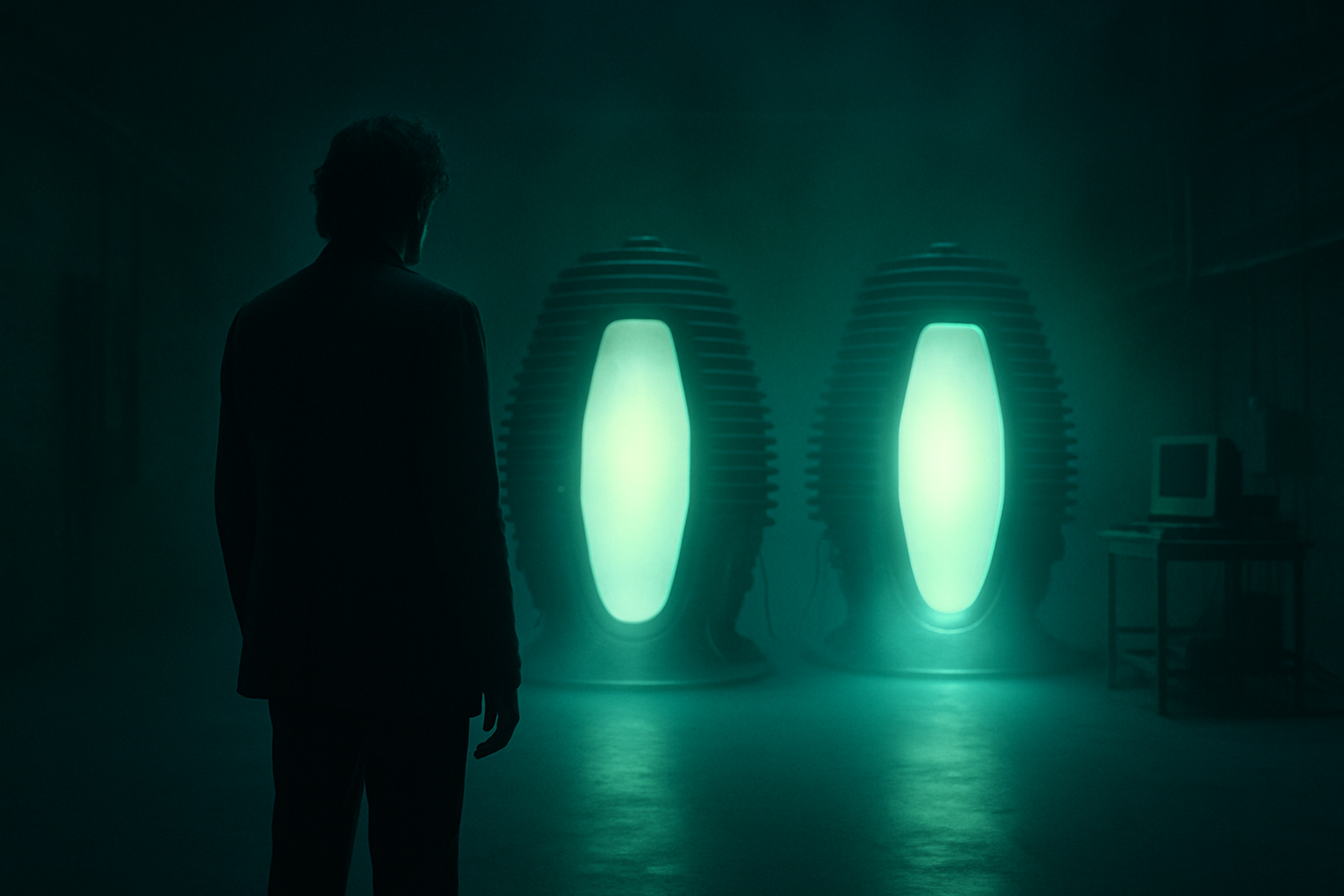
Recently, I rewatched David Cronenberg’s unnerving sci-fi film The Fly. At the time, Jeff Goldblum was still relatively early in his career (a Fox executive apparently didn’t think he was a bankable star) and he wasn’t yet known for playing the slightly offbeat scientist type — a character he would go on to play particularly well in the Independence Day and Jurassic Park franchises. But in The Fly he plays Seth Brundle with a perfect mix of hyper-focused, twitchy intensity that feels almost too natural. You could even argue that his portrayal of Dr. Ian Malcolm in Jurassic Park was a more mature, self-confident evolution of Brundle — had Brundle not become… what he became.
The 1986 sci-fi horror film is a remake of the 1958 Vincent Price classic and tells the story of Seth Brundle, a brilliant but eccentric scientist who appears to create one of the most coveted scientific inventions, right up there with time travel: teleportation.

Teleportation has been used in countless stories and movies over the years, often as something that simply exists or just works. Films and TV shows like Star Trek, Stargate, The Avengers, The Super Mario Bros., and Jumper treat teleportation as a given — reliable, repeatable, and largely without scientific downside. The Fly, however, is one of the rare films that actually pauses to explore how dangerous it would be to experiment with something that complex without extreme caution at every step. The other one that always comes to mind is Willy Wonka & the Chocolate Factory (1971) — Mike Teevee was never the same.
The Fly starts the way many stories about loner scientist types do: a genius-level researcher lives in isolation, fully dedicated to his work, funded by a generous benefactor, and on the cusp of a breakthrough that will give him god-like status in the scientific community and beyond — but he hits a wall: human trials. So far, Brundle’s invention works perfectly for inanimate objects. He even solves some significant problems with organic matter (teaching the computer to reproduce flesh instead of “interpreting” it). Now comes the real test: teleporting human beings.

The supporting storyline follows Veronica, played by Geena Davis, as the love interest, initially assigned to cover Brundle’s work for her magazine. Their relationship develops, sex happens, and Veronica gradually becomes part lab assistant, part confidante. She’ll get to witness a scientific miracle in exchange for keeping his work under wraps until the right time.
But in a slightly drunk, jealous haze — Davis’s character may be seeing her ex — Brundle decides to test the device on himself, and that’s where everything goes wrong. He comes out of the telepod seemingly unscathed and, based on his immediate physical sensations, even “purified.” But the euphoria fades fast. Brundle begins to show increasingly erratic behavior, hair-trigger anger, violent outbursts, and visible signs that his body is starting to break down. After a series of intense scenes and ominous conversations, Brundle has his computer reprocess the data from his maiden teleportation and discovers that, in his less-than-clear state, he hadn’t noticed a fly in the pod. To his horror, the computer confirms that the teleportation process fused Brundle and the fly, and he has emerged as Brundlefly. From there the film spirals: body parts falling off, corrosive vomit, a pregnancy (see the sequel for that one), and the full emergence of Brundlefly in his final form. It is, needless to say, not a fairytale ending.

All in all, The Fly is a solid fixture in the pre-CGI sci-fi/horror genre and doesn’t lean too hard on the fantastical to tell a compelling story. What really stands out, though, is the ethical layer. Brundle is driven by his desire to succeed and to be recognized like his hero Albert Einstein. He even imitates Einstein’s habits — most notably the closet of identical outfits to reduce decision fatigue. But if Brundle had adopted Einstein’s caution along with his wardrobe, he might have saved himself from a horrific fate.
Where Brundle is impulsive and erratic in his biggest decisions, Einstein was much the opposite — a pacifist who spent real time thinking through the consequences of his work. That kind of cautious approach is exactly what Brundle lacked. Had he just waited until he was sober and double-checked his apparatus, he likely would have reached the legendary status that was almost within his grasp. Instead, he was so focused on proving that he could do what he set out to do that basic scientific safeguards went out the window, and he failed to think through the potential consequences of his rushed actions.

Yes, The Fly is just a movie, but in an era where people ask for forgiveness instead of permission and everyone is racing to be first, there are real-world lessons there. No, we’re not going to see a Brundlefly sprinting down the street, but there’s a lot to be said for pausing to think through our actions and their repercussions.
Today we’re staring down our own teleportation-level breakthroughs. Just swap out the telepods for AI, synthetic biology, or quantum computing. These aren’t speculative sci-fi topics anymore; they’re rapidly advancing fields with immense promise and equally immense potential for harm if rushed or misused. From gene-editing tools like CRISPR that can alter the human genome to AI systems trained on opaque datasets making decisions we don’t fully understand, we’re constantly hovering near our own Brundle moments — points where ego, competition, or short-term gain threaten to override caution. The Fly might be grotesque and over-the-top, but its core message is disturbingly evergreen: when the stakes are this high, asking “Should we?” matters far more than “Can we?”
WORDS: Momin Afzal.




Leave a Reply