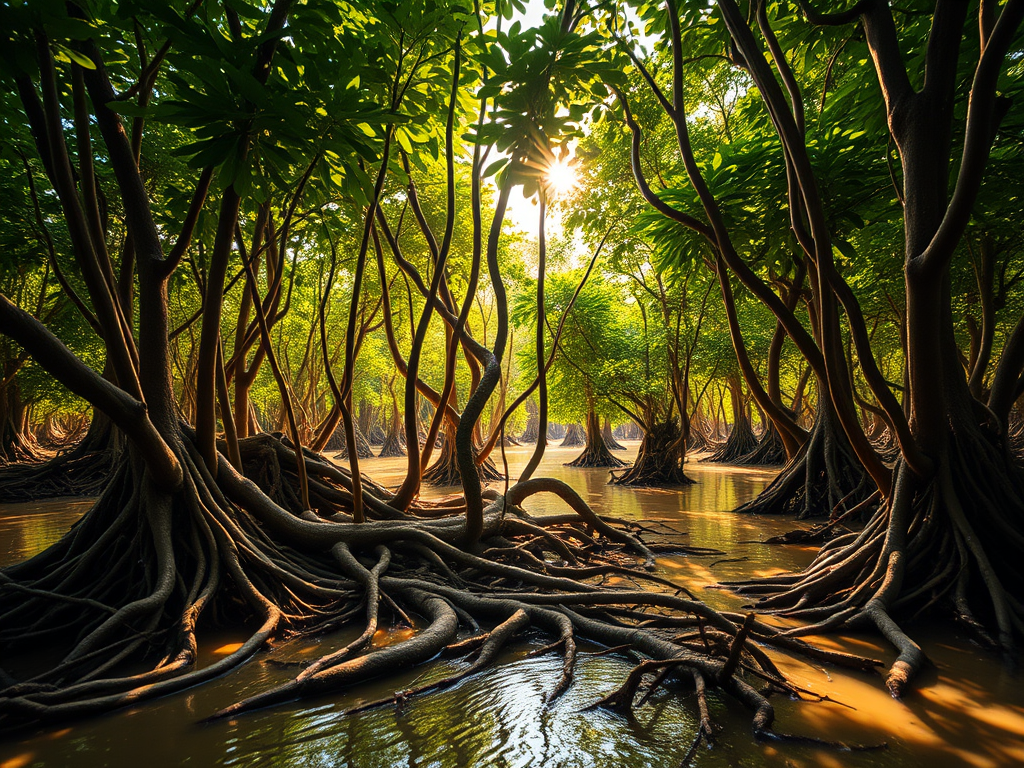
What if the front line in the fight against climate change wasn’t in a high-tech lab or a global summit—but in the muddy, tangled roots of a mangrove forest?
In the coastal heart of the Philippines, a quiet revolution is taking root. A new study published on September 5, 2025, in the open-access journal Carbon Research, shows that mangroves, those hardy, salt-tolerant trees lining tropical shorelines, are not just nature’s coastal defenders. They’re also carbon vaults, quietly locking away tons of carbon dioxide from the atmosphere. And now, thanks to the work of Dr. Hannah Alexis Melquiades Asilo and her team at the University of the Philippines Tacloban College, we finally have the numbers to prove it.
While the world talks about “green” solutions to climate change, scientists are increasingly turning to the blue—blue carbon, that is. This term refers to the carbon captured by marine and coastal ecosystems, especially mangroves, seagrasses, and salt marshes. Among them, mangroves are the undisputed champions, storing up to four times more carbon per hectare than tropical rainforests.
Yet, in the Eastern Visayas region of the Philippines, a biodiversity hotspot still recovering from the impacts of typhoons and deforestation, detailed data on blue carbon stocks has been scarce. Until now.
Dr. Asilo’s team conducted a rigorous, field-based assessment across three types of mangrove stands:
- Natural (undisturbed, mature forests)
- Reforested (areas where mangroves were replanted after degradation)
- Afforested (areas where mangroves were planted on land that previously had none)
Using allometric equations, mathematical models that estimate biomass from tree measurements, and sediment sampling, the researchers calculated the Total Ecosystem Blue Carbon (TEBC) stored in both plants and soil.
The results? A striking average of 387.4 ± 47.4 Mg C ha⁻¹—and up to a massive 1,432.6 ± 231.4 Mg CO₂ equivalent per hectare. That’s like taking hundreds of cars off the road, one forest at a time.

As expected, natural mangrove stands held the highest carbon stocks—proof that protecting existing forests remains critical. But here’s the surprise: afforested sites (newly planted mangroves on previously non-mangrove land) outperformed reforested areas (replanted after loss), challenging the assumption that restoration always beats starting from scratch.
“This finding shifts the narrative,” says Dr. Hannah Alexis Melquiades Asilo, corresponding author and environmental science leader at the Division of Natural Sciences and Mathematics, University of the Philippines Tacloban College. “We’ve long prioritized reforestation. But our data shows that well-planned afforestation can be just as powerful—especially when done right, with the right species and conditions.”
The study highlights that biological diversity, soil composition, and local hydrology all play crucial roles in carbon storage, emphasizing the need for site-specific assessments rather than one-size-fits-all policies.
Why It Matters: Science for Policy and Protection
This research isn’t just about numbers—it’s about action. With the Philippines on the front lines of climate change, facing rising sea levels and stronger storms, mangroves are more than carbon sinks: they’re natural storm barriers, fish nurseries, and livelihood sources for coastal communities.
By providing quantitative, localized data, Dr. Asilo’s work empowers policymakers, conservation groups, and local governments to make smarter decisions—whether it’s designating protected areas, designing restoration projects, or accessing international climate funding through carbon credit programs.
“Blue carbon isn’t just a scientific concept,” Dr. Asilo emphasizes. “It’s a tool for resilience, for justice, and for sustainable development in vulnerable coastal regions like ours.”
A Beacon of Science in Eastern Visayas
At the center of this discovery is the University of the Philippines Tacloban College, emerging as a vital hub for environmental research in the Western Pacific. Despite limited resources and the challenges of post-disaster recovery, the institution is producing world-class science that speaks to global issues—from climate mitigation to ecosystem-based adaptation.
Dr. Asilo’s study is a powerful reminder that local knowledge and local research are essential to solving global problems.
The Future is Blue—and Rooted in Science
So next time you walk past a mangrove forest, don’t see it as just a swamp. See it as a carbon vault. A climate shield. A living laboratory.
Thanks to pioneering scientists like Dr. Hannah Alexis Melquiades Asilo and the team at University of the Philippines Tacloban College, we’re learning to measure, value, and protect these incredible ecosystems like never before.
The message is clear: when it comes to fighting climate change, sometimes the best solutions aren’t high-tech—they’re rooted in mud, sustained by tides, and powered by science.
Stay tuned for more insights from this dynamic research group—where every tree tells a story, and every measurement brings us closer to a cooler, safer planet.

Leave a Reply