By 1828–29, James W.C. Pennington was in New York, stitching wages to night study and Sabbath schooling as he entered free Black networks of mutual aid, the antislavery press, and the first Colored Conventions. Rejecting colonization, he claimed the United States as his homeland and married Harriet Walker even as a fugitive. In 1833, he received an opportunity that would change his life.
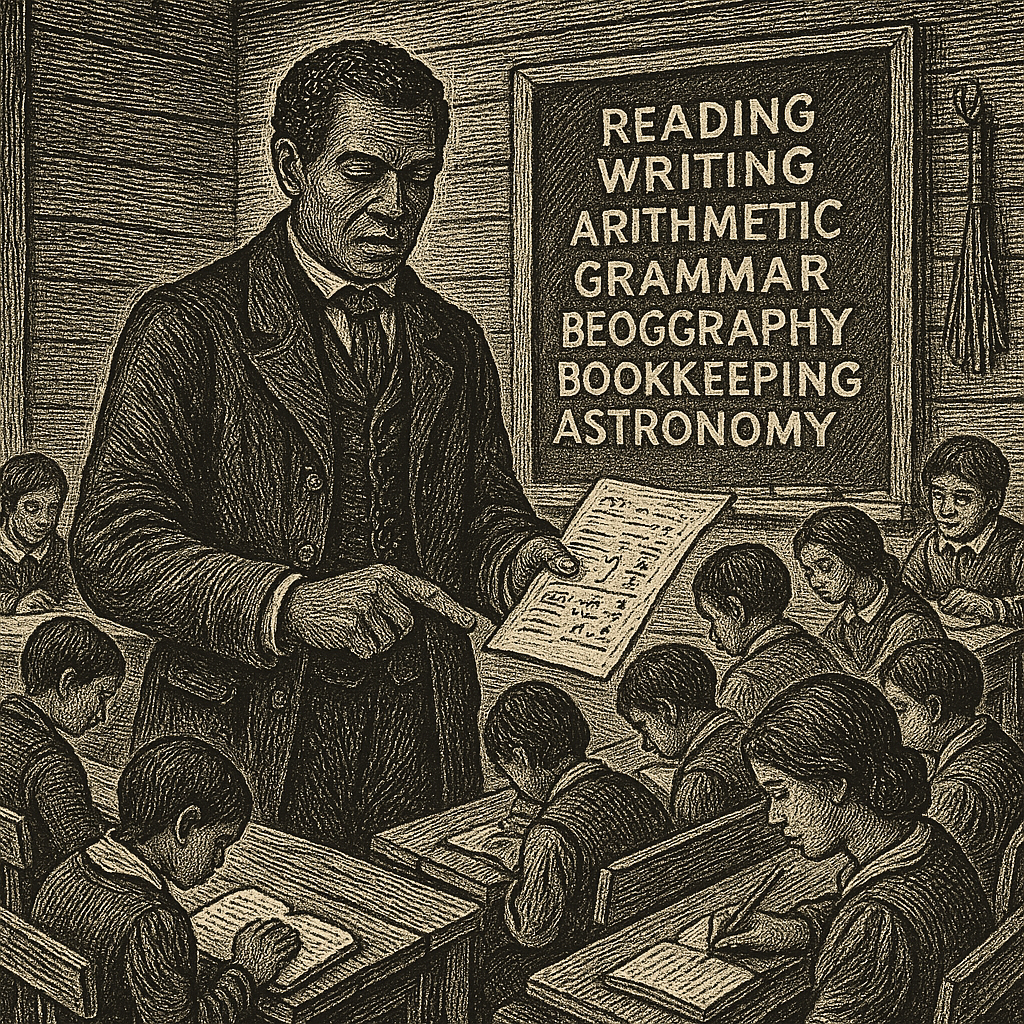
At the behest of a wealthy Newtown merchant named Peter Remsen, Pennington opened a one-room school for Black children in Newtown, Long Island, crafting a disciplined “education for freedom.” Two years later, barred from admission at Yale, he audited Divinity lectures, absorbing a “moral government” theology that yoked conscience to law. By 1837 he had forged the pattern of his life: study, ministry, institution-building, and everyday resistance to caste.
What feels fresh about Pennington’s Newtown years is how concrete—and frankly experimental—his “education for freedom” program really was. He didn’t just preach punctuality; he designed a multi-year curriculum for working-class Black families that climbed deliberately from reading, writing, and arithmetic to grammar, geography, bookkeeping, history, and even astronomy. In his school essays for the Black press he urged parents to think in years, not months, visiting class regularly and enforcing quiet study at home. The aim wasn’t polish but power: a ladder of subjects sturdy enough to lift children into trades, pulpit work, and civic competence.

One characteristic story from Newtown captures both his humor and discipline: a father sent a child as a “pet” to test Pennington’s authority; the teacher’s firm but affectionate handling of the ruse won over the household and, soon after, more pupils. He also turned the benches to face him to thwart the children’s “Peep-O” whispers and kept the birch—his joking “Dr. Hickory”—as a last resort, preferring persuasion and routine to the rod.[1]
The school sat in a web of neighborhood politics that Pennington learned to navigate. He spotted efforts to “trap” him—like a handwriting “test” staged by whites to discredit a Black schoolmaster—and he warned against “clanning,” the opportunistic alignment of prejudiced whites with “lower-minded” Blacks to undermine a teacher’s standing. His defense, again, was institutional: regular reports to supporters, home-to-home recruiting by sleigh in the March snow, and early contributions to the press that later grew into his serialized “Common School Review,” a plain-spoken audit of broken stoves, short supplies, late pay for teachers, and the folly of making instructors fee-collectors. The refrain was simple: if you want learning to stick, fund the basics and show up.[2]
Even as he built the school, Pennington widened his target list beyond classrooms to pews and public conveyances—what he called the ordinary sites of caste. A widely discussed episode in Manhattan fixed his rule for a lifetime. After reformer Arthur Tappan attempted a pointedly interracial seating gesture in Laight Street Presbyterian, trustees balked; Pennington drew the opposite lesson and vowed never to accept a segregated pew, “standing in the aisle” if needed.
That stance steered him toward First Colored Presbyterian (Shiloh) under Theodore S. Wright, where he soon helped with pastoral work during Wright’s illness and began reporting, with telling self-possession, as “J. W. C. Pennington, Pastor.” The reports combined spiritual metrics (conversions, funerals) with offerings for manumission and aid to a struggling sister church in Hoboken—an early sign that for him, devotional life and social provision were inseparable.[3]
Pennington’s print voice also sharpened in this window. He backed temperance as a keystone reform (helping launch Brooklyn’s temperance association for people of color and later serving as secretary) and took up the anticolonization cause in committee rooms and columns.
When the American Colonization Society’s secretary Ralph Gurley boasted of Black Brooklyn’s Liberia sympathies, Pennington fired off a corrective to The Liberator under the initial “P.,” denying ACS support in his community and insisting on a simple principle that would become his watchword: “This is our home, and this is our country.”
At the Colored Conventions (Philadelphia 1831 and 1832; New York 1834), Pennington worked rules and resolutions and ultimately helped draft the movement’s “Address to the Free Colored Inhabitants of the United States,” which condemned slavery and colonization together, elevated education as the path to influence, and mapped out a dues-supported national structure to keep local efforts aligned.[4]
If Newtown taught him logistics, New Haven (1834–1836/7) taught him the limits of northern liberality and gave him the theological instrument he would later wield against pro-slavery law. Barred from Yale matriculation because of race, Pennington was admitted only as a “visitor,” a liminal status he later named as “oppression”: a seat in lecture but no voice, no library privileges, no line in the catalogue.
Yet Pennington wrung from that half-open door a real seminary education—sitting under Nathaniel W. Taylor on the “moral government of God,” which bound conscience, social arrangements, and public law to a single divine standard, and under Josiah W. Gibbs on scripture and languages. The “moral government” frame became his through-line: if law or covenant obliges a moral wrong, it is not binding—an argument he would later apply to the Fugitive Slave Clause and to church bodies that sought fellowship with enslavers.[5]
Yale also placed Pennington inside the New Haven college controversy of 1831–32, whose aftershocks still shook the town: a bold plan (backed by Jocelyn, Garrison, and Tappan) for a manual-labor college for Black students had been scuttled by mob action and elite opposition—made fiercer by news of Nat Turner’s revolt. That failure, and the city’s still-raw prejudices, clarified Pennington’s strategy. He would not wait for ivy-covered benevolence; he would build: Sabbath schools, temperance societies, and congregations whose discipline made freedom practicable.
Back on Long Island in 1837, Pennington organized a small interdenominational church with American Home Missionary Society support; his first report listed twenty-seven communicants and thirty to forty Sabbath-school pupils, humble numbers anchored by routines he knew how to sustain.[6]

Two final, under-noticed threads round out these years. First, Pennington’s publishing hustle had already begun in earnest. Before his famous 1849 spiritual autobiography, he laid down the scaffolding for a history of Black intellect and a theology of oneness—work that crystallized in his 1841 Text Book of the Origin and History of the Colored People, but whose reading lists, outlines, and tone were honed in Newtown and New Haven.
Second, his ministry already touched the Underground Railroad in personal ways. In September 1838, at David Ruggles’s request, he married Frederick Douglass to Anna Murray—no fee taken, just haste and pastoral care—before the couple slipped quietly out of the city’s reach. It was the perfect emblem of his method: classrooms and pulpits on the surface, discreet freedom work just beneath.[7]
By the spring of 1838, the experiment in Newtown had done its deeper work: it had taught Pennington how to turn conviction into structure—syllabi into schools, pew principles into pastoral practice, press habits into public leverage. Ordination only formalized what the previous five years had forged: a minister who treated conscience and law as joint tutors, and who could recruit, report, fund, and hold a community together through routine as much as rhetoric. When the call came from Hartford’s Talcott Street Church, he carried north a toolkit honed on benches and blackboards—temperance discipline, school reform, anticolonization clarity, and the conventions’ patient machinery. In a city soon to be electrified by the Amistad case, Pennington would scale those same habits to a wider stage, becoming not merely a local schoolman with a pulpit, but a pastor-organizer whose steady architecture helped give abolition a durable public shape.
Endnotes
- Christopher L. Webber, American to the Backbone, “School Teacher in Newtown”: curriculum ladder; sleigh recruiting; “Peep-O,” “Dr. Hickory,” and the “pet” anecdote.
- Webber, American to the Backbone, “School Teacher in Newtown”: handwriting “test,” “clanning,” and the genesis of his Common School Review series.
- Webber, American to the Backbone, “School Teacher in Newtown”: Laight Street/pew episode; vow against segregated seating; Pennington’s reports signed “J. W. C. Pennington, Pastor,” with manumission and Hoboken offerings.
- Webber, American to the Backbone, ch. 5: Liberator letter signed “P.” correcting Gurley; anticolonization formula “This is our home…”; convention roles and the Address to the Free Colored Inhabitants of the United States.
- Webber, American to the Backbone, ch. 7: visitor status, lack of catalogue line and library privileges (“oppression”); study with Taylor and Gibbs; emergence of the moral government argument.
- Webber, American to the Backbone, ch. 8: AHMS backing; first report numbers (27 members; 30–40 Sabbath-school pupils); 1831–32 New Haven Black college proposal’s collapse and its lingering effects.
- Webber, American to the Backbone, ch. 8: Pennington officiates the Douglass–Murray wedding at Ruggles’s request (Sept. 1838).




Leave a Reply