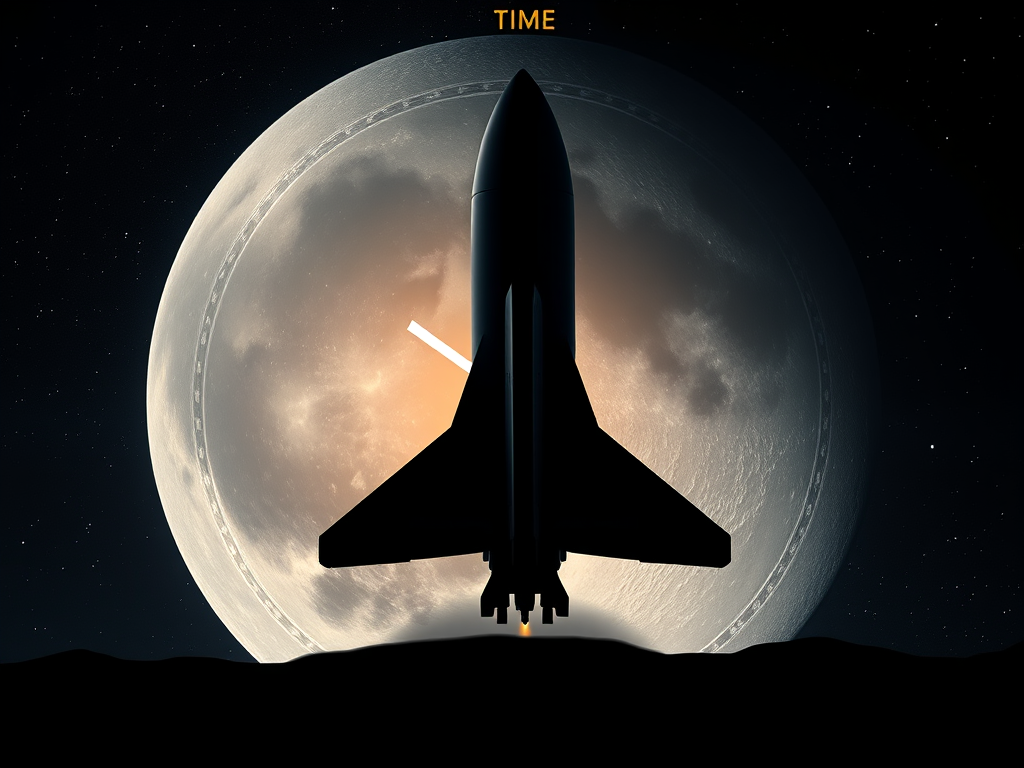
Moon Shot on the Clock: Doubts Mount Over Starship’s Schedule
Officials increasingly fear SpaceX’s Starship won’t be ready to land Artemis III astronauts before China’s 2030 goal. Critics cite missed milestones, four recent test flights with three explosions, limited payload so far, and a risky, unfinished in-orbit refueling plan that could require 15+ rapid launches. The lunar lander’s towering height also raises stability concerns on the surface. Despite political noise around Elon Musk and the White House, current and former NASA leaders say worries are technical: too many unproven elements on an aggressive timeline. Acting NASA administrator Sean Duffy defends the plan, pointing to SpaceX’s Falcon 9 record and insisting the U.S. will land first. Veterans urge a “Plan B”: a simpler, proven lander without refueling to accelerate a safe return. (New York Times)
AI-designed phages take a step toward programmable therapeutics
Researchers used large AI models (Evo 1 and Evo 2) to generate complete bacteriophage genomes, then synthesized and tested the best designs in lab. Starting from a ΦX174 template and training on millions of phage sequences, the system produced hundreds of viable candidates aimed at infecting antibiotic-resistant E. coli. Of 302 designs screened, 16 could infect target strains; cocktails of these phages killed E. coli that wild-type ΦX174 could not. Authors frame this as the first demonstration of AI writing viral sequences with intended function. The report is a 17 September 2025 preprint, not yet peer-reviewed, and raises biosafety questions, but suggests a path to phage therapies against resistant bacteria and a window into AI-designed biological systems. (Nature)
Loudest gravitational-wave yet lets scientists verify black-hole basics
The LIGO–Virgo–KAGRA collaboration reports event GW250114 with a signal-to-noise ratio near 80, enabling precision tests of black-hole physics. The merger of two ~32-solar-mass black holes increased event-horizon area from ~240,000 to ~400,000 km², consistent with Hawking’s area theorem. During ringdown, analysts detected two distinct “tones” matching predictions for a rotating (Kerr) black hole characterized by mass and spin, offering strong support for Kerr geometry. Detectors in the United States, Italy, and Japan observed the signal. Researchers call the result a milestone showing how improved sensitivity has made gravitational-wave astronomy a precision science a decade after the first detection, with university teams contributing hardware, waveform modeling, and analysis. Birmingham researchers emphasized the event’s brightness and led key analyses. (SpaceDaily)
NOAA’s SWFO-L1 aims to fix looming gap in space-weather warning system
Launching September 23, the Space Weather Follow-On L1 mission will station a spacecraft a million miles sunward to deliver upstream solar-wind measurements and alerts. Officials say the capability is urgent because current sentinels—ACE (1997), SOHO (1995), and DSCOVR (2015)—are beyond design life, threatening warning lead time for geomagnetic storms that disrupt grids, satellites, aviation, and communications. SWFO-L1 will monitor the solar wind and interplanetary magnetic field from L1, complementing observatories and feeding forecasts for space-weather centers. Advocates argue replacing aging assets now safeguards essential services during a solar cycle, when coronal mass ejections are more frequent. A briefing stressed the need to “replace this capability now,” presenting the launch as risk reduction for resilience. (Space)
China’s chronic-care megaplatform bets on AI to ease aging-health burden
A Guangdong company, Fangzhou, is rolling out “XingShi,” a health-care large language model integrating speech and image recognition with medical data to manage chronic diseases. The firm reports more than 50 million users and 200,000 physicians. Supporters say AI triage and continuous monitoring could reduce pressure as China’s older population with cardiovascular disease, diabetes, respiratory disorders, and cancer grows. The push aligns with ambitions to lead in AI and an “AI Plus” strategy embedding AI across sectors via funding, tax breaks, and university programs. Details remain sparse, and independent validation is lacking, but experts say demand and policy could drive adoption. Article highlights promise and oversight questions as China pilots AI chronic-care management at scale. (Nature)
House Levels Give NASA Temporary Lifeline Amid Budget Chaos
With Congress stalled on the fiscal 2026 budget and an Oct. 1 shutdown looming, NASA’s outlook has whipsawed. The White House sought a 20% cut, lowering the agency to $18.81 billion and directing science teams to prepare closeout plans for roughly two dozen missions. Interim administrator Sean Duffy now says to plan to the House Appropriations level—about $24.84 billion—offering partial relief. Science would be $6 billion under the House plan versus $3.9 billion in the request; Earth science drops from $2.14 billion to $1.33 billion. Key missions remain funded and some extended, including OSIRIS-APEX ahead of Apophis’s 2029 flyby. Nothing is final, and guidance could change before Congress acts, but for many scientists the risk of cancellations and shutdown disruptions has eased, at least temporarily. (Ars Technica)
More extreme Indian monsoon rainfall in El Niño summers
From the Science Editors: India, the world’s most populous country and third-largest economy, depends on the rainfall it receives during the summer monsoon season. How much and when that rain falls has major implications for the environment, agriculture, water supply, and river flow. Hill et al. found that although the well-documented effect of El Niño events is to decrease summer rainfall, it also paradoxically intensifies extreme daily precipitation amounts, thereby resulting in hazardous conditions across the region. The processes that create this intensification may be important in other tropical locations as well. (Science)
Drunken Roots of an Ape Appetite for Alcohol
New measurements strengthen the “drunken monkey” hypothesis by quantifying ethanol in fruits eaten by chimpanzees in Uganda and Côte d’Ivoire. Fallen fruit contained ~0.31–0.32% alcohol by volume; because fruit dominates chimp diets, researchers estimate ~14 grams of ethanol daily—about a standard drink—and, scaled to body mass, nearly two. Using breathalyzers, portable gas chromatography, and chemical assays, teams documented selective sharing and preference for riper, more alcoholic fruit, echoing footage of chimps sharing fermented breadfruit. Although levels are low, chronic exposure is likely and intoxication unlikely, consistent with ancestral adaptations for alcohol metabolism. The work implies evolutionary links between fruit sugars, ethanol cues, and social foraging. Next, scientists will analyze urine for alcohol metabolites to refine intake estimates. (Ars Technica)




Leave a Reply