Too little snowfall is now also shaking the foundations of some of the world’s most resilient ‘water towers’, a new study led by the Pellicciotti group at the Institute of Science and Technology Austria (ISTA) shows. After establishing a monitoring network on a new benchmark glacier in central Tajikistan, the international team of researchers was able to model the entire catchment’s behavior from 1999 to 2023. The results, showing decreasing glacier health, were published in Communications Earth & Environment.
High-mountain Asia has been nicknamed the Third Pole due to its massive meltwater reserves, which are second only to the Arctic and Antarctic polar caps. In Central Asia, the northwestern Pamir Mountains in Tajikistan have been home to some of the last stable or growing glaciers outside the polar regions. However, between the collapse of the Soviet Union and the return of new monitoring networks, this region has also suffered from a dire lack of observational data for decades.
Researchers from Professor Francesca Pellicciotti’s group at the Institute of Science and Technology Austria (ISTA) are contributing to an international effort to address this issue. They teamed up with local researchers in Tajikistan and collaborators in Switzerland, Austria, and France to establish their own climate station on a benchmark catchment and model the glacier’s changes over more than two decades. Now, their first joint publication shows evidence that the glacier likely reached its tipping point in 2018.
“Due to the general lack of data and robust future projections in the region, we can’t tell yet whether this was truly the ‘point of no return’ for Pamir glaciers,” says the study’s first author, Achille Jouberton, a PhD student in the Pellicciotti group at ISTA. “We must keep in mind that this study only considers one specific catchment and extends from 1999 to 2023. However, it is the first study of its kind. Similar efforts will need to address these issues on a larger geographical scale.”
Understanding an anomalous state
Climate change has had a substantial impact on glaciers worldwide. While those in the Alps, Andes, and elsewhere in the world have been melting at a disconcerting rate, some glaciers in the Central Asian Pamir and Karakoram mountains were found to be surprisingly stable, possibly even growing. This unexpected and counterintuitive behavior of the glaciers has been termed the Pamir-Karakoram Anomaly. “Central Asia is a semiarid region that is highly dependent on snow and ice melt for downstream water supply,” says ISTA Professor Pellicciotti. “But we still do not fully understand the causes of this anomalous glacier state.” Are these the last resilient glaciers in the face of climate change?
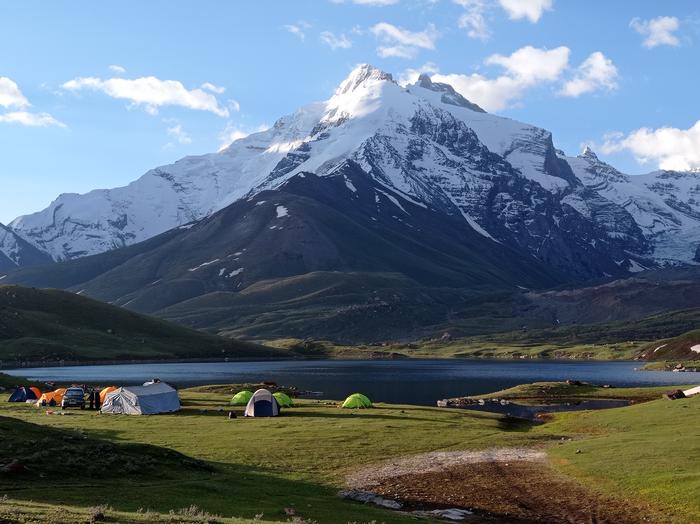
The team chose to establish their monitoring site on Kyzylsu Glacier in the northwestern Pamir, in central Tajikistan. This climate station is situated at an elevation of just below 3400 meters above sea level in a country where half of the territory rises above 3000 meters. “Kyzylsu is becoming a benchmark monitoring site due to the various observational sites recently established on and around the glacier,” explains Jouberton. There, the researchers aim to start to shed light on the glaciers’ anomalous behavior in the region.
Sign up for the Daily Dose Newsletter and get every morning’s best science news from around the web delivered straight to your inbox? It’s easy like Sunday morning.
“The challenge is that there is almost no data at all.”
Since setting up their monitoring network at the Kyzylsu catchment in 2021, the team has collected extensive data about snowfall and water resources in the area. Using these observations and climate reanalysis data as inputs to their computational models, they were able to simulate the glacier’s behavior from 1999 to 2023. “We modeled the catchment’s climate, its snowpack, the glacier mass balances, and the water movements,” says Jouberton. “But whichever way we analyzed the model, we saw an important tipping point in 2018 at the latest. Since then, the decreased snowfall has changed the glacier’s behavior and affected its health.”
In fact, the glacier ice melt has increased, compensating for around a third of the lost water resources from reduced precipitation. Therefore, it seems the anomalous phase of the glacier’s relative stability in the face of climate change has reached its end.
The researchers used computational models driven by their critically important, new local observations. However, observational data alone would not have answered all questions, even if dense coverage was provided. “We need models and simulations anyway in our work, from the bottom of the valley to the top of the glacier. Even in Europe and Canada, where the monitoring networks are much more extensive, climate stations remain small, localized points on the map,” says Jouberton. “But the challenge in the Pamir region is that there is almost no data at all.” Therefore, the researchers have to densify the observational mesh. “In light of all these challenges, we are not sure how accurate the input to the model is. But since it performed well against independent observations, we are quite confident about the output. Our work is a first step in the right direction.”
Backpacks loaded with precious equipment
Since establishing the collaboration in 2021, while the Pellicciotti group was located at the Swiss Federal Institute for Forest, Snow and Landscape Research (WSL), the researchers have visited Tajikistan seven times. “We’ve planned field trips every summer with the local research institutes in Dushanbe and hiked with our backpacks loaded with precious equipment to set camp in remote mountains, cut off from the world. Having local scientists as part of the field trip not only favors close collaboration and scientific exchange but also helps us overcome the language barrier while interacting with the local inhabitants who depend on the glaciers,” says Jouberton.
2025 marks a milestone as this summer’s field trip was the last one within the project’s current funding period. Among this year’s goals were updating and automating the monitoring networks to ensure they remain functional for decades to come. By also sharing essential knowledge about the equipment’s maintenance with local inhabitants, they hope to make their work more sustainable and reduce the need for frequent field trips. Up to now, they had to travel to exchange the equipment’s internal batteries, maintain the stations’ functionality, and collect their data using USB sticks.
Considerable local impact
The team’s work relies on close cooperation with the locals. “The shepherds know us. They see us every year and often invite us for lunch. They know where we set up our stations and do their best to ensure that nothing disturbs the measurements,” says Jouberton. The team discusses the data with the locals, shares information, and works in the wilderness amid the local inhabitants, their children, and livestock. Frequently, the locals report events that have happened in the mountains. “It is impressive to hear the locals tell us about things we only saw in satellite data. This gives a real and personal impact to our work.”
The Kyzylsu catchment contributes to the drainage basin of the Amu Darya, one of the major rivers in Central Asia, whose water originates almost entirely from glaciers. The Amu Darya is also a former inflow of the now mostly dried-up Aral Sea. This inland sea has suffered from the ongoing decades-long diversion of its two main inflow rivers, the Amu Darya to the south and the Syr Darya to the northeast, to irrigate cotton fields created in the desert during Soviet times. “But the effects of the glaciers are the strongest in their immediate ecosystems,” says Jouberton. “Even though the Kyzylsu Glacier and likely other Pamir glaciers seem to be melting faster and pumping more water into the system, it is unlikely that they will refill what’s left of the Aral Sea.”
IMAGE CREDIT: Marin Kneib/ISTA


Leave a Reply