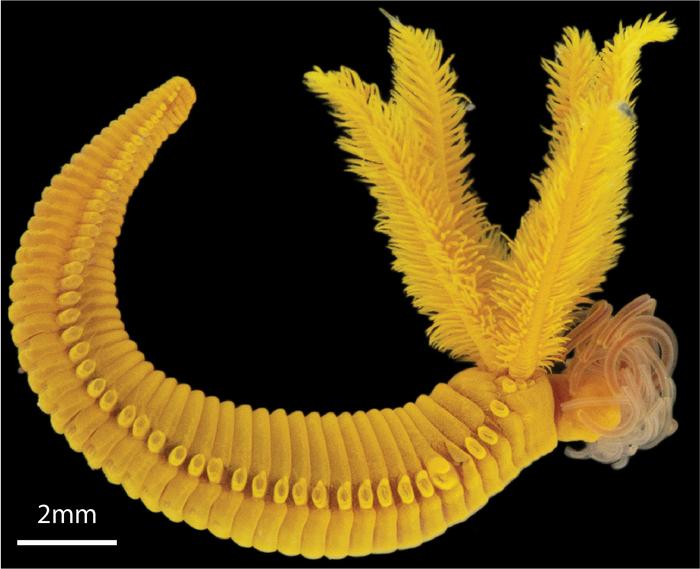
A deep sea worm that inhabits hydrothermal vents survives the high levels of toxic arsenic and sulfide in its environment by combining them in its cells to form a less hazardous mineral. Chaolun Li of the Institute of Oceanology, CAS, China, and colleagues report these findings in a new study published August 26th in the open-access journal PLOS Biology.
The worm, named Paralvinella hessleri, is the only animal to inhabit the hottest part of deep sea hydrothermal vents in the west Pacific, where hot, mineral-rich water spews from the seafloor. These fluids can contain high levels of sulfide, as well as arsenic, which builds up in the tissues of P. hessleri, sometimes making up more than 1% of the worm’s body weight.
Li and his team investigated how P. hessleri can tolerate the high levels of arsenic and sulfide in the vent fluids. They used advanced microscopy, and DNA, protein and chemical analyses to identify a previously unknown detoxification process. The worm accumulates particles of arsenic in its skin cells, which then react with sulfide from the hydrothermal vent fluids to form small clumps of a yellow mineral called orpiment.
The study provides new insights into the novel detoxification strategy that P. hessleri uses for “fighting poison with poison,” which enables it to live in an extremely toxic environment. Previous studies have found that related worms living in other parts of the world, as well as some snail species in the west Pacific, also accumulate high levels of arsenic, and may use this same strategy.
Coauthor Dr. Hao Wang adds, “This was my first deep-sea expedition, and I was stunned by what I saw on the ROV monitor—the bright yellow Paralvinella hessleri worms were unlike anything I had ever seen, standing out vividly against the white biofilm and dark hydrothermal vent landscape. It was hard to believe that any animal could survive, let alone thrive, in such an extreme and toxic environment.”
Dr. Wang says, “What makes this finding even more fascinating is that orpiment—the same toxic, golden mineral produced by this worm—was once prized by medieval and Renaissance painters. It’s a curious convergence of biology and art history, unfolding in the depths of the ocean.”
Sign up for the Daily Dose Newsletter and get every morning’s best science news from around the web delivered straight to your inbox? It’s easy like Sunday morning.
The authors note, “We were puzzled for a long time by the nature of the yellow intracellular granules, which had a vibrant color and nearly perfect spherical shape. It took us a combination of microscopy, spectroscopy, and Raman analysis to identify them as orpiment minerals—a surprising finding.”
The authors conclude, “We hope that this ‘fighting poison with poison’ model will encourage scientists to rethink how marine invertebrates interact with and possibly harness toxic elements in their environment.”
IMAGE CREDIT: Wang H, et al., 2025, PLOS Biology, CC-BY 4.0.


Leave a Reply to Deep sea worm fights ‘poison with poison’ to survive high arsenic and sulfide levels – Scientific Inquirer – Additional survival tricksCancel reply