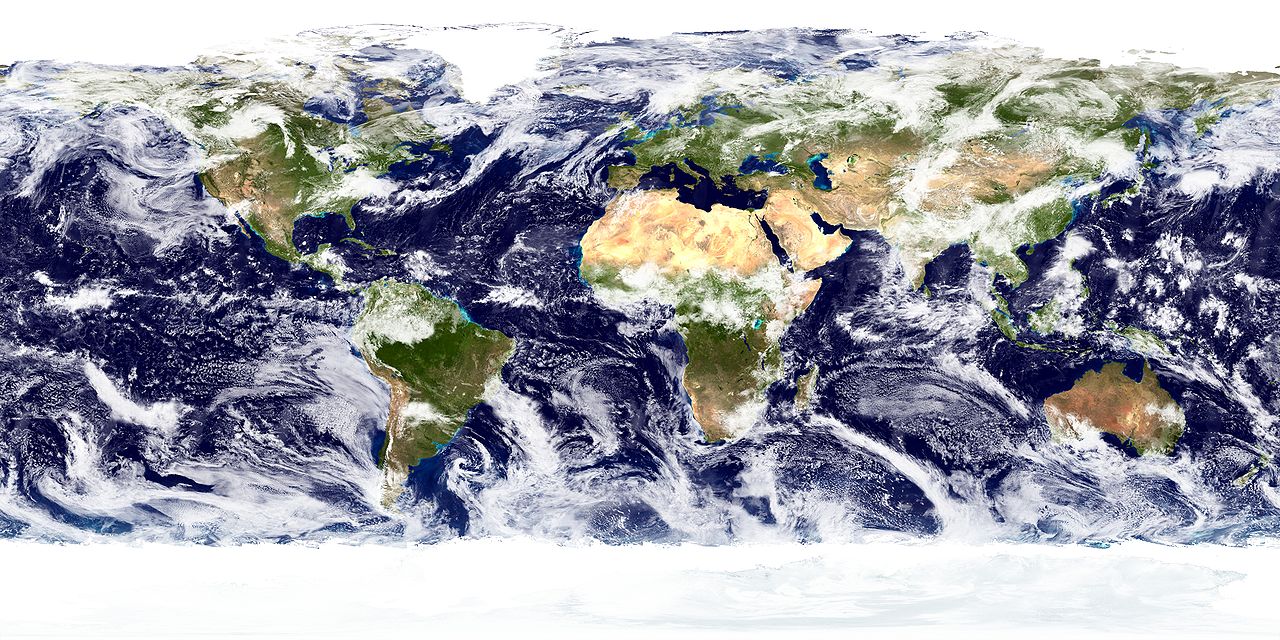

This iconic “Blue Marble” mosaic stitches together months of satellite observations to render Earth’s land, seas, clouds, and polar ice in unprecedented true‑color detail. Composed from NASA’s Moderate Resolution Imaging Spectroradiometer (MODIS) data aboard the Terra satellite at approximately 1 km per pixel resolution, it provides a comprehensive, natural-light view of planetary systems.
The image reveals three interconnected domains: the ocean’s surface color, cloud patterns, and sea ice extent. Ocean color shifts—from deep blues to muted greens—signal varying chlorophyll concentrations and suspended particles. SeaWiFS and similar sensors allow scientists to estimate phytoplankton biomass by comparing blue-to-green reflectance ratios—a higher green reflectance means more chlorophyll and thus algal abundance.
Cloud formations—visible as widespread swirling bands and storm systems—trace atmospheric circulation and convection zones. Tracking each cloud structure aids meteorologists in forecasting weather and understanding climate dynamics and transport of moisture and heat.
At the poles, bright white sea ice reveals seasonal coverage and extent. Persistent ice influences albedo—the reflectivity of Earth—and thus planetary heat balance. During melt seasons, shrinking ice reveals darker ocean surfaces that absorb more sunlight, accelerating warming in a positive feedback loop.
This mosaic transcends a simple Earth snapshot. It becomes a baseline for monitoring ecosystem changes. Regular MODIS observations let scientists detect shifts in ocean chlorophyll patterns due to warming seas or nutrient changes, track variations in sea ice due to climate change, and identify how cloud cover responds to global warming.
By visualizing circulation systems, light-scattering signals, and seasonal cycles collectively, the image underscores Earth’s coupled systems: ocean biology, atmospheric behavior, cryosphere dynamics, and land distributions all interrelate. This integrated perspective empowers researchers to model climate change, forecast marine productivity, and inform policy decisions on a planetary scale—making the “Blue Marble” not just beautiful, but scientifically vital.




Leave a Reply