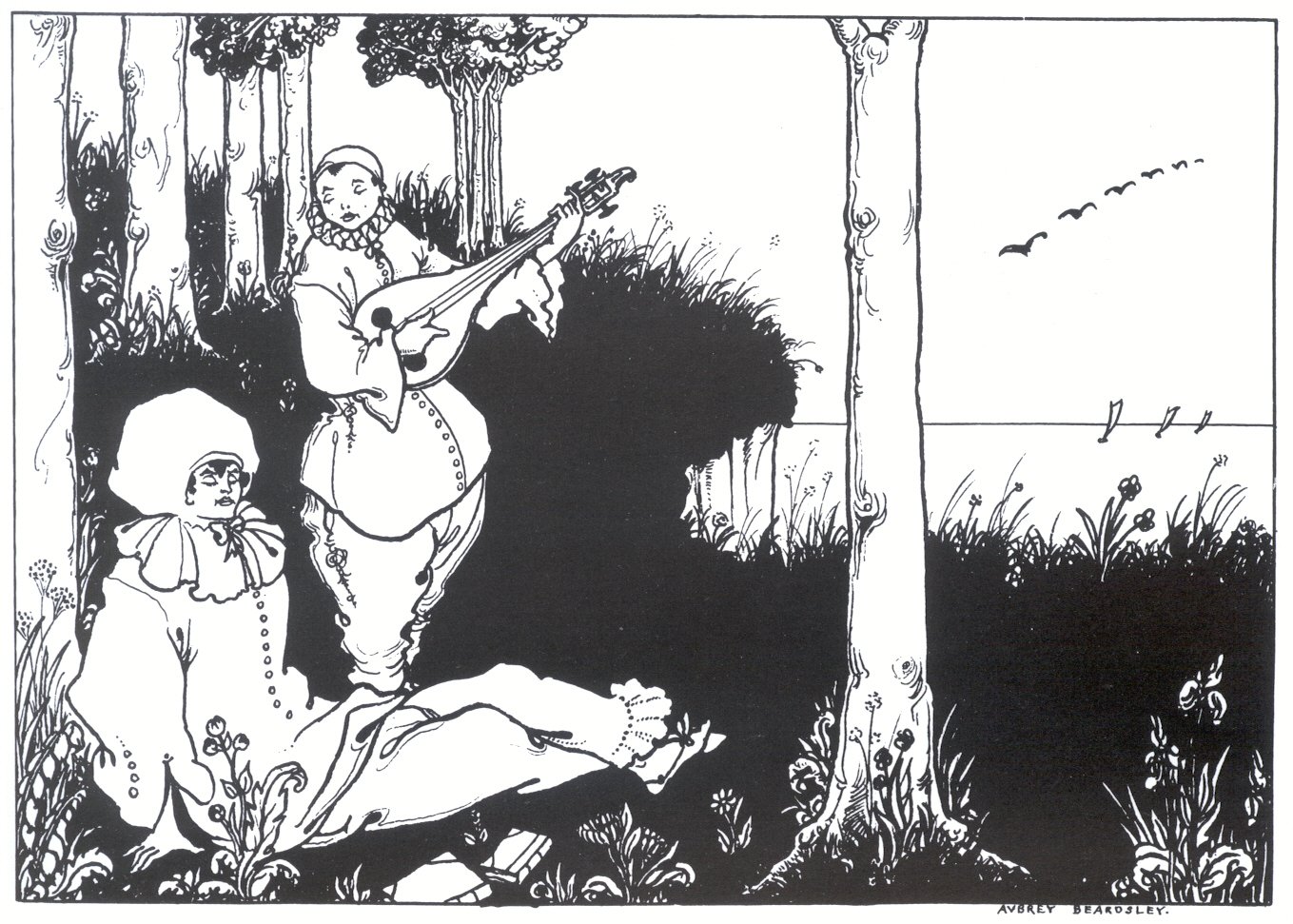
Sharp, skeletal silhouettes wrapped in luxurious drapery. Pale faces drawn in precise lines, small cruel mouths. Women floating in spaces almost devoid of depth, their elegance teetering between seduction and grotesquerie. In the final phase of Aubrey Beardsley’s incandescent career, his female figures grew increasingly spectral—at once decadent and dying. These drawings, particularly in The Lysistrata and The Pierrot of the Minute, embody what critics call “consumptive chic”—the nineteenth-century aestheticization of tuberculosis that transformed disease into beauty.
For Beardsley, tuberculosis wasn’t merely a subject but a signature. As the disease ravaged his lungs, it sharpened his vision, intensifying his art’s morbidity, eroticism, and elegance until illness and aesthetic became indistinguishable.

The Romantic Invalid
Born in 1872, Beardsley carried tuberculosis from childhood. The disease would claim him before his twenty-sixth birthday, but not before he revolutionized illustration with his sinuous lines, flat planes of black ink, and unnervingly stylized figures. Though largely self-taught, he became the defining visual artist of the 1890s, contributing iconic work to The Yellow Book, Oscar Wilde‘s Salomé, and other publications of the Decadent movement.
Victorian culture had already romanticized tuberculosis, especially in women. As Kirsten Ostherr notes in “Consumptive Chic and the Sickroom as Stage,” the disease’s symptoms—sunken cheeks, luminous eyes, translucent pallor, extreme thinness—became “aestheticized into signs of refinement and sexual allure.” These markers signified not just beauty but poetic genius, heightened sensitivity, and tragic eroticism. Beardsley, steeped in this atmosphere, drew both inspiration and identification from these ideals.

His illustrated Salomé embodies this consumptive aesthetic perfectly. She holds John the Baptist’s severed head, her own body coiled like smoke—frail yet alluring, sadistic yet refined. Art historian Margaret Stetz observes that Beardsley “reinvented the femme fatale not as a lush or voluptuous figure, but as someone already marked by death… by the disease that everyone feared and yet, perversely, admired.”
- Phage Therapy Plus a Fecal Transplant Kept Recurrent Urinary Infections at Bay in Two Women
- Genetically Identical Fish Raised Alike Still Formed Shoals With Distinct ‘Personalities’
- An Experimental Anti-Scarring Drug Unexpectedly Turns Down Cells’ Release of Molecular Messages
- Two Bacteria Working in Sequence Boost the Lysine in Faba Beans and Rapeseed More Than Threefold
- A Wearable Clip Turns a Deliberate Breath Into a Hands-Free Command
The Line Between Life and Death
As Beardsley’s illness advanced through the mid-1890s—hemorrhages, forced relocations, desperate searches for healing climates—his work evolved toward greater complexity and ambiguity. The line grew more delicate, forms more skeletal. “The Climax” (1893) shows Salomé raising the prophet’s head in religious ecstasy, its bloodless eroticism and brittle elegance foreshadowing Beardsley’s fate: an artist worshipping beauty at death’s edge.
The labor of illustration mirrored the tubercular experience—painstaking, exacting, solitary. As Beardsley’s condition worsened, his artwork distilled. Critics note “a formal economy in his later pieces that reflects not only aesthetic maturity, but also the shrinking window of time he had left to work.”

Disease became central to his creative process. Aware of his proximity to death, Beardsley imbued his works with erotic morbidity. His female figures simultaneously embodied desire and decay, reflecting tuberculosis’s cultural paradox: the consumptive woman as both dangerously sexual and spiritually elevated. Beardsley’s women weren’t passive sufferers but cunning avatars of consumption’s contradiction—dying yet desirous, delicate yet dangerous.
Performance and Penitence
Tuberculosis carried artistic cachet in Victorian imagination. The “romantic invalid” became a stock figure, lionized in literature as bearing tragic brilliance. Susan Sontag later called it “the disease of sensitivity.” Beardsley seemed to perform this role consciously, joking about his illness while using it to heighten his artistic identity. “I have one foot in the grave,” he wrote to publisher Leonard Smithers, “but the other still dances.”

By 1897, after converting to Catholicism, Beardsley publicly repudiated his erotic work. In a famous deathbed letter, he begged Smithers to destroy “all copies of Lysistrata and bad drawings.” Yet scholars debate whether this religious turn was genuine repentance or final aesthetic gesture—the consumptive artist staging his own drama.
His final works, created in exile in Menton, retained their characteristic fragility. “The Bath of Salomé” (1897) renders figures as spectral outlines, suggestions rather than forms, as if Beardsley drew with his lungs’ failing breath. In these last months, his drawings grew smaller, more symbolic, pared to essentials—an almost ascetic minimalism. As one historian notes, “Beardsley’s tuberculosis was both crucible and compass. It hollowed his body but refined his vision.”

The Legacy of Beautiful Disease
That refined vision anticipated Symbolism, Surrealism, even goth subculture. Beardsley’s aesthetic—beauty married to morbidity, elegance to grotesque—remains arresting precisely for its contradictions. Tuberculosis was simultaneously his subject and signature. As disease consumed his body, it sharpened his lines. As it closed his lungs, it opened new spaces on the page.

Beardsley stands as the most compelling example of illness not merely deforming but defining an artist’s aesthetic. His late female figures remain icons of a cultural moment when disease was beautiful, art was fatal, and the boundaries between the two dissolved in ink. Consumption didn’t destroy his vision—it distilled it to its purest, most haunting essence.



Leave a Reply