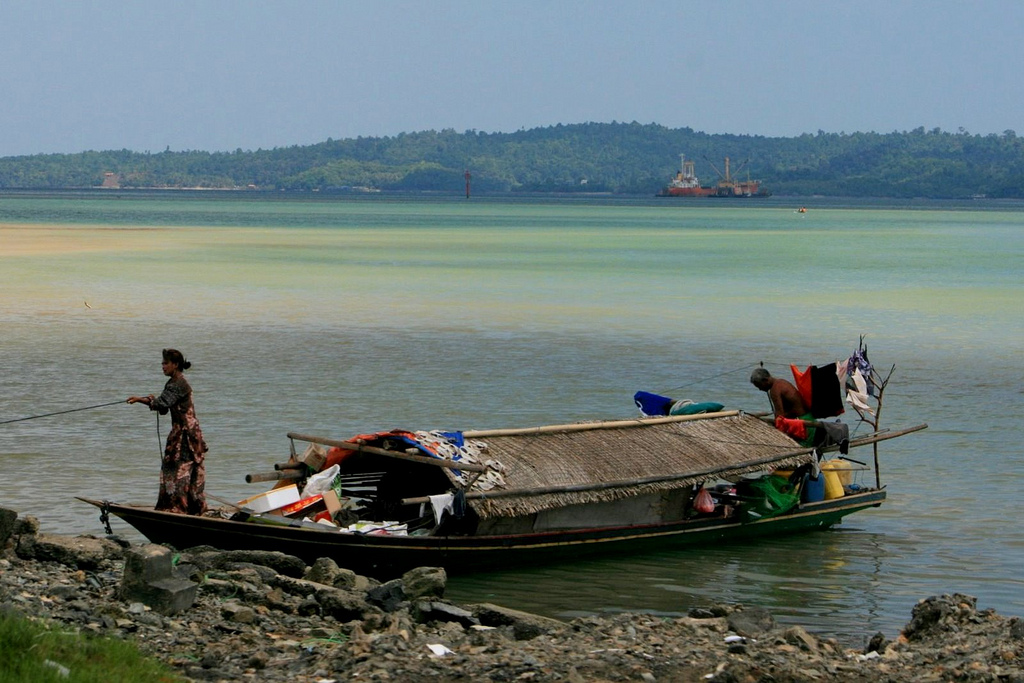

In the turquoise shallows off the coast of Southeast Asia, a Bajau Laut woman guides her lepa boat to shore, the vessel heavy with daily life: drying clothes, containers of fresh water, and supplies stacked under a thatched roof. Behind her, a man prepares gear for fishing. This is not a temporary excursion—it’s home. For centuries, the Bajau Laut, or “Sea Nomads,” have lived much of their lives afloat, navigating the waters of the Coral Triangle, which spans the Philippines, Malaysia, and Indonesia.
Unlike most maritime communities, the Bajau Laut don’t just make their living from the sea—they live on it. Traditionally stateless and semi-nomadic, they spend most of the year aboard handcrafted lepa-lepa boats, venturing ashore only for trade or when storms threaten. These long, narrow wooden vessels are often ornately carved and uniquely adapted for life at sea. With a roofed central section and open ends, the lepa functions as both a family home and a fishing platform. Families cook, sleep, and store possessions in this compact space while traveling between islands in search of fish and shellfish.
Their deep connection to the ocean is more than cultural—it’s biological. A 2018 study published in Cell by Melissa Ilardo and colleagues revealed a remarkable evolutionary adaptation in the Bajau people: significantly enlarged spleens. In most humans, the spleen acts as a reservoir for oxygen-rich red blood cells. During breath-hold diving, the spleen contracts, releasing these cells and boosting oxygen availability. The Bajau’s spleens are, on average, 50% larger than those of neighboring communities, allowing them to free-dive longer and deeper, often without equipment, in pursuit of fish and sea cucumbers.
This adaptation is believed to be the result of natural selection. For generations, Bajau divers have routinely submerged themselves to depths of over 70 meters, sometimes for minutes at a time. The researchers identified a gene called PDE10A that influences spleen size and is more prevalent in Bajau DNA, suggesting that the pressures of their diving lifestyle have literally reshaped their bodies.
But modernity is encroaching. As maritime borders tighten and traditional fishing zones are restricted, many Bajau families are being pushed ashore. Some now live in stilt villages on the edges of islands, their lepa moored nearby but used less frequently. Climate change, declining fish stocks, and political marginalization also threaten their way of life.
Still, the Bajau Laut embody an enduring link between culture and biology. Their adaptations—both evolutionary and societal—offer profound insights into human resilience, the plasticity of tradition, and the ways in which our environments shape who we are. As they float through the changing tides of the Anthropocene, the Bajau remain a vivid reminder that the boundaries between land and sea, nature and nurture, are more porous than we often think.



Leave a Reply