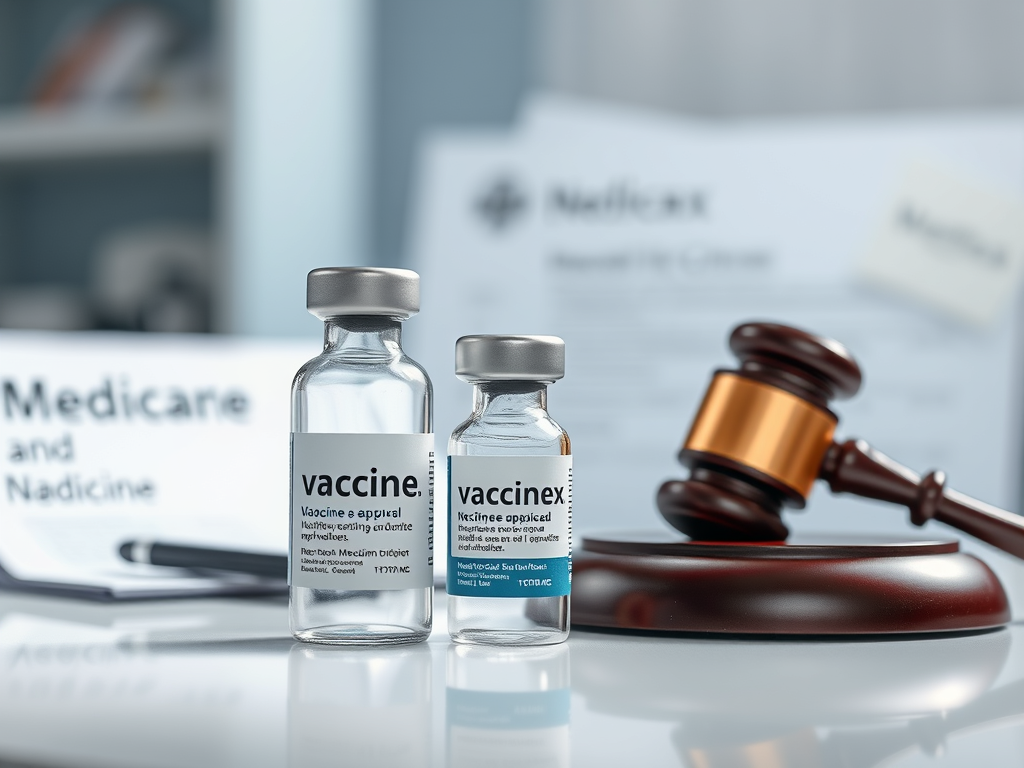
FDA APPROVES NOVAVAX COVID VACCINE WITH RESTRICTIONS
The FDA has granted full approval to Novavax’s COVID-19 vaccine but with notable restrictions. Unlike Pfizer and Moderna vaccines, which are fully licensed for anyone 12 and older and authorized for children as young as 6 months, Novavax’s vaccine is approved only for adults 65+ or for people aged 12–64 with underlying health conditions increasing COVID-19 risk. Previously, Novavax held emergency authorization for anyone 12 and older. The FDA’s approval letter did not explain these limits, reflecting possible skepticism influenced by Health Secretary Robert F. Kennedy Jr. and former Trump administration officials. Novavax’s vaccine was shown to be safe and effective in a large 30,000-person trial and was expected to gain unrestricted approval by April 1. However, the FDA requested an additional trial after approval, an unusual move, and mandated further studies on potential heart risks and the vaccine’s benefit in lower-risk 50–64-year-olds. Novavax CEO welcomed the approval as a step toward seasonal vaccination for vulnerable populations. (AP)
US ADVOCATES FIGHT HOUSE REPUBLICAN BILL CUTTING MEDICAID
U.S. advocacy groups are fiercely opposing a House Republican bill proposing \$880 billion in Medicaid and Obamacare cuts, which could strip insurance from 13 million Americans. The bill adds work requirements to Medicaid—a public program serving 71 million low-income, disabled, and elderly people—aiming to save \$715 billion. However, studies show work mandates burden beneficiaries without increasing employment, disproportionately harming sick and disabled individuals. Even some Republicans, like Senator Josh Hawley, criticize the approach as politically and morally wrong. The bill also seeks to end Affordable Care Act premium tax credits, making insurance less affordable. Advocates argue most Medicaid recipients who can work already do and emphasize that health is essential for employment. Health Secretary Robert F. Kennedy Jr. defended the bill, focusing on able-bodied adults refusing work. The Biden administration has rolled back state work requirements due to their negative impacts. The bill passed committee with a Memorial Day deadline for full House consideration. (The Guardian)
TRUMP ADMINISTRATION CUTS SCIENCE RESEARCH FIGHTBACK PLANS EMERGE
The Trump administration’s early tenure brought drastic cuts to U.S. scientific and medical research, threatening progress in vaccines, climate science, addiction treatment, and more. Experts suggest various ways to counter these setbacks. Key strategies include protecting vaccination programs amid politicization, innovating state-level policies like Hawaii’s climate impact fee, and scientists actively speaking out against misinformation. Legal actions have restored critical public health resources removed from federal websites. Scientific societies have stepped up to disseminate research independently. Effective charitable giving can mitigate global health losses caused by funding cuts. New collaborative funding models, akin to mini-NIH entities, could stabilize research support. Advocates urge using opioid settlement funds for addiction care and emphasize patient-led research, especially for emerging diseases like long Covid. Humanitarian organizations need support as government aid wanes. Building new scientific alliances, restoring research for vulnerable groups, and direct political engagement through calls to representatives are crucial to safeguarding America’s science and health future. (New York Times)
PHILADELPHIA BABY TREATED WITH PERSONALIZED CRISPR BREAKTHROUGH
Researchers in Philadelphia have successfully treated a 6-month-old baby, KJ, with a personalized CRISPR gene-editing therapy targeting an ultra-rare liver enzyme mutation that impairs ammonia conversion, a life-threatening condition. The rapid development—from mutation identification shortly after birth to clinical treatment at six months—marks a breakthrough in personalized medicine. The therapy uses mRNA delivered via lipid nanoparticles to correct the genetic defect, showing safety and efficacy in animal tests and regulatory approval within a week. Post-treatment, KJ’s condition improved significantly: he can tolerate more protein, his ammonia levels stabilized, and his growth percentiles increased. While not a complete cure and with ongoing monitoring needed, this case sets a precedent for treating other rare genetic disorders swiftly. Presented at the American Society of Gene & Cell Therapy meeting and published in the New England Journal of Medicine, experts hail this approach as a “platform technology” with potential to transform treatment for millions of patients with rare conditions. (Ars Technica)

SURGEONS COMPLETE WORLDS FIRST HUMAN BLADDER TRANSPLANT SUCCESSFULLY
Surgeons in Southern California have performed the world’s first human bladder transplant on 41-year-old Oscar Larrainzar, who had lost most of his bladder capacity due to rare bladder cancer treatments. The procedure, led by doctors from UCLA and USC, offers hope for patients suffering from severe bladder conditions, chronic pain, and recurrent infections. Traditional bladder removal often requires using bowel tissue to create a new urinary system, but this causes complications due to bacterial contamination and digestive issues. The new transplant technique preserves complex blood vessel connections by merging arteries and veins to simplify surgery and improve organ survival. Oscar’s surgery also included a kidney transplant and lasted eight hours. Remarkably, just days after surgery, he was able to urinate naturally for the first time in seven years—a milestone the surgeons described as a “miracle.” While immune suppression risks remain, this breakthrough could transform treatment options for bladder patients facing debilitating conditions. (New York Times)
RADBOUD UNIVERSITY SCIENTISTS REVISE UNIVERSE DECAY TIMELINE
Recent calculations by Radboud University scientists suggest the universe may be decaying far faster than previously believed. Their research focuses on Hawking radiation—a black-body radiation emitted near black holes causing their slow decay—and extends the concept to other celestial bodies like neutron stars and white dwarfs. Earlier estimates placed the lifetime of white dwarfs at around 10^1,100 years, but the new study dramatically reduces this to about 10^78 years. This marks a significant revision of the universe’s timeline toward its ultimate end, though the timeframe remains unimaginably long. The team also calculated the evaporation time for objects like the Moon and humans via Hawking-like radiation at about 10^90 years, noting that other physical processes would likely cause their disappearance sooner. Lead author Heino Falcke emphasized that while the universe’s final decay may occur sooner than thought, it still lies trillions of trillions of times beyond current cosmic scales. (CGTN)
CHINA LAUNCHES SATELLITES WITH FOUR HEAVENLY KINGS PATCHES
Mission patches have long been a tradition in spaceflight, often reflecting a mission’s identity or symbolism—but sometimes puzzling observers. Recently, China introduced striking new patches depicting the Four Heavenly Kings, Buddhist protector deities guarding the Dharma. These patches represent China’s secretive Tongxin Jishu Shiyan (TJS) series of communication technology test satellites launched since March. Positioned in geosynchronous orbit, the satellites are believed by U.S. officials to serve missile warning or reconnaissance purposes, possibly similar to U.S. early warning and inspection satellites. Ground trackers have observed objects separating from some TJS satellites, hinting at possible maneuvering or deployment of smaller spacecraft. The Four Heavenly Kings—each symbolizing protection in a cardinal direction—may metaphorically align with the satellites’ surveillance and defense roles, though this connection might also serve as deliberate misdirection. The U.S. Space Force closely monitors these satellites, with inspector satellites maneuvering nearby, highlighting ongoing orbital intrigue amid great-power competition in space. (Ars Technica)
JAPAN SUSPENDS POULTRY IMPORTS AFTER MONTENEGRO BIRD FLU OUTBREAK
Japan has suspended imports of poultry meat from Montenegro and live poultry from Rio Grande do Sul, Brazil, following the country’s first confirmed bird flu outbreak on a farm in Montenegro. The ban, effective since May 17, follows similar trade restrictions by China, the EU, and South Korea. Brazil, the world’s largest chicken exporter, supplies nearly 70% of Japan’s poultry meat imports—about 429,000 metric tons in fiscal 2024—and over half of China’s chicken imports. Japan’s poultry self-sufficiency rate is roughly 65%, but the outbreak may disrupt domestic markets amid rising food prices. Brazilian authorities, including state and federal agencies, have implemented strict containment measures, culling thousands of birds, destroying contaminated eggs, and establishing a task force to monitor over 500 nearby properties. Vibra Foods, operating the affected farm, acted quickly to incinerate and bury waste to curb the virus’s spread. The outbreak has heightened global concerns over poultry supply chains and disease control in major exporting regions. (Channel News Asia)
GIANT SEA BASS POPULATION RECOVERS USING PHOTO IDENTIFICATION METHOD
The giant sea bass, a massive fish reaching nearly 9 feet and over 500 pounds, has become a scientific icon thanks to its popularity among divers along California and Mexico’s coasts. Researchers used over 1,600 recreational photos taken between 2015 and 2022 to estimate the local population at around 1,221 adults—much higher than previous estimates based on fisheries data and genetics. Unique spot patterns serve as “fingerprints,” allowing algorithms to identify individual fish with high accuracy. This photographic approach offers a less invasive and community-engaging method of monitoring. The giant sea bass, once critically endangered and heavily fished until a 1982 California ban, is now showing signs of recovery. However, its low genetic diversity and limited migration may challenge adaptability amid climate change. As apex predators, they play a key ecological role maintaining balance in kelp forests and rocky reefs. Future plans include satellite tagging and cross-border collaboration to better understand and protect this charismatic species. (Nautilus)
Thanks for reading. Let’s be careful out there.
WORDS: The Biology Guy.




Leave a Reply