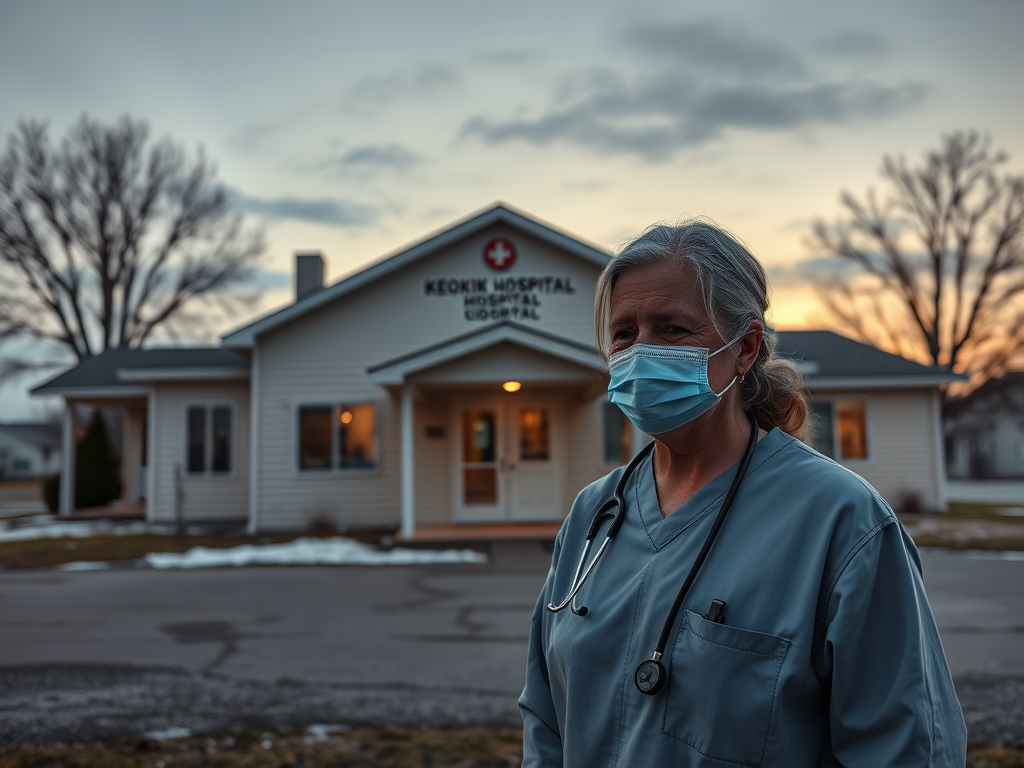
Even by rural hospital standards, Keokuk County Hospital and Clinics in southeastern Iowa is small.
The 14-bed hospital, in Sigourney, doesn’t do surgeries or deliver babies. The small 24-hour emergency room is overseen by two full-time doctors.
CEO Matt Ives wants to hire a third doctor, but he said finding physicians for a rural area has been challenging since the covid-19 pandemic. He said several physicians at his hospital have retired since the start of the pandemic, and others have decided to stop practicing certain types of care, particularly emergency care.
Another rural hospital is down the road, about a 40-minute drive east. Washington County Hospital and Clinics has 22 beds and is experiencing similar staffing struggles. “Over the course of the last few years, we’ve had not only the pandemic, but we’ve had kind of an aging physician workforce that has been retiring,” said Todd Patterson, CEO.
The pandemic was difficult for health workers. Many endured long hours, and the stresses on the nation’s health care system prompted more workers than usual to quit or retire.
“There’s a chunk of workers that were lost and won’t come back,” said Joanne Spetz, who directs the Institute for Health Policy Studies at the University of California-San Francisco. “For a lot of the clinicians that decided and were able to stick it out and work through the pandemic, they have burned out,” Spetz said.
Five years after the World Health Organization declared covid a global pandemic and the first Trump administration announced a national emergency, the United States faces a crucial shortage of medical providers, below the projected need for an aging population.
That could have lasting effects on care, particularly in states like Iowa with significant rural populations. Experts say the problem has been building for a while, but the effects of the pandemic accelerated the shortages by pushing many doctors over the edge into early retirement or other fields.
“Some of them made it through covid like ‘Let’s get us through this public health crisis,’ and then they came out of it saying, ‘OK, and now? Now I’m exhausted,’” said Christina Taylor, president of the Iowa Medical Society.
“Iowa is absolutely in the middle of a physician shortage,” Taylor said. “It’s a true crisis for us. We’re actually 44th in the country in terms of patient-to-physician ratio.”
A 2022 survey by the Centers for Disease Control and Prevention found a significant jump in health workers who reported feeling burned out and wanting a new job, compared with 2018. The number of people in health care has grown since the start of the pandemic, said Janette Dill, an associate professor at the University of Minnesota’s School of Public Health, but the growth has not happened fast enough.
“We have an aging population. We have a lot of needs,” she said.
The Association of American Medical Colleges projected last year that the U.S. faces a shortage of up to 86,000 physicians by 2036 — if lawmakers don’t invest more money in training doctors.
These shortages could push more people to seek care in ERs when they can’t see a local doctor, said Michael Dill, director of workforce studies at the AAMC.
“We’re already at a point where tens of millions of Americans every year can’t get medical care when they need it,” said Dill (no relation to Janette Dill). “If the shortage is sustained or gets even worse, then that problem gets worse too, and it disproportionately negatively impacts the most vulnerable amongst us.”
Iowa lawmakers made addressing the shortage a priority in the current legislative session. They introduced bills aimed at increasing medical student loan forgiveness and requesting federal help to add residency training slots for medical students in the state.
Sign up for the Daily Dose Newsletter and get every morning’s best science news from around the web delivered straight to your inbox? It’s easy like Sunday morning.
Last year, Gov. Kim Reynolds signed a bill into law that drops the residency requirement for some doctors who trained abroad to get a medical license. Lawmakers in at least eight other states have approved similar changes.
Patterson, of the Washington County hospital, appreciates that Iowa lawmakers are trying to increase the pipeline of doctors into Iowa but said it doesn’t address immediate shortages.
“You have a high school student who’s graduating right now; they’re probably nine to 11 years away from entering the workforce as a practicing physician. So it’s a long-term kind of problem,” he said.
For nurses, workforce experts say, the projected national outlook isn’t as dire as in recent years.
“Nursing education is back up. Nursing employment rates are back up. I think, for that workforce, we’ve largely nationally recovered from all the dislocations that occurred,” said Spetz, of the Institute for Health Policy Studies.
But getting nurses to move to the places that need them, like rural communities, will be difficult, she said.
Some rural hospitals in Iowa say an even bigger challenge right now is finding nurses to hire.
Some of that can be traced to the pandemic, said Sara Bruns, nurse manager at Keokuk County Hospital and Clinics. She recalled that some covid patients in critical condition died when they couldn’t be transferred to larger hospitals with more advanced intensive care unit equipment, because those hospitals didn’t have the staff to take on more patients.
“We had to make the horrible decision of ‘You’re probably not going to make it,’” Bruns recalled, saying many patients were then listed as DNR, for “do not resuscitate.”
“That took a big toll on a lot of nurses,” she said.
Another problem is persuading the area’s young nurses to stay, when they would rather live and work in more urban areas, Bruns said.
Her hospital still relies on contracts with travel nurses to fill some night shifts. That’s something the hospital never had to do before the pandemic, Bruns said. Travel nurses are more expensive, adding stress to a small hospital’s budget.
“I think some people just completely got out of nursing,” Bruns said. The pandemic took a special toll “because of the hours that they had to work, the conditions that they had to work.”
Policymakers and health care organizations can’t focus only on recruiting workers, according to Janette Dill at the University of Minnesota. “You also have to retain workers,” she said. “You can’t just recruit new people and then have them be miserable.”
Dill said workers report feeling that patients have been more disrespectful and challenging since the pandemic, and sometimes workers feel unsafe at work. “By ‘unsafe’ I mean physically unsafe. I think that is a very stressful part of the job,” she said.
Research has shown health workers reporting higher levels of burnout and poor mental health since the pandemic — though the risks decreased if workers felt supported by their managers.
Gail Grimes, an intensive care nurse in Des Moines, felt more supported by her employer during the worst parts of the pandemic than she does now, she said. Some hospitals offered pay bumps and more scheduling flexibility to keep nurses on staff.
“We were getting better bonus pay,” Grimes recalled. “We were getting these specialized contracts we could fulfill that were often more worth our time to be able to come in, to miss our families and be there.”
Grimes said she’s seen nurses leave Iowa for neighboring states with better average pay. This creates shortages that she believes affect the care she gives her own patients.
“A nurse taking care of five patients will always be able to provide better care than a nurse taking care of 10 patients,” she said.
She thinks many hospitals have simply accepted staff burnout as a fact, rather than try to prevent it.
“It really is significantly impactful to your mental health when you come home every day and you feel guilty about the things you have not been able to provide to people,” she said.
This article is from a partnership that includes IPR, NPR, and KFF Health News. It originally appeared in KFF Health News.
WORDS: Natalie Krebs, Iowa Public Radio
If you enjoy the content we create and would like to support us, please consider becoming a patron on Patreon! By joining our community, you’ll gain access to exclusive perks such as early access to our latest content, behind-the-scenes updates, and the ability to submit questions and suggest topics for us to cover. Your support will enable us to continue creating high-quality content and reach a wider audience.
Join us on Patreon today and let’s work together to create more amazing content! https://www.patreon.com/ScientificInquirer


Leave a Reply