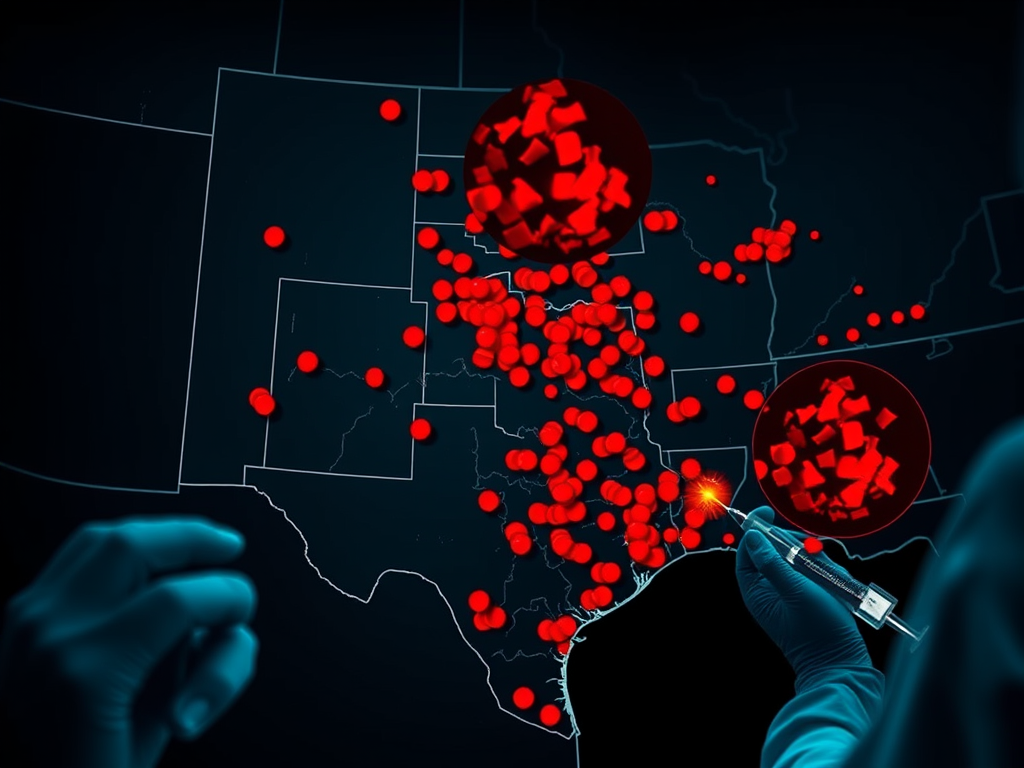
MEASLES OUTBREAK SPREADS ACROSS WEST TEXAS NEW MEXICO OKLAHOMA
A measles outbreak across West Texas, New Mexico, and Oklahoma has led to 258 confirmed cases, with 223 cases reported in Texas, 33 in New Mexico, and 2 in Oklahoma. Health officials have linked the outbreaks in these states through geographic connections and strain identification via genome sequencing. The outbreak continues to spread, with experts noting that these numbers are likely an undercount, especially in communities with low vaccination rates. Texas has seen 29 hospitalizations, with 156 cases in Gaines County, where the outbreak started. The first death, a school-age unvaccinated child, was reported last month. In New Mexico, 32 cases are in Lea County, with one case in Eddy County. Health officials warn that the highly contagious virus is likely to spread further. With cases already nearing last year’s total, experts predict the outbreak will continue for several more months, potentially surpassing 2025’s case numbers. (CNN)
COVID-19 PANDEMIC LINKED TO DEVELOPMENTAL DECLINES IN KINDERGARTNERS
A study in *JAMA Pediatrics* reveals developmental health trends among US kindergartners before and during the COVID-19 pandemic, highlighting significant declines in certain areas. Using data from the Early Development Instrument (EDI) on 475,740 children across 19 states, researchers found no significant changes in physical health and well-being, but declines in communication, language, cognitive development, and social competence between 2021 and 2023 compared to the prepandemic period (2018-2020). Communication and general knowledge saw a drop of 0.21 points, language and cognitive development dropped 0.47 points, and social competence decreased by 0.03 points. The study emphasizes the need for early childhood policies to address both pre-existing challenges and the added stressors from the pandemic, particularly in areas critical for young children’s development. (CIDRAP)
MUSK CLAIMS UKRAINIAN BAD ACTORS BEHIND CYBERATTACK ON X
Elon Musk claimed that a cyberattack on his social media platform X, formerly Twitter, was caused by “bad actors” from Ukraine, based on IP addresses from the region. He acknowledged that the cause of the attack remains unclear but suggested a large, coordinated group or a nation may be involved. The attack led to widespread outages reported by DownDetector, with Musk confirming the platform was under a cyberattack. Rumors circulated that a distributed denial-of-service (DDoS) attack was to blame, a type of attack that has spiked in 2025. Despite Musk’s allegations, he did not accuse the Ukrainian government of involvement. Meanwhile, users continued to refer to the platform as “Twitter,” with hashtags like #MyTwitter trending, showing resistance to the rebrand to X. Musk’s efforts to eliminate the Twitter brand have faced backlash, and users continue to debate whether they’ll ever fully embrace the X name. (Ars Technica)
Biorxiv AND MEDRXIV PREPRINT SERVERS REBRAND TO OPENRXIV
BioRxiv and medRxiv, preprint servers that have accelerated scientific communication in the biomedical field, will now operate under a new nonprofit, openRxiv. The goal of openRxiv is to expand the use of preprints, increase submissions from the Global South, and improve the vetting process. The servers, previously managed by Cold Spring Harbor Laboratory (CSHL), will continue operations with a focus on enhancing technological capabilities, fundraising, and outreach. Key changes include setting up a broader governing board to represent the scientific community. The initiative has received funding from the Chan Zuckerberg Initiative and other donors. Despite potential financial risks, the move allows for more freedom and growth. Preprints on the servers saw a surge during the COVID-19 pandemic and continue to grow, with significant outreach efforts planned to include more global submissions. Additionally, openRxiv will experiment with more preprint vetting to address concerns about unreviewed findings in medical research. (Science)

NASA LAYS OFF 23 EMPLOYEES IN STRATEGIC OFFICE CLOSURES
NASA has closed its Office of the Chief Scientist, Office of Technology, Policy and Strategy, and the diversity branch of its Office of Diversity and Equal Opportunity, leading to the layoff of 23 employees. This move, announced on 10 March, comes as part of a larger federal government downsizing initiative led by President Trump and adviser Elon Musk, aimed at improving efficiency. These layoffs mark NASA’s first under the Trump administration and are distinct from cuts at other agencies, as NASA preemptively terminated career employees rather than probationary staff. The closure of the offices, particularly the Office of the Chief Scientist, is seen as a loss of strategic thinking and a setback for NASA’s future planning, especially as the agency looks toward missions like sending astronauts to the Moon and Mars. The Office of Technology, Policy and Strategy and its work on space-related issues, including AI and debris management, will also cease. The firings have left employees shocked and uncertain about NASA’s direction. (Nature)
NSSA URGES CONGRESS TO INCREASE SPACE FORCE BUDGET TO $60 BILLION
The National Security Space Association (NSSA) has released a position paper urging Congress to increase the U.S. Space Force budget to $60 billion for the FY 2026-2030 Future Years Defense Program (FYDP). The proposed budget is critical to counter the growing threats from China and Russia, which have advanced counterspace capabilities, cyber warfare tactics, and anti-satellite weapons that undermine U.S. national security. NSSA highlights China’s expansion of military space assets and Russia’s development of space-based threats. To maintain U.S. space dominance, the NSSA advocates for a phased budget increase to enhance missile warning, counterspace operations, satellite communications, and rapid launch capabilities. The paper also calls for legislative reforms to improve procurement efficiency and accelerate technology deployment, as well as stronger partnerships with the commercial space sector. NSSA urges Congress to integrate these recommendations into the FY 2026 budget and secure long-term bipartisan support for Space Force funding. (Space Daily)
NASA LAUNCHES SPHEREX AND PUNCH MISSIONS TO STUDY COSMOS AND SPACE WEATHER
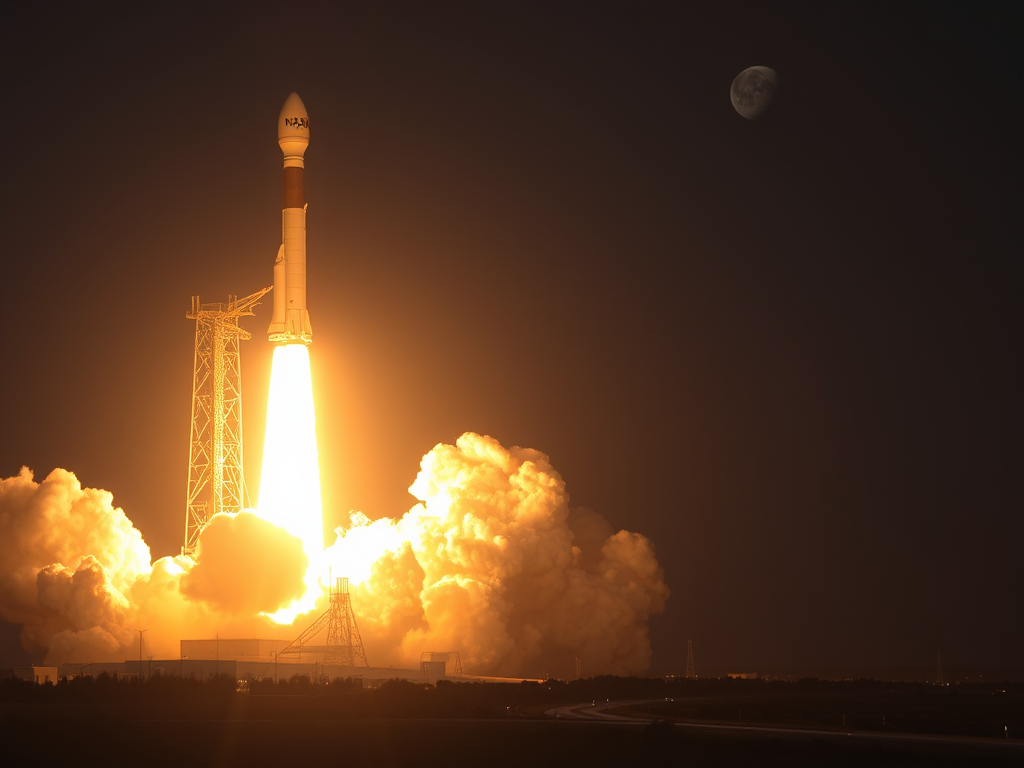
NASA successfully launched two missions late Tuesday night from California’s Vandenberg Space Force Base after overcoming multiple delays. The first mission, SPHEREx, is a space telescope that will survey the entire sky in over a hundred colors of infrared light, aiming to study the evolution of galaxies, the origins of water in the Milky Way, and the physics behind the universe’s rapid inflation post-Big Bang. SPHEREx will create a 3D map of galaxy distribution and capture millions of stellar and galactic images. Accompanying SPHEREx is PUNCH (Polarimeter to Unify the Corona and Heliosphere), a set of four satellites tasked with studying the sun’s corona and solar wind. PUNCH will track the solar wind’s interaction with the solar system, helping predict space weather effects. Together, these missions aim to expand our understanding of the cosmos and space weather, with SPHEREx mapping the sky and PUNCH examining the solar atmosphere. (New York Times)
ASTRONOMERS DISCOVER 128 NEW MOONS ORBITING SATURN
Astronomers have discovered 128 new moons orbiting Saturn, bringing the planet’s total to 274 moons, nearly double the number of moons around all other planets combined. This discovery gives Saturn the lead in the solar system’s moon tally, surpassing Jupiter, which currently has 95 confirmed moons. The moons were found using the “shift and stack” technique and are all irregular, potato-shaped objects a few kilometers across. Most of the new moons belong to the Norse cluster, and future naming will include gods from Gallic, Norse, and Canadian Inuit mythology. These tiny moons are believed to be remnants of larger objects that collided and shattered within the past 100 million years. The discoveries may offer insights into the early solar system’s turbulent period. Additionally, the European Space Agency’s Hera spacecraft will fly by Mars and observe its moons, Deimos and Phobos, before continuing its mission to study an asteroid. (The Guardian)
ASTRONOMERS DISCOVER TINY GALAXIES AROUND ANDROMEDA CHALLENGING COSMIC EVOLUTION THEORIES
Astronomers have discovered a collection of tiny, faint galaxies around Andromeda, including the smallest ever seen, Andromeda XXXV. Located about 3 million light-years away, these dwarf galaxies challenge existing theories about cosmic evolution. Unlike expected, Andromeda XXXV survived the hot, dense conditions of the early universe that typically destroyed small galaxies. While most dwarf galaxies stopped star formation billions of years ago, Andromeda XXXV continued to form stars until about 6 billion years ago, suggesting its gas supply was not exhausted on its own, but rather stripped away by its parent galaxy, Andromeda. This raises questions about whether smaller galaxies can survive such extreme conditions, as Andromeda XXXV defied expectations by maintaining star formation long after most of its peers. This discovery, based on observations using the Hubble Space Telescope, opens new avenues for understanding galaxy formation and evolution, potentially altering our knowledge of the universe’s early history. (space.com)
Thanks for reading. Let’s be careful out there.
WORDS: The Biology Guy.


Leave a Reply