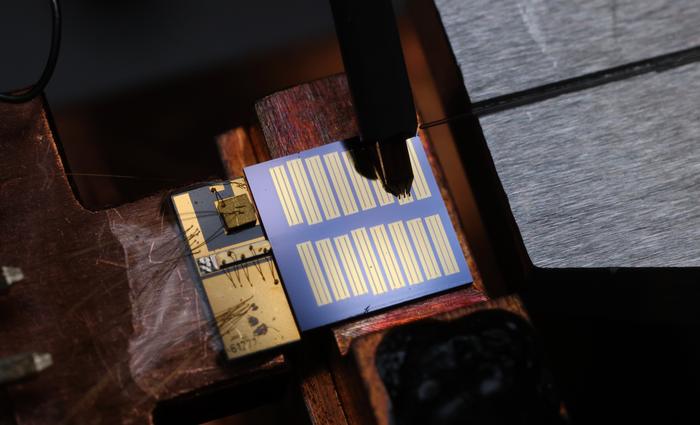
In the world of modern optics, frequency combs are invaluable tools. These devices act as rulers for measuring light, enabling breakthroughs in telecommunications, environmental monitoring, and even astrophysics. But building compact and efficient frequency combs has been a challenge—until now.
Electro-optic frequency combs, introduced in 1993, showed promise in generating optical combs through cascaded phase modulation but progress slowed down because of their high power demands and limited bandwidth. This led to the field being dominated by femtosecond lasers and Kerr soliton microcombs, which, while effective, require complex tuning and high power, limiting field-ready use.
But recent advances in thin-film electro-optic integrated photonic circuits have renewed interest, with materials like lithium niobate. Nonetheless, achieving broader bandwidth with lower power has remained a challenge, the intrinsic birefringence (splitting light beams) of the lithium niobate also sets a upper limit for the achievable bandwidth.
Scientists at EPFL, the Colorado School of Mines and the China Academy of Science, has now tackled this by combining microwave and optical circuit designs on the newly developed lithium tantalate platform, compared with lithium niobate, the lithium tantalate features 17 times lower intrinsic birefringence. Led by Professor Tobias J. Kippenberg, the researchers developed an electro-optic frequency comb generator that achieves an unprecedented 450 nm spectral coverage with over 2000 comb lines. The breakthrough expands the device’s bandwidth and reduces microwave power requirements almost 20-fold compared to previous designs.
The team introduced a “integrated triply resonant” architecture, where three interacting fields—two optical and one microwave—resonate in harmony. This was achieved using a novel co-designed system that integrates monolithic microwave circuits with photonic components. By embedding a distributed coplanar waveguide resonator on lithium tantalate photonics integrated circuits, the team significantly improved microwave confinement and energy efficiency.
The device’s compact size, fitting within a 1×1 cm² footprint, was made possible by leveraging lithium tantalate’s lower birefringence. This minimizes interference between light waves, which enables smooth and consistent frequency comb generation. Additionally, the device operates using a simple, free-running distributed feedback laser diode, making it far more user-friendly than its Kerr soliton counterparts.
Sign up for the Daily Dose Newsletter and get every morning’s best science news from around the web delivered straight to your inbox? It’s easy like Sunday morning.
The new comb generator’s ultra-broadband span, covering 450 nm, exceeds the limits of current electro-optic frequency comb technologies. It achieves this with stable operation across 90% of the free spectral range, eliminating the need for complex tuning mechanisms. This stability and simplicity open the door to practical, field-deployable applications.
The new device can be a paradigm shift in the world of photonics. With its robust design and compact footprint, it can impact areas like robotics, where precise laser ranging is crucial, and environmental monitoring, where accurate gas sensing is essential. Moreover, the success of this co-design methodology highlights the untapped potential of integrating microwave and photonic engineering for next-generation devices.
All samples were fabricated in the EPFL Center of MicroNanoTechnology (CMi) and the Institute of Physics (IPHYS) cleanroom. The LTOI wafers were fabricated in Shanghai Novel Si Integration Technology (NSIT) and the SIMIT-CAS.
IMAGE CREDIT:



Leave a Reply