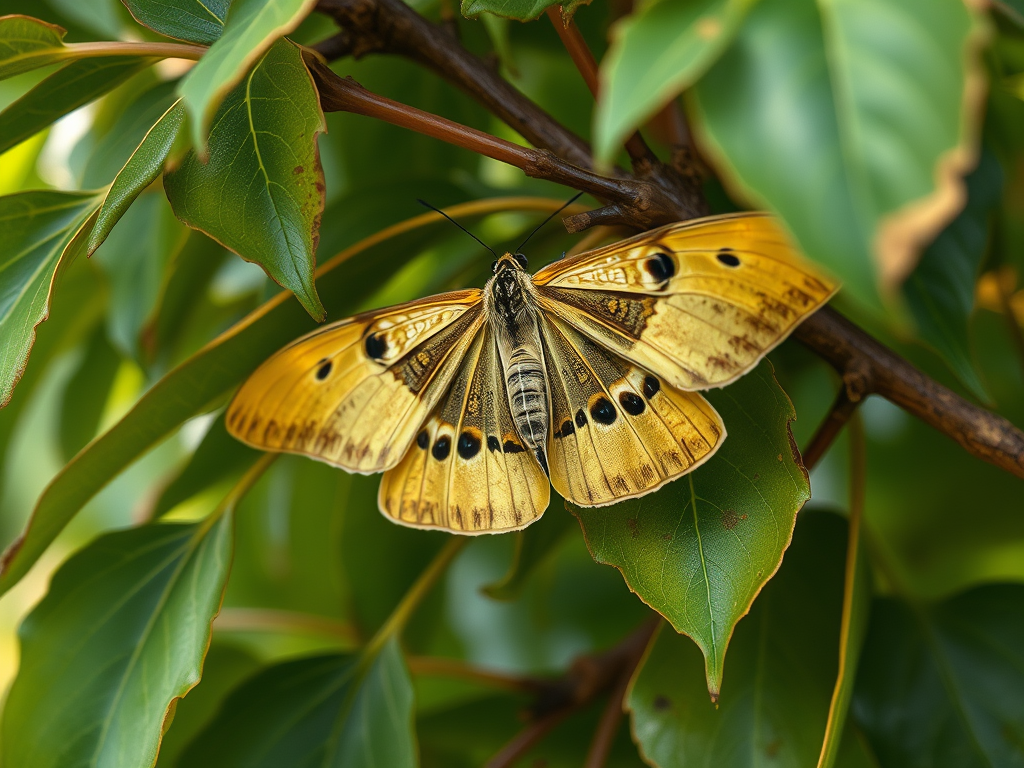
Computer models developed by the University of Chicago and Argonne National Laboratory predict that hotter, drier conditions in North America will limit the growth of a fungus that normally curbs the spread of the spongy moth, an invasive species that has caused millions of dollars in damage to forests.
The research, published in Nature Climate Change, emphasizes the importance of accounting for multiple organisms and their interactions when predicting the potential impacts of climate change, as warmer temperatures cause unexpected domino effects in ecosystems.
“The vast majority of previous climate change studies look at individual organisms, but a small amount of climate change can have a big effect when you compound it across multiple species,” said Greg Dwyer, PhD, Professor of Ecology and Evolution at UChicago and senior author of the new study. “So, computer models are crucial for understanding the effects of climate change on species interactions.”
The spongy moth (Lymantria dispar) was first introduced to the hardwood forests of New England in 1869. Native to Europe, female moths lay eggs on surfaces like branches, stacked firewood, and outdoor furniture. The eggs tend to come with these objects when people move them, so the insect has spread far from where it was first accidentally released in Massachusetts. Spongy moth caterpillars feed on the leaves of trees and shrubs, especially oak trees. For decades after their introduction, the caterpillars carved a path of destruction through forests, defoliating and killing trees by the acre.
In 1989, a lethal infection caused by the fungus Entomophaga maimaiga began spreading among spongy moths. This fungus is also not native to North America, but no one knows for sure how and when it arrived. It might have been introduced deliberately to control the moths, or it might have been accidentally brought into the US from Japan, where it originates. Nevertheless, it has managed to keep spongy moths in check ever since, sparing millions of trees.
Another pathogen, the nucleopolyhedrovirus (NPV), can also keep the insect in check, but it needs large populations to spread. The natural advantage of the fungus is that it can grow and infect moths in small numbers before too much damage has been done, but only if conditions are cool and moist.
Sign up for the Daily Dose Newsletter and get every morning’s best science news from around the web delivered straight to your inbox? It’s easy like Sunday morning.
“Even small reductions in mortality rate for the moths lead to big increases in defoliation,” Dwyer said. “If they don’t get killed off when they’re at low density one year, then the next year they’ll be back at higher density. You get this multiplication process going on.”
Dwyer has spent his career modeling interactions among infectious diseases and various species, from wild rabbits to insects. In 2004, in one of his first publications at UChicago, he developed a model that accounted for the spongy moth, its predators like mice and squirrels, and NPV infection rates. In 2020, his lab designed more models to explore how the density of moth populations and weather conditions affect outbreaks of the E. maimaiga fungus. Those models showed that incorporating climate data produced much better predictions than models that don’t account for climate, planting a seed for the new study.
Dwyer and his student Jiawei Liu worked with Jiali Wang, PhD, an atmospheric scientist in the Environmental Science Division at Argonne National Laboratory, and Rao Kotamarthi, PhD, Chief Scientist for the Environmental Science Division at Argonne, to incorporate more precise climate data into new models for spongy moth infestations. Wang and Kotamarthi specialize in taking large scale climate change models, say for all North America, and downscaling them to smaller regions, like one portion of a state. This allowed Dwyer’s team to account for more nuanced differences in weather patterns and insect populations across multiple regions.
The resulting predictions were dispiriting. As climate change brings hotter and drier conditions to forests, fungal infection rates over the next few decades will drop sharply—meaning that more moths will survive to destroy more trees. While that seems far in the future, below average rainfall and above average temperatures in recent years have already led to big spongy moth outbreaks, which Dwyer said he didn’t expect to happen so soon.
“Our projections were pessimistic, but probably not pessimistic enough. It’s very concerning,” he said.




Leave a Reply