LOS ANGELES — President-elect Donald Trump’s promise of mass deportations and tougher immigration restrictions is deepening mistrust of the health care system among California’s immigrants and clouding the future for providers serving the state’s most impoverished residents.
At the same time, immigrants living illegally in Southern California told KFF Health News they thought the economy would improve and their incomes might increase under Trump, and for some that outweighed concerns about health care.
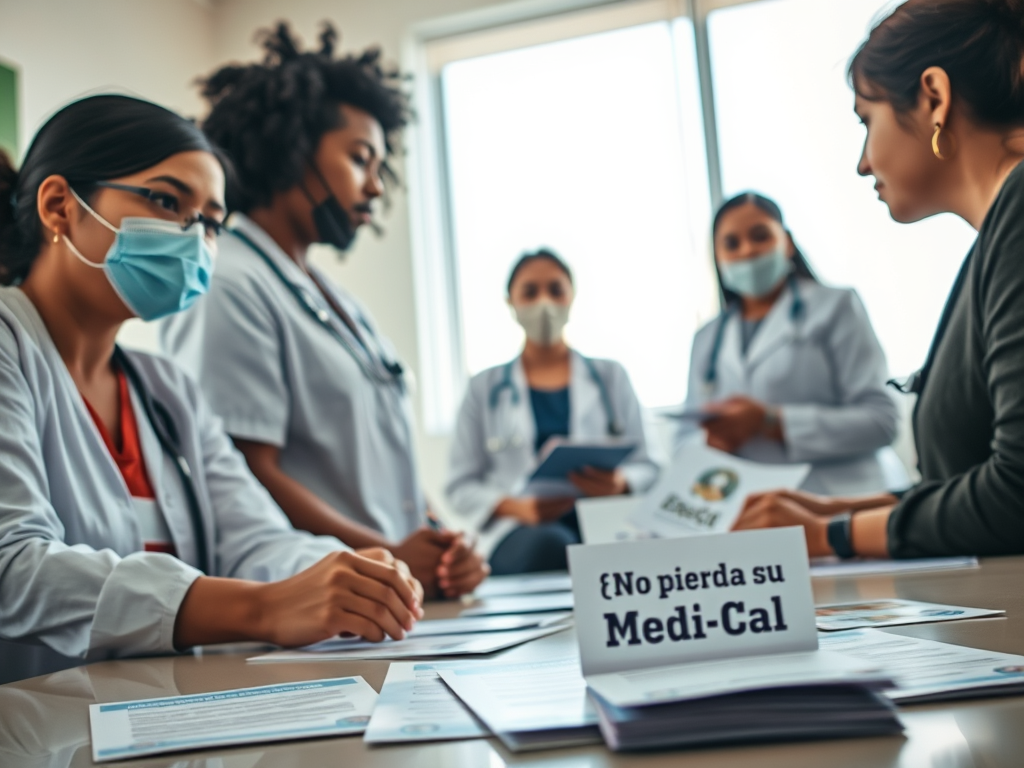
Community health workers say fear of deportation is already affecting participation in Medi-Cal, the state’s Medicaid program for low-income residents, which was expanded in phases to all immigrants regardless of residency status over the past several years. That could undercut the state’s progress in reducing the uninsured rate, which reached a record low of 6.4% last year.
Immigrants lacking legal residency have long worried that participation in government programs could make them targets, and Trump’s election has compounded those concerns, community advocates say.
The incoming Trump administration is also expected to target Medicaid with funding cuts and enrollment restrictions, which activists worry could threaten the Medi-Cal expansion and kneecap efforts to extend health insurance subsidies under Covered California to all immigrants.

“The fear alone has so many consequences to the health of our communities,” said Mar Velez, director of policy with the Latino Coalition for a Healthy California. “This is, as they say, not their first rodeo. They understand how the system works. I think this machine is going to be, unfortunately, a lot more harmful to our communities.”
Alongside such worries, though, is a strain of optimism that Trump might be a boon to the economy, according to interviews with immigrants in Los Angeles whom health care workers were soliciting to sign up for Medi-Cal.
Selvin, 39, who, like others interviewed for this article, asked to be identified by only his first name because he’s living here without legal permission, said that even though he believes Trump dislikes people like him, he thinks the new administration could help boost his hours at the food processing facility where he works packing noodles. “I do see how he could improve the economy. From that perspective, I think it’s good that he won.”
He became eligible for Medi-Cal this year but decided not to enroll, worrying it could jeopardize his chances of changing his immigration status.
“I’ve thought about it,” Selvin said, but “I feel like it could end up hurting me. I won’t deny that, obviously, I’d like to benefit — get my teeth fixed, a physical checkup.” But fear holds him back, he said, and he hasn’t seen a doctor in nine years.
It’s not Trump’s mass deportation plan in particular that’s scaring him off, though. “If I’m not committing any crimes or getting a DUI, I think I won’t get deported,” Selvin said.
Petrona, 55, came from El Salvador seeking asylum and enrolled in Medi-Cal last year.
She said that if her health insurance benefits were cut, she wouldn’t be able to afford her visits to the dentist.
A street food vendor, she hears often about Trump’s deportation plan, but she said it will be the criminals the new president pushes out. “I’ve heard people say he’s going to get rid of everyone who’s stealing.”
Although she’s afraid she could be deported, she’s also hopeful about Trump. “He says he’s going to give a lot of work to Hispanics because Latinos are the ones who work the hardest,” she said. “That’s good, more work for us, the ones who came here to work.”
Newly elected Republican Assembly member Jeff Gonzalez, who flipped a seat long held by Democrats in the Latino-heavy desert region in the southeastern part of the state, said his constituents were anxious to see a new economic direction.
“They’re just really kind of fed up with the status quo in California,” Gonzalez said. “People on the ground are saying, ‘I’m hopeful,’ because now we have a different perspective. We have a businessperson who is looking at the very things that we are looking at, which is the price of eggs, the price of gas, the safety.”
Sign up for the Daily Dose Newsletter and get every morning’s best science news from around the web delivered straight to your inbox? It’s easy like Sunday morning.
Gonzalez said he’s not going to comment about potential Medicaid cuts, because Trump has not made any official announcement. Unlike most in his party, Gonzalez said he supports the extension of health care services to all residents regardless of immigration status.

Health care providers said they are facing a twin challenge of hesitancy among those they are supposed to serve and the threat of major cuts to Medicaid, the federal program that provides over 60% of the funding for Medi-Cal.
Health providers and policy researchers say a loss in federal contributions could lead the state to roll back or downsize some programs, including the expansion to cover those without legal authorization.
California and Oregon are the only states that offer comprehensive health insurance to all income-eligible immigrants regardless of status. About 1.5 million people without authorization have enrolled in California, at a cost of over $6 billion a year to state taxpayers.
“Everyone wants to put these types of services on the chopping block, which is really unfair,” said state Sen. Lena Gonzalez, a Democrat and chair of the California Latino Legislative Caucus. “We will do everything we can to ensure that we prioritize this.”
Sen. Gonzalez said it will be challenging to expand programs such as Covered California, the state’s health insurance marketplace, for which immigrants lacking permanent legal status are not eligible. A big concern for immigrants and their advocates is that Trump could reinstate changes to the public charge policy, which can deny green cards or visas based on the use of government benefits.
“President Trump’s mass deportation plan will end the financial drain posed by illegal immigrants on our healthcare system, and ensure that our country can care for American citizens who rely on Medicaid, Medicare, and Social Security,” Trump spokesperson Karoline Leavitt said in a statement to KFF Health News.
During his first term, in 2019, Trump broadened the policy to include the use of Medicaid, as well as housing and nutrition subsidies. The Biden administration rescinded the change in 2021.
KFF, a health information nonprofit that includes KFF Health News, found immigrants use less health care than people born in the United States. And about 1 in 4 likely undocumented immigrant adults said they have avoided applying for assistance with health care, food, and housing because of immigration-related fears, according to a 2023 survey.
Another uncertainty is the fate of the Affordable Care Act, which was opened in November to immigrants who were brought to the U.S. as children and are protected by the Deferred Action Childhood Arrivals program. If DACA eligibility for the act’s plans, or even the act itself, were to be reversed under Trump, that would leave roughly 40,000 California DACA recipients, and about 100,000 nationwide, without access to subsidized health insurance.
On Dec. 9, a federal court in North Dakota issued an order blocking DACA recipients from accessing Affordable Care Act health plans in 19 states that had challenged the Biden administration’s rule.
Clinics and community health workers are encouraging people to continue enrolling in health benefits. But amid the push to spread the message, the chilling effects are already apparent up and down the state.
“¿Ya tiene Medi-Cal?” community health worker Yanet Martinez said, asking residents whether they had Medi-Cal as she walked down Pico Boulevard recently in a Los Angeles neighborhood with many Salvadorans.
“¡Nosotros podemos ayudarle a solicitar Medi-Cal! ¡Todo gratuito!” she shouted, offering help to sign up, free of charge.
“Gracias, pero no,” said one young woman, responding with a no thanks. She shrugged her shoulders and averted her eyes under a cap that covered her from the late-morning sun.
Since Election Day, Martinez said, people have been more reluctant to hear her pitch for subsidized health insurance or cancer prevention screenings.
“They think I’m going to share their information to deport them,” she said. “They don’t want anything to do with it.”

This article was produced by KFF Health News, which publishes California Healthline, an editorially independent service of the California Health Care Foundation.
WORDS: Vanessa G. Sánchez: vsanchez@kff.org, @vanesanchez_g
If you enjoy the content we create and would like to support us, please consider becoming a patron on Patreon! By joining our community, you’ll gain access to exclusive perks such as early access to our latest content, behind-the-scenes updates, and the ability to submit questions and suggest topics for us to cover. Your support will enable us to continue creating high-quality content and reach a wider audience.
Join us on Patreon today and let’s work together to create more amazing content! https://www.patreon.com/ScientificInquirer




Leave a Reply