The international team, led by Distinguished Chair Professor Chuan-Chou Shen of the Department, of Geosciences, National Taiwan University, uncovered Nan Madol’s history by analyzing the ages of the site’s coral rubbles. The research found that subsidence-related sea level rise and climate change posed serious threated to the construction and maintenance of Nan Madol, ultimately leading to the collapse of the chiefdom and abandonment of the site.
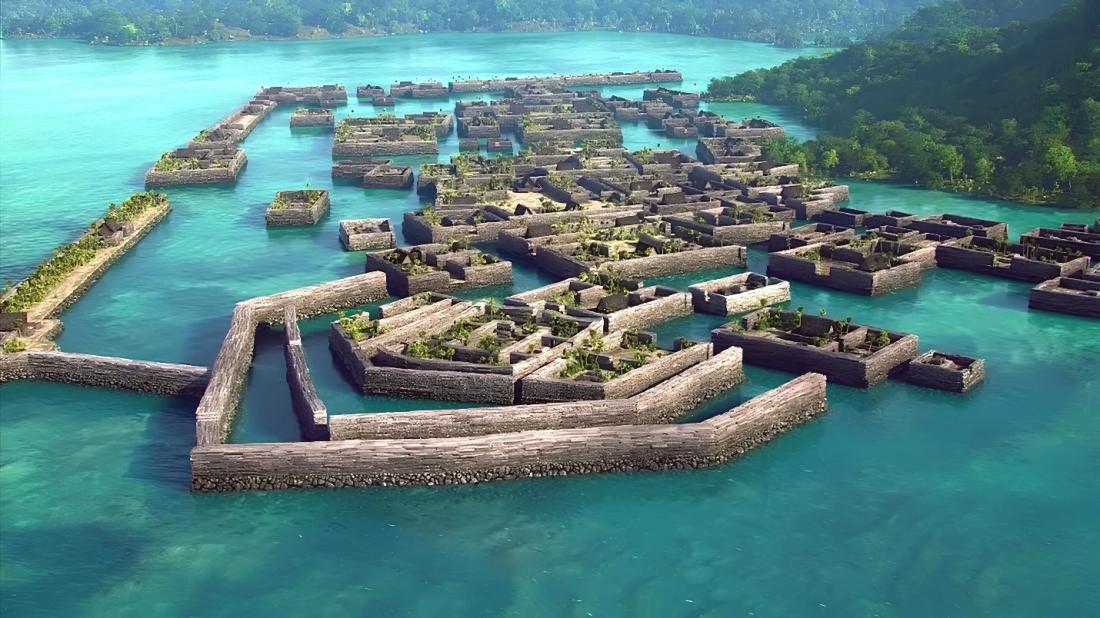
On the eastern coast of Pohnpei Island, Micronesia, lies the abandoned ruin of Nan Madol, the capital of the ancient Saudeleur Dynasty. Comprising over a hundred artificial islets, it resembles a floating city on the sea, referred to as the “Venice of the Pacific”. Nan Madol utilized nearly a million tons of columnar basalt and coral rubbles and covers approximately 18 square kilometers. The chronology and the possible impact of climate change on its development were still unclear.
The international team, led by Distinguished Chair Professor Chuan-Chou Shen of the Department, of Geosciences, National Taiwan University, uncovered Nan Madol’s history by analyzing the ages of the site’s coral rubbles. The research found that subsidence-related sea level rise and climate change posed serious threated to the construction and maintenance of Nan Madol, ultimately leading to the collapse of the chiefdom and abandonment of the site. It imparts valuable lessons for our future, especially for island nations. This study was published in PNAS Nexus, a sibling journal to the Proceedings of the National Academy of Sciences (PNAS), on October 1st (1) and highlighted by Science on October 25th (2).
Evidence shows that two major construction phases spanning from the 10th to the 15th century CE can be discerned. The first phase, spanning the 10th-12th century, marked the dynasty’s rise. The second period, spanning from the late 12th to the early 15th century, provides the most substantial evidence for the demise of the island-scale chiefdom. The phases are centuries earlier than previously believed.
Sign up for the Daily Dose Newsletter and get every morning’s best science news from around the web delivered straight to your inbox? It’s easy like Sunday morning.
Pohnpei Island, formed by volcanic magma, has been slowly cooling over time, causing the island’s landmass to contract and sink at a rate of 1 millimeter per year, leading to a relative sea level rise. Particularly during the second construction phase, the site was already below the average sea level. Additionally, more than a century of severe Pacific climate oscillations, especially during La Niña years, brought strong easterly winds that elevated sea level in the western Pacific. Violent surges from the east induced significant seawater intrusion, damaging compounds and making maintenance and repair a major challenge and heavy burden. Ultimately, accumulated public resentment led to the dynasty’s sudden overthrow. The once-glorious Nan Madol was eventually abandoned.
This case serves as a stark warning for us. With the ongoing intensification of climate oscillations in the Pacific and Indian Oceans, coupled with the global warming induced sea level rise, more islands will face the threat of being submerged and the number of climate refugees is expected to surge dramatically in the coming decades. Curbing global warming to mitigate the induced disasters is our most essential task at present.
IMAGE CREDIT: National Taiwan University.

Leave a Reply