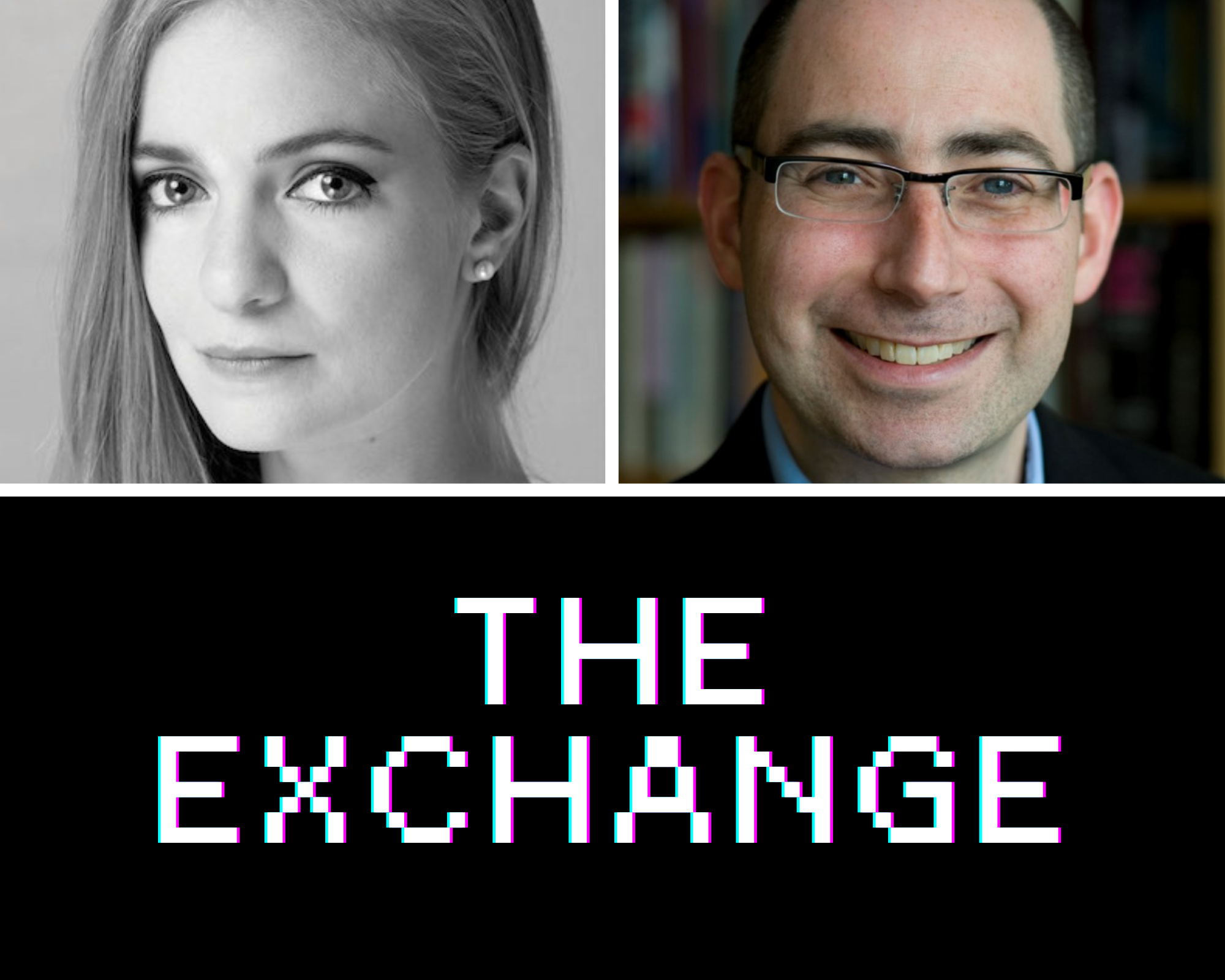
In this edition of The Exchange, we bring together the worlds of ballet and physics with a conversation between San Francisco Ballet principal dancer Sasha de Sola and physicist Prof. David I. Kaiser. Sasha poses a compelling question about the nature of time and its potential influence on human creativity and innovation, drawing from Einstein’s theory of relativity. Prof. Kaiser explores these ideas in relation to physics, while posing a fascinating return question to Sasha, asking how ballet can be used to explore scientific or social themes. What unfolds is a rich dialogue bridging the boundaries between movement, spacetime, and human expression.
Sasha De Sola is a principal dancer with the San Francisco Ballet. Born in Winter Park, Florida, De Sola joined the company in 2006 and quickly rose through the ranks, becoming a soloist in 2012 and principal dancer in 2017. Known for her powerful performances in Swan Lake, Cinderella, and Giselle, De Sola’s artistry shines on stage.
Now, as an inaugural fellow of SF Ballet’s Raising Leaders program, De Sola will explore leadership within the arts sector. This two-year fellowship includes executive coaching and an opportunity to shadow Artistic Director Nicolas le Riche at the Royal Swedish Ballet, equipping her to lead in the ballet world beyond her performance career.
This month’s Exchange also features David I. Kaiser, a physicist and historian of science at MIT. Renowned for his expertise in the history of modern physics, Kaiser has a unique ability to bridge the worlds of science and history, shedding light on how ideas about the universe have evolved over time. He is the Germeshausen Professor of the History of Science and a Professor of Physics, contributing to MIT’s Physics Department and Program in Science, Technology, and Society.
Kaiser’s acclaimed work, including books like How the Hippies Saved Physics, explores the cultural and intellectual forces that have shaped scientific progress. His research delves into quantum physics and relativity while also examining broader trends in the history of science. Through his leadership and scholarship, Kaiser continues to influence both the academic and public understanding of science, making complex ideas accessible and impactful beyond the lab.


I’m interested to learn more about the illusion of time and the concept of spacetime. Considering Einstein’s theory of relativity and the concept that all time exists all at once, is it possible that the future affects present innovation in the sciences, arts, and other fields?
Sasha, These are great questions!
You’re right that one of the big ideas that Albert Einstein put forward as he was working on his theory of relativity is that time and space are quite similar to each other. In particular, we can think of a combination of space and time, which we now simply call “spacetime.” What you or I describe as time is, in some sense, a convention, a particular choice of how we put labels on distinct events around us as we make maps of spacetime.
Just as we can mark the location of a distant city on a map even if we haven’t traveled to it, in principle we can map out events that will occur at specific locations and times on our map of spacetime. In that sense, we can imagine trying to map all kinds of events—including events in our future that have not yet occurred—just as we can imagine mapping a series of locations along a line stretching from east to west.
Remarkably, how we assign labels to space and time depends on our motion. For example, I will assign those labels differently than a friend of mine will, if I am standing on a train station platform while she zooms by on a high-speed train. (In practical terms, our labels will pretty much agree until the relative speed between us approaches the speed of light.) In some cases, if the events that my friend and I are each trying to label are separated far enough apart from each other, then she and I can disagree on the relative order of those events: which came “first” will depend on whose map we are referring to.
And yet—one thing we don’t seem to be able to do is to receive any information right now about events that will occur in our future. This is an example of what physicists call the “arrow of time”: although the laws that govern the behavior of tiny objects, like individual atoms, don’t seem to care which way time flows, on larger scales, when we consider combinations of lots and lots of atoms, time only flows in one direction. An egg that has splattered on the ground never reassembles to form an unbroken egg. This seems to be why we can remember events that occurred in our past but we can’t receive information about events that will occur in our future.
There’s another complication: even after a century, physicists have not yet found a consistent way to combine Einstein’s relativity with quantum theory. Relativity describes the behavior of spacetime, whereas quantum theory governs how matter behaves on the scales of atoms and parts of atoms.
Relativity is deterministic. In principle, if we could know all there was to know about the location and motion of objects across all of space at a given moment of time, and we could account for all the various forces that one object could exert upon another (such as electrical
repulsion, magnetic attraction, or the stranger nuclear forces among elementary particles), then we could calculate how every object would behave at arbitrarily later times. That still wouldn’t mean that we could receive information now that came from the future, but it would imply that the future was knowable now, since it would follow inexorably from the past.
Quantum theory, at its root, is not deterministic. According to quantum theory, no one could ever specify the initial locations and motions of every object with sufficient accuracy to be able to predict their behavior far into the future. (This is one consequence of Werner Heisenberg’s famous “uncertainty principle.”) So according to quantum theory, the future need not be determined from what had come before. That would mean that we couldn’t even apply labels on our maps of spacetime to far-future events, let alone receive any concrete information from future events now.Given all that, alas, I don’t think there is any good explanation we can draw from the laws of physics by which the future could affect our present-day efforts in the arts or sciences. Of course, we imagine possible futures all the time, and those aspirations impact how we act in the world today.

I wonder whether you have been able to use dance as a way to explore scientific or social ideas, which might not typically be associated with dance. For example, a few years ago, for the hundredth anniversary of Einstein’s relativity, some colleagues commissioned an original ballet to try to convey key ideas about relativity, including phenomena like tiny ripples in spacetime known as “gravitational waves.” After all, the scientists and artists realized, relativity is all about the motion of bodies through space and time—much like dance.
In a similar way, my daughter has been studying ballet for many years, and she just started college. (She was thrilled when she learned that I’d have this chance to ask you a question! She’s a big fan.) One thing she has been thinking about recently is how she might be able to use ballet as a medium in which to explore broad social questions about equality and justice.
Of course, an art form like ballet doesn’t have to be “about” something else, but I wonder if you have found that ballet could be an especially effective medium for broaching certain topics or themes.
Dance is a form of human expression that transcends language barriers. It is an enhanced version of something all humans are familiar with: reading body language and facial expressions. This is what makes ballet a particularly effective way to communicate with diverse audiences and explore themes that resonate with people from all walks of life. In fact, research has shown that when people attend live music concerts or other shared experiences, their brainwaves can synchronize. In a world that can seem increasingly divided, this feeling of connection and effective communication is especially meaningful. (Which brings me to say that I am so happy to learn that your daughter is a fellow dancer and is already considering the exploration of broader themes through this medium! I will be keeping an eye out for her work.)
I initially became entranced with ballet because I found it to be an exceptional form of nonverbal communication. As an especially shy child, dance was the medium through which I gained a sense of unparalleled freedom and intrepidity. That sensory input and way of experiencing the world became a necessity for me. It is an experience of mutual connection and deeper meaning that reaches far beyond the topical and dives into the soul. I feel incredibly fortunate that I get to experience a state of childlike wonder, curiosity and play on a daily basis.
Ballet’s unique blend of physical expression, storytelling, and emotional depth can make it a powerful medium for exploring a variety of themes. In fact, I have personally been able to work through different themes such as love, heartbreak, loss of identity, despair, collectivism versus individualism, and more through ballet. These themes can be explored through subtle and nuanced ways using choreographic elements, music, set design, and production elements to enhance symbolism and allegory. Some of my favorite ballets are thought-provoking and can raise questions about injustice and inequality. For example, the traditional ballet warhorse, Giselle (which was first performed in 1841), examines themes of socio-economic disparity, manipulation, feminism, mysticism and mental health. Quite forward-thinking, if you ask me!
One of my personal favorite themes to explore and share with audiences is the inevitability and complexities of human fallibility. This season, San Francisco Ballet is presenting some works that examine moralistic questions and the nature of human flaws or shortcomings. In Kenneth MacMillan’s Manon, which was first performed in 1974 and based on Prevost’s 1731 novel Manon Lescaut, we follow the story through the psyche of a young woman inundated by societal pressures, her discovery of sexuality, and both her tangible and emotional needs. How does a young woman from humble means navigate her desires for love, affection, wealth, and a possibility for a more stable future? In a ballet based on Mary Shelley’s 1818 novel by the same name, choreographer Liam Scarlett’s Frankenstein uses the backdrop of the Industrial Revolution to explore free will, Promethean hubris, scientific advances, ethics and responsibility. Analyzing these themes through physicality instead of written language allows the audience to receive it in a personal and intuitive manner.
Ultimately, that’s what I find so special about ballet. While it is steeped in tradition, it continuously innovates. It reflects to society some of its most pressing issues, whether overtly or through symbolism. The exploration of these complex emotions through the nuances of ballet allows an experience that is difficult to convey through words alone. Similarly, the audience can in turn connect with these emotions through this deeply personal visceral experience. My ultimate wish is for ballet audiences to be able to connect and create community, to go home with a fresh perspective and bring deeper meaning to everyday life.
Sign up for the Daily Dose Newsletter and get the morning’s best science news from around the web delivered straight to your inbox? It’s easy like Sunday morning.




Leave a Reply