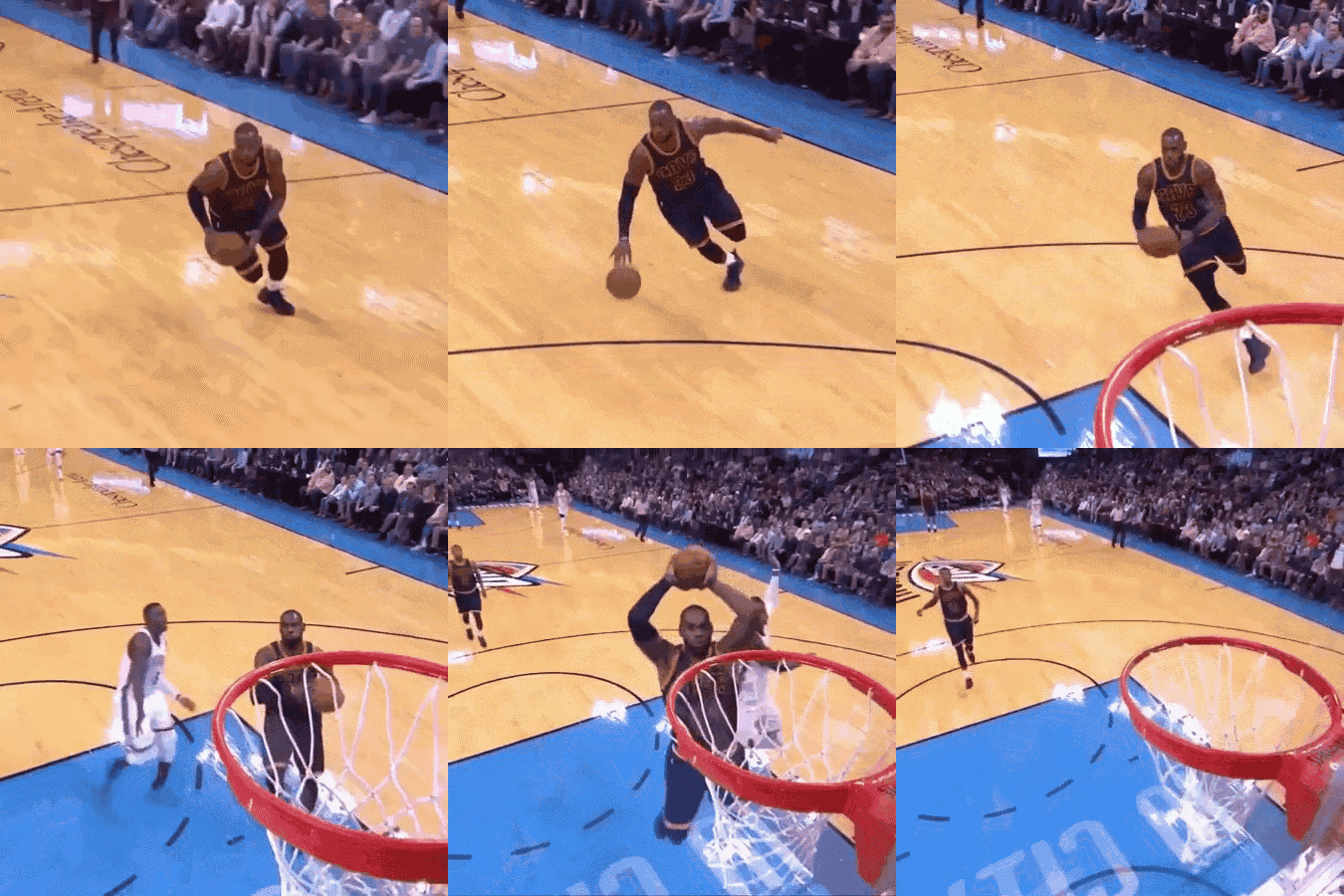
Choking under pressure—a phenomenon where individuals perform worse than expected in high-stakes situations—is a well-documented occurrence in humans. Athletes miss critical shots, musicians falter during important performances, and professionals stumble during key presentations. This decline in performance is often attributed to increased anxiety, overthinking, or an overwhelming sense of urgency that disrupts normal functioning.
Interestingly, this psychological phenomenon is not exclusive to humans. Neuroscientist Steven Chase and his team at Carnegie Mellon University sought to explore whether non-human primates experience similar performance declines under pressure. Their study, published in the journal Neuron on September 12, provides new insights into the neural mechanisms behind choking under pressure by examining rhesus monkeys.
The Experimental Design
The researchers designed a computer-based task that required the monkeys to move a cursor to a target accurately using a joystick. Successful completion of the task resulted in rewards of varying sizes. Most rewards were standard, but occasionally, the monkeys had the chance to win a rare “jackpot” prize—an especially large reward intended to create a high-stakes scenario.
To monitor the monkeys’ brain activity during the tasks, the team implanted electrode chips into the motor cortex—the region of the brain responsible for planning, controlling, and executing voluntary movements. This allowed the researchers to record neuronal activity related to motor preparation and execution in real time.
Key Findings
Contrary to the expectation that the prospect of a larger reward would enhance performance, the monkeys performed worse during the jackpot trials. The neural recordings revealed that in these high-reward scenarios, neuronal activity associated with motor preparation significantly decreased. This reduction indicated that the monkeys’ brains were less prepared to initiate movement when a larger reward was at stake, leading to underperformance.
Behavioral neuroscientist Bita Moghaddam commented on these findings, noting that increased rewards do not linearly enhance performance. Instead, there appears to be an optimal level of motivation and arousal for peak performance. Beyond this point, additional pressure or incentive can lead to a decline—a concept known as the Yerkes-Dodson Law in psychology.
Sign up for the Daily Dose Newsletter and get every morning’s best science news from around the web delivered straight to your inbox? It’s easy like Sunday morning.
The Neural-Bias Hypothesis
The observations from the study support the neural-bias hypothesis, which suggests that excessive motivation or anticipation of a reward can bias neural activity in a way that impairs performance. Essentially, when the stakes are too high, the brain’s normal processing can become disrupted, leading to decreased efficiency in task execution.
Understanding that choking under pressure has a neural basis in primates opens the door to exploring similar mechanisms in humans. If the same neural patterns are found, it could explain why even highly skilled individuals sometimes fail in critical moments. This knowledge could lead to interventions aimed at mitigating performance declines.
Future Research Directions
Steven Chase and his team plan to extend their research to human subjects. They aim to investigate whether real-time feedback of brain activity can help individuals recognize when they are about to choke under pressure and adjust accordingly. Techniques such as neurofeedback training could potentially teach people to regulate their neural activity to maintain optimal performance levels.
Additionally, the research highlights the importance of balancing motivation and stress. Strategies that manage anxiety and maintain focus without overloading the neural circuits responsible for task execution could prove beneficial in high-pressure environments.
The study provides compelling evidence that choking under pressure is not a uniquely human experience but is rooted in fundamental neural processes shared with other primates. By uncovering the neural mechanisms that lead to decreased performance when stakes are high, scientists can work toward developing tools and strategies to help both humans and animals perform at their best, regardless of the pressure.




Leave a Reply