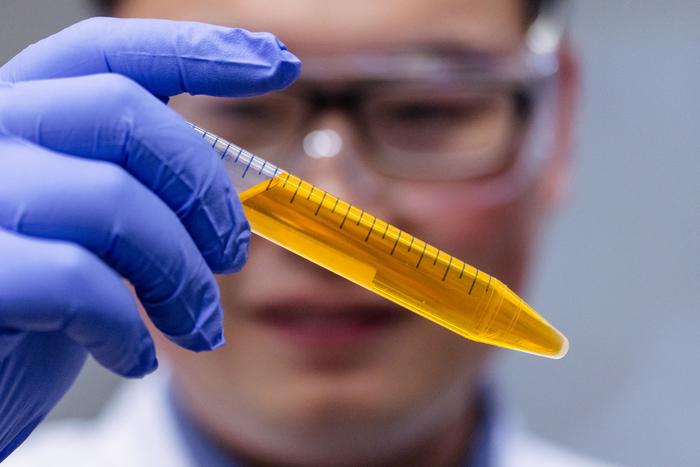
In a pioneering new study, researchers made the skin on the skulls and abdomens of live mice transparent by applying to the areas a mixture of water and a common yellow food coloring called tartrazine.
Dr. Zihao Ou, assistant professor of physics at The University of Texas at Dallas, is lead author of the study, published in the Sept. 6 print issue of the journal Science.
Living skin is a scattering medium. Like fog, it scatters light, which is why it cannot be seen through.
“We combined the yellow dye, which is a molecule that absorbs most light, especially blue and ultraviolet light, with skin, which is a scattering medium. Individually, these two things block most light from getting through them. But when we put them together, we were able to achieve transparency of the mouse skin,” said Ou, who, with colleagues, conducted the study while he was a postdoctoral researcher at Stanford University before joining the UT Dallas faculty in the School of Natural Sciences and Mathematics in August.
“For those who understand the fundamental physics behind this, it makes sense; but if you aren’t familiar with it, it looks like a magic trick,” Ou said.
Sign up for the Daily Dose Newsletter and get every morning’s best science news from around the web delivered straight to your inbox? It’s easy like Sunday morning.
The “magic” happens because dissolving the light-absorbing molecules in water changes the solution’s refractive index — a measure of the way a substance bends light — in a way that matches the refractive index of tissue components like lipids. In essence, the dye molecules reduce the degree to which light scatters in the skin tissue, like dissipating a fog bank.
In their experiments with mice, the researchers rubbed the water and dye solution onto the skin of the animals’ skulls and abdomens. Once the dye had completely diffused into the skin, the skin became transparent. The process is reversible by washing off any remaining dye. The dye that has diffused into the skin is metabolized and excreted through urine.
“It takes a few minutes for the transparency to appear,” Ou said. “It’s similar to the way a facial cream or mask works: The time needed depends on how fast the molecules diffuse into the skin.”
Through the transparent skin of the skull, researchers directly observed blood vessels on the surface of the brain. In the abdomen, they observed internal organs and peristalsis, the muscle contractions that move contents through the digestive tract.
The transparent areas take on an orangish color, Ou said. The dye used in the solution is commonly known as FD&C Yellow #5 and is frequently used in orange- or yellow-colored snack chips, candy coating and other foods. The Food and Drug Administration certifies nine color additives — tartrazine is one — for use in foods.
“It’s important that the dye is biocompatible — it’s safe for living organisms,” Ou said. “In addition, it’s very inexpensive and efficient; we don’t need very much of it to work.”
The researchers have not yet tested the process on humans, whose skin is about 10 times thicker than a mouse’s. At this time it is not clear what dosage of the dye or delivery method would be necessary to penetrate the entire thickness, Ou said.
“In human medicine, we currently have ultrasound to look deeper inside the living body,” Ou said. “Many medical diagnosis platforms are very expensive and inaccessible to a broad audience, but platforms based on our tech should not be.”
Ou said one of the first applications of the technique will likely be to improve existing research methods in optical imaging.
“Our research group is mostly academics, so one of the first things we thought of when we saw the results of our experiments was how this might improve biomedical research,” he said. “Optical equipment, like the microscope, is not directly used to study live humans or animals because light can’t go through living tissue. But now that we can make tissue transparent, it will allow us to look at more detailed dynamics. It will completely revolutionize existing optical research in biology.”
IMAGE CREDIT: University of Texas at Dallas



Leave a Reply