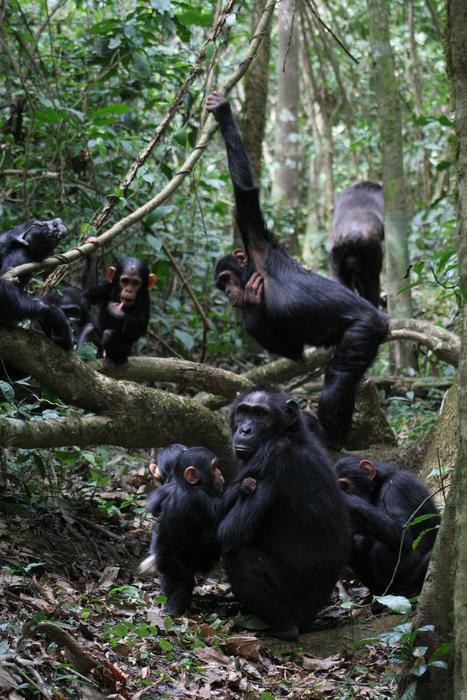
When people are having a conversation, they rapidly take turns speaking and sometimes even interrupt. Now, researchers who have collected the largest ever dataset of chimpanzee “conversations” have found that they communicate back and forth using gestures following the same rapid-fire pattern. The findings are reported on July 22 in the journal Current Biology.
“While human languages are incredibly diverse, a hallmark we all share is that our conversations are structured with fast-paced turns of just 200 milliseconds on average,” said Catherine Hobaiter (@NakedPrimate) at the University of St Andrews, UK. “But it was an open question whether this was uniquely human, or if other animals share this structure.”
“We found that the timing of chimpanzee gesture and human conversational turn-taking is similar and very fast, which suggests that similar evolutionary mechanisms are driving these social, communicative interactions,” says Gal Badihi (@Gal_Badihi), the study’s first author.

The researchers knew that human conversations follow a similar pattern across people living in places and cultures all over the world. They wanted to know if the same communicative structure also exists in chimpanzees even though they communicate through gestures rather than through speech. To find out, they collected data on chimpanzee “conversations” across five wild communities in East Africa.
Altogether, they collected data on more than 8,500 gestures for 252 individuals. They measured the timing of turn-taking and conversational patterns. They found that 14% of communicative interactions included an exchange of gestures between two interacting individuals. Most of the exchanges included a two-part exchange, but some included up to seven parts.
Overall, the data reveal a similar timing to human conversation, with short pauses between a gesture and a gestural response at about 120 milliseconds. Behavioral responses to gestures were slower. “The similarities to human conversations reinforce the description of these interactions as true gestural exchanges, in which the gestures produced in response are contingent on those in the previous turn,” the researchers write.
Sign up for the Daily Dose Newsletter and get every morning’s best science news from around the web delivered straight to your inbox? It’s easy like Sunday morning.
“We did see a little variation among different chimp communities, which again matches what we see in people where there are slight cultural variations in conversation pace: some cultures have slower or faster talkers,” Badihi says.
“Fascinatingly, they seem to share both our universal timing, and subtle cultural differences,” says Hobaiter. “In humans, it is the Danish who are ‘slower’ responders, and in Eastern chimpanzees that’s the Sonso community in Uganda.”
This correspondence between human and chimpanzee face-to-face communication points to shared underlying rules in communication, the researchers say. They note that these structures could trace back to shared ancestral mechanisms. It’s also possible that chimpanzees and humans arrived at similar strategies to enhance coordinated interactions and manage competition for communicative “space.” The findings suggest that human communication may not be as unique as one might think.
“It shows that other social species don’t need language to engage in close-range communicative exchanges with quick response time,” Badihi says. “Human conversations may share similar evolutionary history or trajectories to the communication systems of other species suggesting that this type of communication is not unique to humans but more widespread in social animals.”
In future studies, the researchers say they want to explore why chimpanzees have these conversations to begin with. They think chimpanzees often rely on gestures to ask something of one another.
“We still don’t know when these conversational structures evolved, or why!” Hobaiter says. “To get at that question we need to explore communication in more distantly related species—so that we can work out if these are an ape-characteristic, or ones that we share with other highly social species, such as elephants or ravens.”
IMAGE CREDIT: Catherine Hobaiter
If you enjoy the content we create and would like to support us, please consider becoming a patron on Patreon! By joining our community, you’ll gain access to exclusive perks such as early access to our latest content, behind-the-scenes updates, and the ability to submit questions and suggest topics for us to cover. Your support will enable us to continue creating high-quality content and reach a wider audience.
Join us on Patreon today and let’s work together to create more amazing content! https://www.patreon.com/ScientificInquirer



Leave a Reply