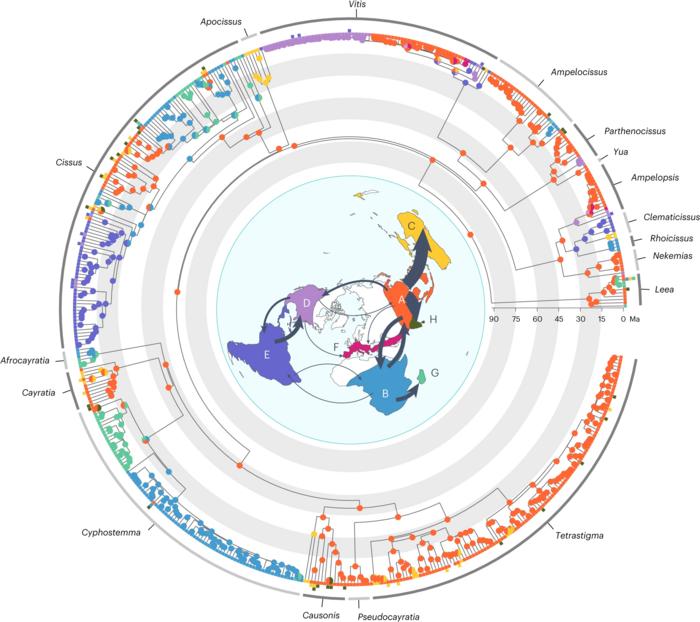
In a study published in Nature Plants, scientists have identified Eocene, Oligocene, and Miocene boundaries as turning points for the transition of survival strategies in the grape family (Vitaceae).
The “move” strategy dominated during the Eocene and Miocene Climatic Optimums, while “evolve” began to prevail after the Miocene, correlating with global cooling and the emergence of new habitats.
Understanding the origin and dynamics of biodiversity is a fundamental question in the context of global climate change. Faced with environmental fluctuations, plants can either “move” to seek their suitable habitats elsewhere or “evolve” to adapt to the changed environment. Although the transition between “move” and “evolve” has profound implications for the survival and adaptation of organisms, it remains hotly debated whether alternative strategies may dominate under different environmental conditions.

The globally distributed grape family has occupied a wide variety of contrasting niches, including rainforests, savannas, limestone outcrops and even deserts, making it an excellent model to study the transitions of plant survival strategies on a global scale.
Prof. CHEN Zhiduan’s research team from the Institute of Botany of the Chinese Academy of Sciences (IBCAS) and their international collaborators investigated the transition between “move” and “evolve” strategies, and demonstrated their adaptive significance involving niche opportunity and trait innovation throughout the evolutionary history of Vitaceae.
The researchers constructed a robust phylogeny of Vitaceae based on a worldwide sampling of 495 species from 17 genera, covering ~52% of Vitaceae species. By integrating diversification analyses, ancestral distributions, niche and trait reconstructions, and palaeobotanic data, they inferred the biogeographic diversification patterns and adaptive evolution of Vitaceae under climatic changes.
Sign up for the Daily Dose Newsletter and get every morning’s best science news from around the web delivered straight to your inbox? It’s easy like Sunday morning.
The grape family probably originated in Asia in the late Cretaceous (~72.43 million years ago (Ma)) and spatially diversified to all major continents in the Paleogene. Four genera of Vitaceae (Ampelocissus, Cyphostemma, Vitis, and Tetrastigma) have experienced a significant increase in diversification rate since the Oligocene, coinciding with their niche shifts and the emergence of adaptive traits.
The researchers further identified the “move” strategy as dominant during the Eocene and Miocene, coinciding with the high global temperatures of both periods, while “evolve” has been the dominant strategy since the last glacial period at 3.3 Ma, when several new habitats emerged in both hemispheres.
This study highlights the importance of niche shifts in recent timeframes and suggests that hypotheses based on niche conservatism should be used with caution as an established assumption or be explicitly tested against comparable alternative hypotheses.
The results of this study advance our understanding of the origins and maintenance of biodiversity and provide insights into how plants may respond to a future changing world.
IMAGE CREDIT: IBCAS
If you enjoy the content we create and would like to support us, please consider becoming a patron on Patreon! By joining our community, you’ll gain access to exclusive perks such as early access to our latest content, behind-the-scenes updates, and the ability to submit questions and suggest topics for us to cover. Your support will enable us to continue creating high-quality content and reach a wider audience.
Join us on Patreon today and let’s work together to create more amazing content! https://www.patreon.com/ScientificInquirer




Leave a Reply