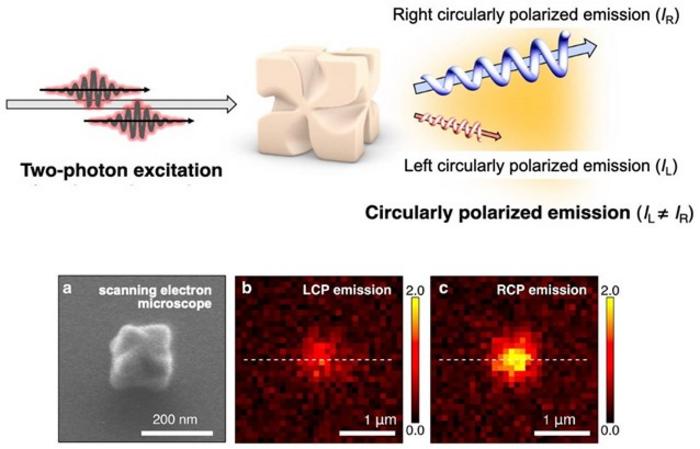
When chiral gold nanoparticles are irradiated with near-infrared femtosecond pulses, visible emission of luminescence is observed. In this study, this luminescence was found to yield high selectivity for left- or right-handed circularly polarized light, depending on the chirality of the nanoparticles, with a dissymmetry factor of approximately 0.7. This finding suggests the potential to elevate various applications using circularly polarized light to practical levels.
The research group led by Project Assistant Professor Dr. Hyo-Yong AHN, Dr. Khai Quang LE, Dr. Tetsuya NARUSHIMA, Research Assistant Professor Dr. Junsuke YAMANISHI, and Professor Dr. Hiromi OKAMOTO from the Institute for Molecular Science, and Dr. Ryeong Myeong KIM and Professor Dr. Ki Tae NAM from Seoul National University, found that the visible luminescence from chiral gold nanoparticles caused by irradiated with near-infrared femtosecond pulses depends on the chirality of the nanoparticles and yields high selectivity for left- or right-handed circularly polarized light. While the dissymmetry factor for circular polarization of luminescence in most chiral materials is typically of the order of 0.01 or below, the emission from these chiral gold nanoparticles exhibited a high dissymmetry factor of approximately 0.7.
Chirality refers to a property of materials where their structure is not superimposable on a mirror image of itself. Light also has a chiral structure in the form of circular polarization, which can be left-handed or right-handed. Circularly polarized light has possible future applications in the fields of trace analysis of chiral substances, anti-counterfeiting, quantum information, screens or displays, and so forth.

A number of research papers on efficient generation methods for circularly polarized light have been published. One such method involves generating circular polarization through the luminescence from a material excited by light, where the wavelengths of the excitation and emitted light are different. While many studies have developed materials that generate circular polarization using this method, in most cases they provide only small dissymmetry factors (described below). That is, they produce mixed left- and right-handed circularly polarized light, with only a slight intensity difference between them.
The dissymmetry factor is an indicator of how much circular polarization is biased to be left- or right-handed. It is determined by calculating the difference between the left- and right-circularly polarized intensity divided by their average. Pure circular polarization has a dissymmetry factor (g value) of ±2, and linear or unpolarized light has a g value of 0. Most traditional circularly polarized light-emitting materials have a dissymmetry factor of the order of 0.01 or less, and thus it has been difficult to reliably identify the generated circularly polarized light.
Sign up for the Daily Dose Newsletter and get every morning’s best science news from around the web delivered straight to your inbox? It’s easy like Sunday morning.
The research group focused on the visible luminescence generated when chiral gold nanoparticles are irradiated with near-infrared femtosecond pulses. Although the incident light was non-chiral and linearly polarized, the emitted light was found to be highly selective for either left- or right-handed circular polarization. The dissymmetry factor was approximately 0.7, indicating a significantly higher degree of circular polarization compared to many other circularly polarized light-emitting materials used in previous studies (the dissymmetry factors are typically of the order of 0.01 or less). Additionally, theoretical calculations and analyses revealed the mechanism for this high selectivity.
This research demonstrates that chiral structured metal nanoparticles are useful materials for generating circularly polarized light, biased to left- or right-handed polarization. Understanding this mechanism also provides guidelines for more efficient circular polarization generation. This work paves the way for developing materials and devices that can efficiently generate circular polarization at various wavelengths and applications in anti-counterfeiting and quantum information using circularly polarized light.
IMAGE CREDIT: Hiromi OKAMOTO, Hyo-Yong AHN
If you enjoy the content we create and would like to support us, please consider becoming a patron on Patreon! By joining our community, you’ll gain access to exclusive perks such as early access to our latest content, behind-the-scenes updates, and the ability to submit questions and suggest topics for us to cover. Your support will enable us to continue creating high-quality content and reach a wider audience.
Join us on Patreon today and let’s work together to create more amazing content! https://www.patreon.com/ScientificInquirer




Leave a Reply