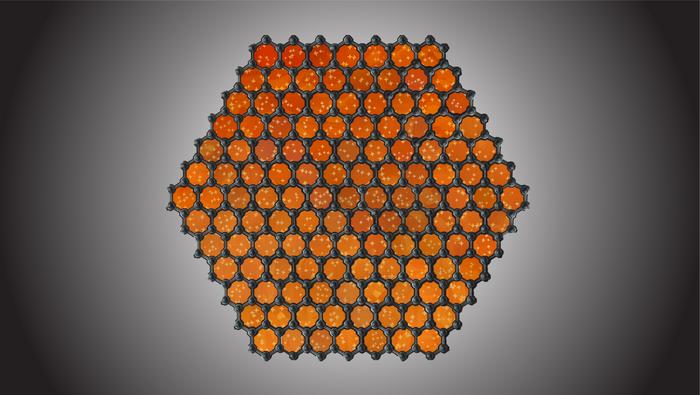
Graphene has been called “the wonder material of the 21st century.” Since its discovery in 2004, the material—a single layer of carbon atoms—has been touted for its host of unique properties, which include ultra-high electrical conductivity and remarkable tensile strength. It has the potential to transform electronics, energy storage, sensors, biomedical devices, and more. But graphene has had a dirty little secret: it’s dirty.
Now, engineers at Columbia University and colleagues at the University of Montreal and the National Institute of Standards and Technology are poised to clean things up with an oxygen-free chemical vapor deposition (OF-CVD) method that can create high-quality graphene samples at scale. Their work, published May 29 in Nature, directly demonstrates how trace oxygen affects the growth rate of graphene and identifies the link between oxygen and graphene quality for the first time.
“We show that eliminating virtually all oxygen from the growth process is the key to achieving reproducible, high-quality CVD graphene synthesis,” said senior author James Hone, Wang Fong-Jen Professor of Mechanical Engineering at Columbia Engineering. “This is a milestone towards large-scale production of graphene.”

Graphene has historically been synthesized in one of two ways. There’s the “scotch-tape” method, in which individual layers are peeled from a bulk sample of graphite (the same material you’ll find in pencil lead) using household tape. Such exfoliated samples can be quite clean and free from impurities that would otherwise interfere with graphene’s desirable properties. However, they tend to be too small—just a few tens of micrometers across–for industrial-scale applications and, thus, better suited for lab research.
To move from lab explorations to real-world applications, researchers developed a method to synthesize large-area graphene about 15 years ago. This process, known as CVD growth, passes a carbon-containing gas, such as methane, over a copper surface at a temperature high enough (about 1000 °C) that the methane breaks apart and the carbon atoms rearrange to form a single honeycomb-shaped layer of graphene. CVD growth can be scaled up to create graphene samples that are centimeters or even meters in size. However, despite years of effort from research groups around the world, CVD-synthesized samples have suffered from problems with reproducibility and variable quality.
The issue was oxygen. In prior publications, co-authors Richard Martel and Pierre Levesque from Montreal had shown that trace amounts of oxygen can slow the growth process and even etch the graphene away. So, about six years ago, Christopher DiMarco, GSAS’19, designed and built a CVD growth system in which the amount of oxygen introduced during the deposition process could be carefully controlled.
Sign up for the Daily Dose Newsletter and get every morning’s best science news from around the web delivered straight to your inbox? It’s easy like Sunday morning.
Current PhD students Xingzhou Yan and Jacob Amontree continued DiMarco’s work and further improved the growth system. They found that when trace oxygen was eliminated, CVD growth was much faster—and gave the same results every time. They also studied the kinetics of oxygen-free CVD graphene growth and found that a simple model could predict growth rate over a range of different parameters, including gas pressure and temperature.
The quality of the OF-CVD-grown samples proved virtually identical to that of exfoliated graphene. In collaboration with colleagues in Columbia’s physics department, their graphene displayed striking evidence for the fractional quantum Hall effect under magnetic fields, a quantum phenomenon that had previously only been observed in ultrahigh-quality, two-dimensional electrical systems.
From here, the team plans to develop a method to cleanly transfer their high-quality graphene from the metal growth catalyst to other functional substrates such as silicon — the final piece of the puzzle to take full advantage of this wonder material.
“We both became fascinated by graphene and its potential as undergraduates,” Amontree and Yan said. “We conducted countless experiments and synthesized thousands of samples over the past four years of our PhDs. Seeing this study finally come to fruition is a dream come true.”
IMAGE CREDIT: Jacob Amontree & Christian Cupo, Columbia University
If you enjoy the content we create and would like to support us, please consider becoming a patron on Patreon! By joining our community, you’ll gain access to exclusive perks such as early access to our latest content, behind-the-scenes updates, and the ability to submit questions and suggest topics for us to cover. Your support will enable us to continue creating high-quality content and reach a wider audience.
Join us on Patreon today and let’s work together to create more amazing content! https://www.patreon.com/ScientificInquirer




Leave a Reply