What is the largest ligament in the human body? It might surprise some people that it is the Achilles tendon. Even though it is also considered the toughest ligament, the Achilles tendon can rupture, with many such injuries involving sports enthusiasts in their 30s or 40s. Surgery might be required, and a prolonged period of rest, immobilization, and treatment can be difficult to endure.

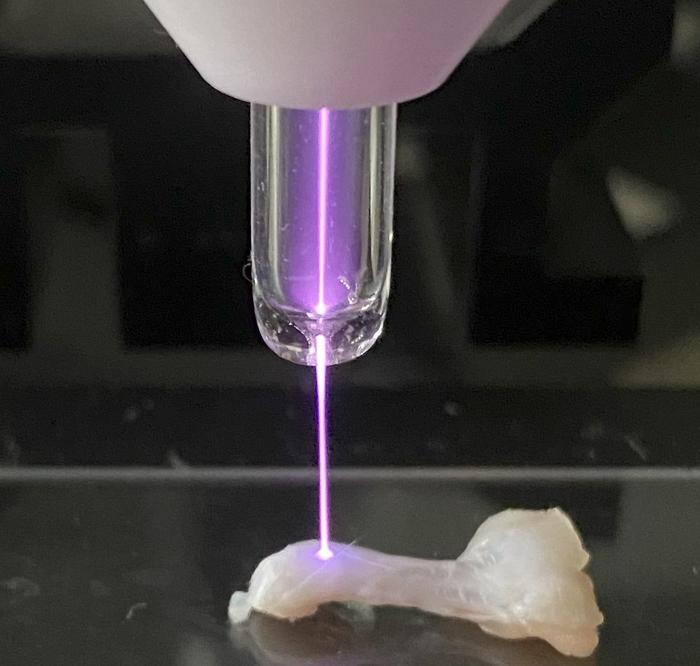
Seeking to shorten the recovery time, a research team led by Osaka Metropolitan University Graduate School of Medicine’s Katsumasa Nakazawa, a graduate student in the Department of Orthopedic Surgery, Associate Professor Hiromitsu Toyoda, and Professor Hiroaki Nakamura, and Graduate School of Engineering Professor Jun-Seok Oh has focused on non-thermal atmospheric-pressure plasma as a treatment method.
This study is the first to show that such plasma irradiation can accelerate tendon repair. The team ruptured then sutured the Achilles tendon of lab rats. For one group of rats, the sutured area was irradiated with a helium plasma jet. The plasma-irradiated group exhibited faster tendon regeneration and increased strength at two, four, and six weeks after surgery compared to the untreated group.
Sign up for the Daily Dose Newsletter and get every morning’s best science news from around the web delivered straight to your inbox? It’s easy like Sunday morning.
“We have previously discovered that irradiation of non-thermal atmospheric-pressure plasma has the effect of promoting bone regeneration. In this study, we discovered that the technology also promotes tendon regeneration and healing, showing that it has applications for a wide range of fields,” Professor Toyoda declared. “Combined with current tendon treatments, it is expected to contribute to more reliable tendon regeneration and shorter treatment time.”
IMAGE CREDIT: Osaka Metropolitan University
If you enjoy the content we create and would like to support us, please consider becoming a patron on Patreon! By joining our community, you’ll gain access to exclusive perks such as early access to our latest content, behind-the-scenes updates, and the ability to submit questions and suggest topics for us to cover. Your support will enable us to continue creating high-quality content and reach a wider audience.
Join us on Patreon today and let’s work together to create more amazing content! https://www.patreon.com/ScientificInquirer



Leave a Reply