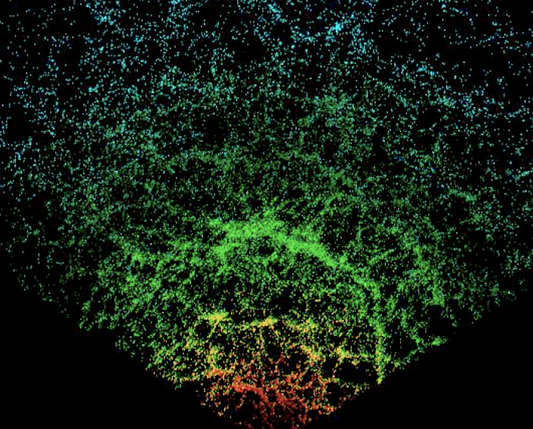

The Sloan Great Wall is one of the largest known cosmic structures, a colossal filament of galaxies stretching over 1.37 billion light-years across. Discovered through the Sloan Digital Sky Survey (SDSS), it is a stunning testament to the fractal-like patterns that characterize the large-scale structure of the universe. Though galaxies themselves aren’t fractal, the arrangement of clusters and superclusters within the cosmic web shows self-similar features that suggest an underlying fractal geometry.
Fractals are patterns that repeat at different scales, and this characteristic is visible in the Sloan Great Wall’s branching network of galaxy clusters and superclusters. It is organized in a way that mimics the structures at smaller scales, reflecting how gravity and dark matter have shaped the universe. This fractal-like organization arises from the gravitational clustering of matter after the Big Bang, which caused density fluctuations that later became seeds for galaxy formation.
The distribution of matter in the Sloan Great Wall offers crucial insights into the universe’s large-scale organization and supports the idea that cosmic structures have a hierarchy reminiscent of fractals. By studying the Sloan Great Wall, scientists can explore how dark matter and dark energy influence cosmic evolution, and test models that predict the formation and arrangement of galaxies.
While not a perfect fractal in the mathematical sense, the Sloan Great Wall’s scale and complexity evoke the repeating patterns that fractals imply, offering a glimpse into the hidden forces shaping the cosmos. Its discovery has inspired new ways to interpret the fundamental structure of the universe.




Leave a Reply