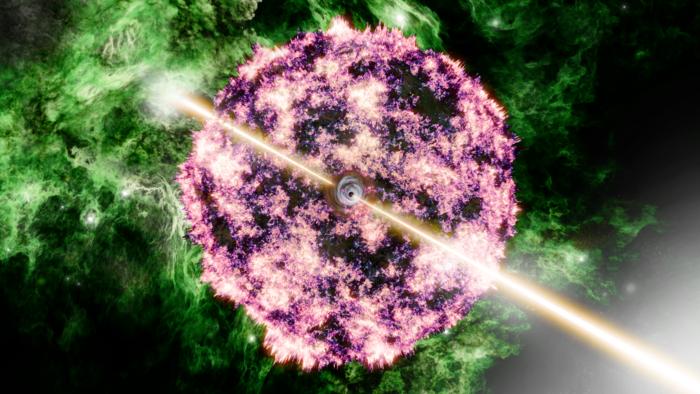
In October 2022, an international team of researchers, including Northwestern University astrophysicists, observed the brightest gamma-ray burst (GRB) ever recorded, GRB 221009A.
Now, a Northwestern-led team has confirmed that the phenomenon responsible for the historic burst — dubbed the B.O.A.T. (“brightest of all time”) — is the collapse and subsequent explosion of a massive star. The team discovered the explosion, or supernova, using NASA’s James Webb Space Telescope (JWST).

While this discovery solves one mystery, another mystery deepens.
The researchers speculated that evidence of heavy elements, such as platinum and gold, might reside within the newly uncovered supernova. The extensive search, however, did not find the signature that accompanies such elements. The origin of heavy elements in the universe continues to remain as one of astronomy’s biggest open questions.
Sign up for the Daily Dose Newsletter and get every morning’s best science news from around the web delivered straight to your inbox? It’s easy like Sunday morning.
The research will be published on Friday (April 12) in the journal Nature Astronomy.
“When we confirmed that the GRB was generated by the collapse of a massive star, that gave us the opportunity to test a hypothesis for how some of the heaviest elements in the universe are formed,” said Northwestern’s Peter Blanchard, who led the study. “We did not see signatures of these heavy elements, suggesting that extremely energetic GRBs like the B.O.A.T. do not produce these elements. That doesn’t mean that all GRBs do not produce them, but it’s a key piece of information as we continue to understand where these heavy elements come from. Future observations with JWST will determine if the B.O.A.T.’s ‘normal’ cousins produce these elements.”
Blanchard is a postdoctoral fellow at Northwestern’s Center for Interdisciplinary Exploration and Research in Astrophysics (CIERA), where he studies superluminous supernovae and GRBs. The study includes co-authors from the Center for Astrophysics | Harvard & Smithsonian; University of Utah; Penn State; University of California, Berkeley; Radbound University in the Netherlands; Space Telescope Science Institute; University of Arizona/Steward Observatory; University of California, Santa Barbara; Columbia University; Flatiron Institute; University of Greifswald and the University of Guelph.
Birth of the B.O.A.T.
When its light washed over Earth on Oct. 9, 2022, the B.O.A.T. was so bright that it saturated most of the world’s gamma-ray detectors. The powerful explosion occurred approximately 2.4 billion light-years away from Earth, in the direction of the constellation Sagitta and lasted a few hundred seconds in duration. As astronomers scrambled to observe the origin of this incredibly bright phenomenon, they were immediately hit with a sense of awe.
“As long as we have been able to detect GRBs, there is no question that this GRB is the brightest we have ever witnessed by a factor of 10 or more,” Wen-fai Fong, an associate professor of physics and astronomy at Northwestern’s Weinberg College of Arts and Sciences and member of CIERA, said at the time.
“The event produced some of the highest-energy photons ever recorded by satellites designed to detect gamma rays,” Blanchard said. “This was an event that Earth sees only once every 10,000 years. We are fortunate to live in a time when we have the technology to detect these bursts happening across the universe. It’s so exciting to observe such a rare astronomical phenomenon as the B.O.A.T. and work to understand the physics behind this exceptional event.”
A ‘normal’ supernova
Rather than observe the event immediately, Blanchard, his close collaborator Ashley Villar of Harvard University and their team wanted to view the GRB during its later phases. About six months after the GRB was initially detected, Blanchard used the JWST to examine its aftermath.
“The GRB was so bright that it obscured any potential supernova signature in the first weeks and months after the burst,” Blanchard said. “At these times, the so-called afterglow of the GRB was like the headlights of a car coming straight at you, preventing you from seeing the car itself. So, we had to wait for it to fade significantly to give us a chance of seeing the supernova.”
Blanchard used the JWST’s Near Infrared Spectrograph to observe the object’s light at infrared wavelengths. That’s when he saw the characteristic signature of elements like calcium and oxygen typically found within a supernova. Surprisingly, it wasn’t exceptionally bright — like the incredibly bright GRB that it accompanied.
“It’s not any brighter than previous supernovae,” Blanchard said. “It looks fairly normal in the context of other supernovae associated with less energetic GRBs. You might expect that the same collapsing star producing a very energetic and bright GRB would also produce a very energetic and bright supernova. But it turns out that’s not the case. We have this extremely luminous GRB, but a normal supernova.”
Missing: Heavy elements
After confirming — for the first time — the presence of the supernova, Blanchard and his collaborators then searched for evidence of heavy elements within it. Currently, astrophysicists have an incomplete picture of all the mechanisms in the universe that can produce elements heavier than iron.
The primary mechanism for producing heavy elements, the rapid neutron capture process, requires a high concentration of neutrons. So far, astrophysicists have only confirmed the production of heavy elements via this process in the merger of two neutron stars, a collision detected by the Laser Interferometer Gravitational-Wave Observatory (LIGO) in 2017. But scientists say there must be other ways to produce these elusive materials. There are simply too many heavy elements in the universe and too few neutron-star mergers.
“There is likely another source,” Blanchard said. “It takes a very long time for binary neutron stars to merge. Two stars in a binary system first have to explode to leave behind neutron stars. Then, it can take billions and billions of years for the two neutron stars to slowly get closer and closer and finally merge. But observations of very old stars indicate that parts of the universe were enriched with heavy metals before most binary neutron stars would have had time to merge. That’s pointing us to an alternative channel.”
Astrophysicists have hypothesized that heavy elements also might be produced by the collapse of a rapidly spinning, massive star — the exact type of star that generated the B.O.A.T. Using the infrared spectrum obtained by the JWST, Blanchard studied the inner layers of the supernova, where the heavy elements should be formed.
“The exploded material of the star is opaque at early times, so you can only see the outer layers,” Blanchard said. “But once it expands and cools, it becomes transparent. Then you can see the photons coming from the inner layer of the supernova.”
“Moreover, different elements absorb and emit photons at different wavelengths, depending on their atomic structure, giving each element a unique spectral signature,” Blanchard explained. “Therefore, looking at an object’s spectrum can tell us what elements are present. Upon examining the B.O.A.T.’s spectrum, we did not see any signature of heavy elements, suggesting extreme events like GRB 221009A are not primary sources. This is crucial information as we continue to try to pin down where the heaviest elements are formed.”
Why so bright?
To tease apart the light of the supernova from that of the bright afterglow that came before it, the researchers paired the JWST data with observations from the Atacama Large Millimeter/Submillimeter Array (ALMA) in Chile.
“Even several months after the burst was discovered, the afterglow was bright enough to contribute a lot of light in the JWST spectra,” said Tanmoy Laskar, an assistant professor of physics and astronomy at the University of Utah and a co-author on the study. “Combining data from the two telescopes helped us measure exactly how bright the afterglow was at the time of our JWST observations and allow us to carefully extract the spectrum of the supernova.”
Although astrophysicists have yet to uncover how a “normal” supernova and a record-breaking GRB were produced by the same collapsed star, Laskar said it might be related to the shape and structure of the relativistic jets. When rapidly spinning, massive stars collapse into black holes, they produce jets of material that launch at rates close to the speed of light. If these jets are narrow, they produce a more focused — and brighter — beam of light.
“It’s like focusing a flashlight’s beam into a narrow column, as opposed to a broad beam that washes across a whole wall,” Laskar said. “In fact, this was one of the narrowest jets seen for a gamma-ray burst so far, which gives us a hint as to why the afterglow appeared as bright as it did. There may be other factors responsible as well, a question that researchers will be studying for years to come.”
Additional clues also may come from future studies of the galaxy in which the B.O.A.T. occurred. “In addition to a spectrum of the B.O.A.T. itself, we also obtained a spectrum of its ‘host’ galaxy,” Blanchard said. “The spectrum shows signs of intense star formation, hinting that the birth environment of the original star may be different than previous events.”
Team member Yijia Li, a graduate student at Penn State, modeled the spectrum of the galaxy, finding that the B.O.A.T.’s host galaxy has the lowest metallicity, a measure of the abundance of elements heavier than hydrogen and helium, of all previous GRB host galaxies. “This is another unique aspect of the B.O.A.T. that may help explain its properties,” Li said.
IMAGE CREDIT: Aaron M. Geller / Northwestern / CIERA / IT Research Computing and Data Services
If you enjoy the content we create and would like to support us, please consider becoming a patron on Patreon! By joining our community, you’ll gain access to exclusive perks such as early access to our latest content, behind-the-scenes updates, and the ability to submit questions and suggest topics for us to cover. Your support will enable us to continue creating high-quality content and reach a wider audience.
Join us on Patreon today and let’s work together to create more amazing content! https://www.patreon.com/ScientificInquirer

Leave a Reply