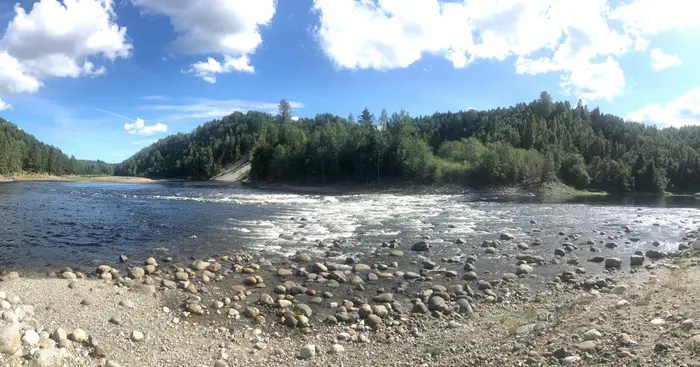
In a Finnish outcrop nestled between some of Northern Europe’s oldest mountains, researchers have found traces of a previously hidden part of Earth’s crust that points more than three billion years back in time and north towards Greenland.
These traces were found in the mineral zircon, which after chemical analyses, indicated to researchers from the Department of Geosciences and Natural Resource Management that the “foundation” upon which Denmark and Scandinavia rest, was probably ‘born’ from Greenland approximately 3.75 billion years ago.
“Our data suggest that the oldest part of Earth’s crust beneath Scandinavia originates in Greenland and is about 250 million years older than we previously thought,” says Professor Tod Waight, a geologist at the Department of Geosciences and Natural Resource Management.
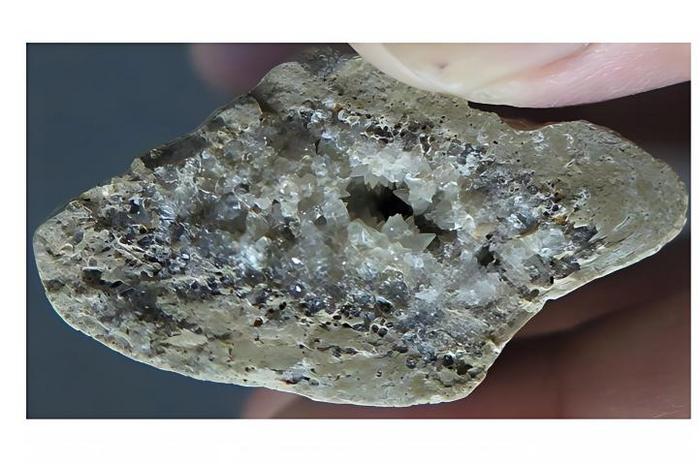
The researchers’ study of the zircon showed that, in several ways, its chemical fingerprint matches those of some of the oldest rocks on the planet found in West Greenland’s North Atlantic Craton.
“The zircon crystals we found in river sand and rocks from Finland have signatures that point towards them being much older than anything ever found in Scandinavia, while matching the age of Greenlandic rock samples. At the same time, the results of three independent isotope analyses confirm that Scandinavia’s bedrock was most likely linked to Greenland,” says Department of Geosciences and Natural Resource Management researcher Andreas Petersson.
Denmark, Sweden, Norway and Finland rest atop a part of Earth’s crust known as the Fennoscandian Shield, or the Baltic Shield. The researchers believe that it broke away from Greenland as a “seed” and shifted for hundreds of millions of years until it “took root” where Finland is today.

Here, the plate grew as new geological material accumulated around it, until it became Scandinavia. At the time of the crust’s detachment from Greenland, the planet looked very different than today.
“Earth was probably a watery planet, like in the movie Waterworld, but without any oxygen in the atmosphere and without emergent crust. But, because that’s so far back in time, we can’t be really be sure about what it actually looked like,” says Tod Waight.
According to the researchers, the fact that Earth even has a continental crust composed of granite is quite special when they look out into space and compare it with other planets in our galactic neighborhood.
“This is unique in our solar system. And, evidence of liquid water and a granite crust are key factors when trying to identify habitable exoplanets and the possibility of life beyond Earth,” explains Andreas Petersson.
Continents are the key to life
The new study adds pieces to a primordial continental puzzle that began long before life on Earth truly blossomed, but which has largely paved the way for both human and animal life.
“Understanding how continents formed helps us understand why ours is the only planet in the solar system with life on it. Because without fixed continents and water in between them, we wouldn’t be here. Indeed, continents influence both ocean currents and climate, which are crucial for life on Earth,” says Andreas Petersson.
Furthermore, the new study contributes to a growing number of studies which reject the means used thus far to calculate how continents have grown – especially during the first billion years of Earth’s history.
“The most commonly used models assume that Earth’s continental crust began to form when the planet was formed, about 4.6 billion years ago. Instead, our and several other recent studies suggest that the chemical signatures showing growth of the continental crust can only be identified about a billion years later. This means that we may need to revise much of what we thought about how early continents evolved,” says Professor Waight.
At the same time, results of the study add to previous research that found similar “seeds” from ancient crusts in other parts of the world.
“Our study provides us with another important clue in the mystery of how continents formed and spread across Earth – especially in the case of the Fennoscandian Shield. But there is still plenty that we don’t know. In Australia, South Africa and India, for example, similar seeds have been found, but we’re unsure of whether they all come from the same “birthplace”, or whether they originated independently of one another in several places on Earth. This is something that we would like to investigate more using the method we used in this study,” concludes Professor Waight.
About the study
- The study demonstrates that the oldest part of Earth’s crust beneath Scandinavia comes from Greenland and is about 250 million years older than once thought.
- Therefore, Denmark and Scandinavia’s geologic foundation was most likely connected to Greenland approximately 3.75 billion years ago.
- The researchers analysed zircons from modern river sand and rock samples from the remote Pudasjärvi and Suomujärvi regions of Finland, whose geological origins have been little studied.
- The zircon crystals found in the Finnish river sand originally crystallized in granitic magmas deep within the crust. These granites were then lifted to the surface and eroded to eventually form sand.
- The researchers used isotopic compositions of lead, hafnium and oxygen to trace the chemical fingerprint from the Fennoscandian Shield back to Greenland.
- The study has been published in the scientific journal Geology.
IMAGE CREDIT: Andreas Petersson.
Sign up for the Daily Dose Newsletter and get the morning’s best science news from around the web delivered straight to your inbox? It’s easy like Sunday morning.

Leave a Reply