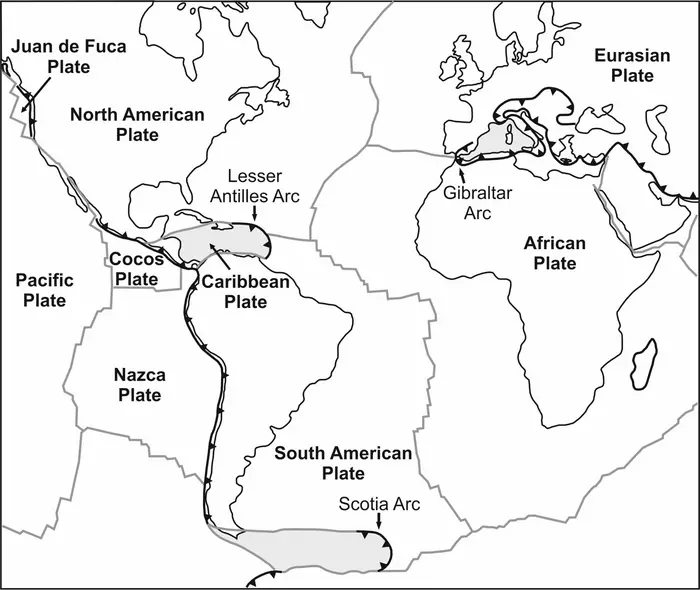
Oceans are subject to continuous change, mostly over extremely vast periods of time running into millions of years. Researchers from Universidade de Lisboa in Portugal and Johannes Gutenberg University Mainz (JGU) in Germany now used computer simulations to demonstrate that a subduction zone originating in the Western Mediterranean will propagate into the Atlantic under the Strait of Gibraltar.
According to their model, this will create a new Atlantic subduction zone 50 million years into the future, which will then move down into the Earth’s mantle. The new geodynamic model explains the evolution of the Gibraltar subduction zone and its likely development, which will contribute to the renewal of the Atlantic Ocean floor. The findings are the result of many years of collaboration between the partners in Lisbon and Mainz and have been published recently in Geology.
Oceans come into existence and grow, but eventually they shrink and close – a sequence of events known as the Wilson cycle. One of the cornerstones of this cycle is the initiation of subduction, i.e., when the oceanic lithosphere returns to the Earth’s mantle to be recycled. “The Atlantic Ocean is unique because here there are hardly any subduction zones, in contrast with the Pacific,” said Professor Boris Kaus of JGU. The only fully developed subduction zones in the Atlantic with volcanic island arcs are the Lesser Antilles arc in the Caribbean and the Scotia arc between the southern tip of Argentina and the Antarctic, both formed in the Cretaceous period. “The Gibraltar arc that is now about to invade the Atlantic is the third,” explained Kaus, head of the Geodynamics and Geophysics group at JGU. The Atlantic is thus a unique laboratory that enables the analysis of subduction initiation.
The Gibraltar arc came into being as part of subduction zones that have developed in the Western Mediterranean since the Oligocene epoch some 30 million years ago. Most of the arc is today present under the Alborán Sea, the westernmost portion of the Mediterranean Sea, extending already into the Atlantic. Its propagation to the west has slowed down over the past 5 million years, leading some researchers to conclude that it may possibly have become completely inactive. “We do not share this view,” emphasized Professor Boris Kaus and Dr. Nicolas Riel. “Our computer simulations allow us to accurately reconstruct the physical development of the Gibraltar arc and assess its future development.” For their calculations, the research team used the MOGON II supercomputer at JGU.

The simulations start at a period 30 million years ago and show the arc of the subduction zone gradually moving from the French/Spanish Mediterranean region towards the south. Some 17 million years ago, the center of the arc reached North Africa. Islands, such as the Kabylies, wandered with this southward movement and became attached to the North African mainland. “Our model also helps explain certain geological observations,” said Professor Boris Kaus. Roughly 10 million years ago, the so-called slab, which is the part of the lower plate that already descends into the mantle, began to push toward the Atlantic. The Atlantic subduction zone of the Gibraltar arc is currently on a line that approximately corresponds with that of the border between Spain and Portugal.
The geophysicists in Mainz and Lisbon expect the rate of expansion of the arc to decelerate in the future so that it will come almost to a standstill in about 20 million years. Following that, the rate of migration will pick up so that – over the following 30 million years – the subduction zone will spread into the Atlantic in the form of a semicircle, creating a new Atlantic subduction system.
The model reproduces the propagation of a subduction zone from a closing ocean – in this case, the Mediterranean – through a narrow oceanic corridor into a new opening ocean, the Atlantic. “Our simulations have shown for the first time that this form of direct migration can occur,” added Professor João Duarte of Universidade de Lisboa, lead author of the published article.
IMAGE CREDIT: João Duarte.
Sign up for the Daily Dose Newsletter and get the morning’s best science news from around the web delivered straight to your inbox? It’s easy like Sunday morning.


Leave a Reply