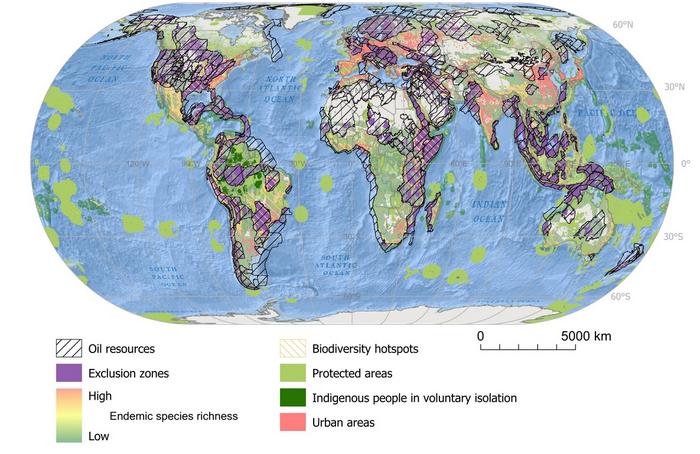
In order to limit the increase in global average temperature to 1.5°C, it is essential to drastically reduce carbon dioxide (CO₂) emissions in the atmosphere. This would mean not exploiting most of the existing coal, conventional gas and oil energy resources in regions around the world, according to research led by the University of Barcelona and published in the journal Nature Communications. The new article presents the atlas of unburnable oil in the world, a world map designed with environmental and social criteria that warns which oil resources should not be exploited to meet the commitments of the Paris Agreement signed in 2015 to mitigate the effects of climate change.
The article is led by Professor Martí Orta-Martínez, from the UB’s Faculty of Biology and the UB Biodiversity Research Institute (IRBio), and co-authored by Gorka Muñoa and Guillem Rius-Taberner (UB-IRBio), Lorenzo Pellegrini and Murat Arsel, from the Erasmus University Rotterdam (The Netherlands), and Carlos Mena, from the University of San Francisco de Quito (Ecuador).
The unburnable oil atlas reveals that to limit global warming to 1.5°C, it is essential to avoid the exploitation of oil resources in the most socio-environmentally sensitive areas of the planet, such as natural protected areas, priority areas for biodiversity conservation, areas of high endemic species richness, urban areas and the territories of indigenous peoples in voluntary isolation. It also warns that not extracting oil resources in these most sensitive areas would not be enough to keep global warming below 1.5°C as indicated in the Paris Agreement.
The Paris Agreement is an international treaty on climate change that calls for limiting global warming to below 2°C above pre-industrial levels and making efforts to limit it to 1.5°C. It was signed by 196 countries on 12 December 2015 at the UN Climate Change Conference COP21 in Paris and has been in force since 4 November 2016.
In this context, the unburnable oil atlas provides a new roadmap to complement the demands of international climate policy — based primarily on demand for fossil fuels — and to enhance socio-environmental safeguards in the exploitation of energy resources.
“Our study reveals which oil resources should be kept underground and not commercially exploited, with special attention to those deposits that overlap with areas of high endemic richness or coincide with outstanding socio-environmental values in different regions of the planet. The results show that the exploitation of the selected resources and reserves is totally incompatible with the achievement of the Paris Agreement commitments”, says Professor Martí Orta-Martínez.
There is now a broad consensus among the scientific community to limit global warming to 1.5°C if we want to avoid reaching the tipping points of the Earth’s climate system, such as melting permafrost, loss of Arctic sea ice and the Antarctic and Greenland ice sheets, forest fires in boreal forests, and so on. “If these thresholds are exceeded, this could lead to an abrupt release of carbon into the atmosphere (climate feedback)”, Orta-Martínez states, and adds that this would “amplify the effects of climate change and trigger a cascade of effects that commit the world to large-scale, irreversible changes”.

To limit average global warming to 1.5°C, the total amount of CO₂ emissions that must not be exceeded is known as the remaining carbon budget. In January 2023, the remaining carbon budget for the 50 % chance of keeping warming to 1.5°C was about 250 gigatonnes of CO₂ (GtCO2). “This budget is steadily decreasing at current rates of human-induced emissions — about 42 GtCO2 per year — and will be completely used up by 2028,” says researcher Lorenzo Pellegrini.
The combustion of the world’s known fossil fuel resources would result in the emission of about 10,000 GtCO2, forty times more than the carbon budget of 1.5°C. “In addition, the combustion of developed fossil fuel reserves — i.e. those reserves of oil and gas fields and coal mines currently in production or under construction — will emit 936 GtCO2, four times more than the remaining carbon budget for a global warming of 1.5°C,” notes expert Gorka Muñoa.
“The goal of no more than 1.5°C global warming requires a complete halt to exploration for new fossil fuel deposits, a halt to the licensing of new fossil fuel extraction, and the premature closure of a very significant share (75%) of oil, gas and coal extraction projects currently in production or already developed,” the authors note.
With the prospect of the results of the study, which has received funding from the Spanish Ministry of Science and Innovation and the European Union’s Next Generation funds, the authors call for urgent action by governments, corporations, citizens and large investors — such as pension funds — to immediately halt any investment in the fossil fuel industry and infrastructure if socio-environmental criteria are not applied. “Massive investment in clean energy sources is needed to secure global energy demand, enact and support suspensions and bans on fossil fuel exploration and extraction, and adhere to the fossil fuel non-proliferation treaty”, the team concludes.
IMAGE CREDIT: NATURE COMMUNICATIONS.
Sign up for the Daily Dose Newsletter and get the morning’s best science news from around the web delivered straight to your inbox? It’s easy like Sunday morning.



Leave a Reply