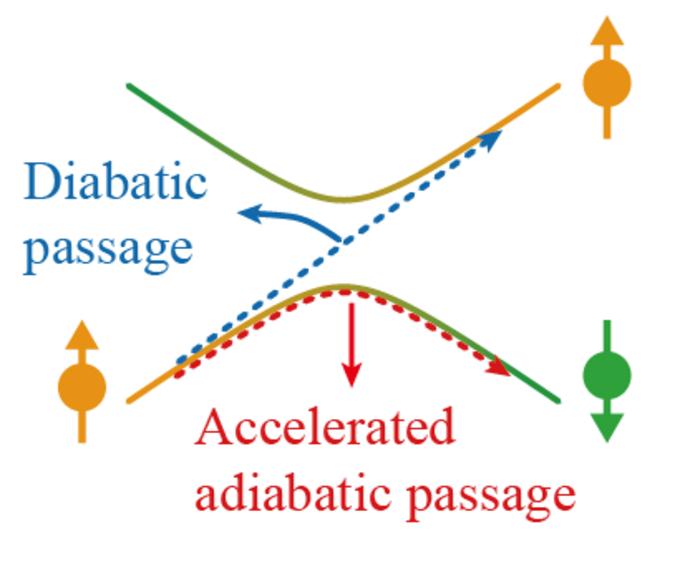
Researchers at Osaka University’s Institute of Scientific and Industrial Research (SANKEN) used the shortcuts to the adiabaticity (STA) method to greatly speed-up the adiabatic evolution of spin qubits. The spin flip fidelity after pulse optimization can be as high as 97.8% in GaAs quantum dots. This work may be applicable to other adiabatic passage and will be useful for fast and high-fidelity quantum control.
A quantum computer uses the superposition of “0” and “1” states to perform information processing, which is completely different from classical computing, thus allowing for the solution of certain problems at a much faster rate. High-fidelity quantum state operation in large enough programmable qubit spaces is required to achieve the “quantum advantage.” The conventional method for changing quantum states uses pulse control, which is sensitive to noises and control errors. In contrast, adiabatic evolution can always keep the quantum system in its eigenstate. It is robust to noises but requires a certain length of time.

Recently, a team from SANKEN used the STA method to greatly accelerate the adiabatic evolution of spin qubits in gate-defined quantum dots for the first time. The theory they used was proposed by the scientist Xi Chen et al. “We used the transitionless quantum driving style of STA, thus allowing the system to always remain in its ideal eigenstate even under rapid evolution.” co-author Takafumi Fujita explains.
According to the target evolution of spin qubits, this group’s experiment adds another effective driving to suppress diabatic errors, which guarantees a fast and nearly ideal adiabatic evolution. The dynamic properties were also investigated and proved the effectiveness of this method. Additionally, the modified pulse after optimization was able to further suppress noises and improve the efficiency of quantum state control. Finally, this group achieved spin flip fidelity of up to 97.8%. According to their estimation, the acceleration of adiabatic passage would be much better in Si or Ge quantum dots with less nuclear spin noise.
Sign up for the Daily Dose Newsletter and get every morning’s best science news from around the web delivered straight to your inbox? It’s easy like Sunday morning.
“This provides a fast and high-fidelity quantum control method. Our results may also be useful to accelerate other adiabatic passage in quantum dots.” corresponding author Akira Oiwa says. As a promising candidate for quantum computing, gate-defined quantum dots have long coherence times and good compatibility with the modern semiconductor industry. The team is trying to find more applications in gate-defined quantum dots systems, such as the promotion to more spin qubits. They hope to find a simpler and more feasible solution for fault-tolerant quantum information processing using this method.
IMAGE CREDIT: Xiao-Fei Liu et al.
If you enjoy the content we create and would like to support us, please consider becoming a patron on Patreon! By joining our community, you’ll gain access to exclusive perks such as early access to our latest content, behind-the-scenes updates, and the ability to submit questions and suggest topics for us to cover. Your support will enable us to continue creating high-quality content and reach a wider audience.
Join us on Patreon today and let’s work together to create more amazing content! https://www.patreon.com/ScientificInquirer




Leave a Reply