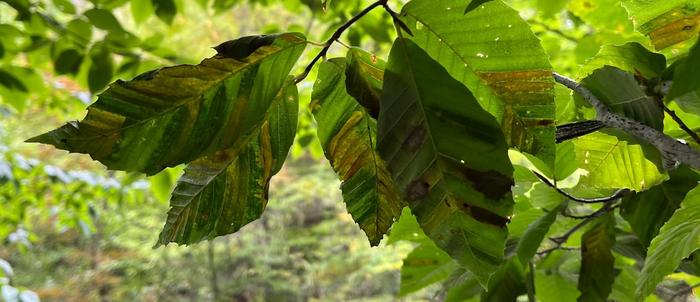
Beech trees provide food for animals, timber for wood products, and sustenance for beech drop plants, but they are under threat from Beech Leaf Disease (BLD). The disease, first documented in 2012 in the Midwest, is associated with the nematode Litylenchus crenatae mccannii and is spreading rapidly throughout the central and northeast regions of North America.
A team of scientists led by Craig Brodersen, professor of plant physiological ecology, and Leila Fletcher, postdoctoral associate, at the Yale School of the Environment has uncovered new insights on how the disease is impacting leaves at the cellular level and provided a novel mechanistic explanation for the decline of the trees post-infection.

Brodersen first became interested in the disease after noticing the infected trees during a walk in the woods with his children.
“It’s a beautiful tree and an important part of the landscape. I wanted to do something with the tools we have to contribute to a better understanding of what the disease is doing to the tree. In order to come up with a solution, you have to come at it from as many angles as possible,” he said.
Sign up for the Daily Dose Newsletter and get every morning’s best science news from around the web delivered straight to your inbox? It’s easy like Sunday morning.
The team studied leaves collected from beech trees at Yale-Myers Forest, which hadn’t yet been infected by the nematode, and leaves from infected trees in New Haven’s West Rock Ridge State Park. The presence of the nematode influences the physical or hormonal regulation of leaf development, which leads to the distinctive dark green stripes on affected leaves, the research team said.
Cross section of an infected leaf (left) and healthy leaf (right) chemically stained with bleach shows that the veins are wider and less dense in symptomatic regions of the leaf.
This transverse cross-section of an infected beech leaf shows that the diseased portion (left) is 249% thicker than the healthy portion of the leaf (right).
After comparing the leaf structures at the cellular level, the scientists discovered that maximum photosynthetic rates were approximately 61% lower in symptomatic leaves and respiration rates increased as the percentage of affected leaf tissue increased. A combination of reduced leaf area for photosynthetic tissues, and stomatal deformation (stomata are pores in the leaf surface that provide for the exchange of gases) and reduced stomatal density likely led to the reduced photosynthetic rates observed in symptomatic leaves, the study, which was published in Forest Pathology, found.
“BLD, likely in combination with other foliar pathogens and canopy thinning, causes a reduction in carbon assimilation capacity, which can potentially lead to tree mortality by depleting the trees’ stored carbon,” the study’s authors concluded.
This information will further research on the disease, which is still in its early stages.
“We hope this leads to a better understanding of what the disease is doing to the tree and enable others to use that information to come up with new strategies to manage the disease,” Brodersen said.
IMAGE CREDIT: Craig Brodersen
If you enjoy the content we create and would like to support us, please consider becoming a patron on Patreon! By joining our community, you’ll gain access to exclusive perks such as early access to our latest content, behind-the-scenes updates, and the ability to submit questions and suggest topics for us to cover. Your support will enable us to continue creating high-quality content and reach a wider audience.
Join us on Patreon today and let’s work together to create more amazing content! https://www.patreon.com/ScientificInquirer


Leave a Reply