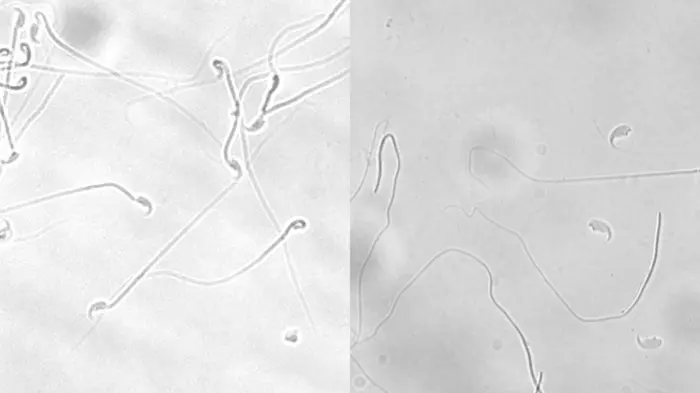
Mice lacking a certain gene are unable to produce offspring because their sperm lack the connection between the tail and the head. A new thesis from the University of Gothenburg indicates a probable cause of male infertility.
Researchers at the University of Gothenburg have identified a new protein, dubbed by them as “MC2”, that plays a crucial part in the formation of swimmable sperm in mice. This protein is needed to create a functional connection between the head and the tail of the sperm.

“The connection is located in the ‘neck’ of the sperm head and facilitates coordinated movement and function as the sperm swims towards the egg. Certainly, the tail and head will each be created perfectly without such a connection – but to no avail, as they will be unable to reach their target,” says Kexin Zhang, a doctoral student at the Department of Chemistry and Molecular Biology at the University of Gothenburg.
Gene of no importance for females
Experiments on mice indicated to Kexin Zhang and her research colleagues that production of the MC2 protein was controlled by a specific gene in the genome. When the gene was removed using genetic scissors, the researchers saw that the mice stopped producing the protein and became completely infertile. It is already known that genetic factors are responsible for 15 to 30 per cent of infertility in men. The gene is not on the sex chromosome and had no impact on the females’ ability to produce offspring.
Sign up for the Daily Dose Newsletter and get every morning’s best science news from around the web delivered straight to your inbox? It’s easy like Sunday morning.
“My research helped to enhance understanding of the causes of infertility due to the absence of the head of the sperm, which is known as acephalic spermatozoa syndrome. The underlying cause of this diagnosis has been unknown until now,” says Kexin Zhang.
Contraceptive
The discovery of the MC2 protein provides new insights into the molecular structure of sperm cells that then develop into spermatozoa. Researchers will be able to study these insights further.
“It is estimated that some 15 per cent of all heterosexual couples have problems with having children. The man is responsible for the problems in about half of these cases. I hope our research will eventually lead to new diagnostic methods and new treatments for male infertility. It may also be possible to create a male contraceptive by switching off this gene,” says Kexin Zhang.
IMAGE CREDIT: Kexin Zhang
If you enjoy the content we create and would like to support us, please consider becoming a patron on Patreon! By joining our community, you’ll gain access to exclusive perks such as early access to our latest content, behind-the-scenes updates, and the ability to submit questions and suggest topics for us to cover. Your support will enable us to continue creating high-quality content and reach a wider audience.
Join us on Patreon today and let’s work together to create more amazing content! https://www.patreon.com/ScientificInquirer



Leave a Reply