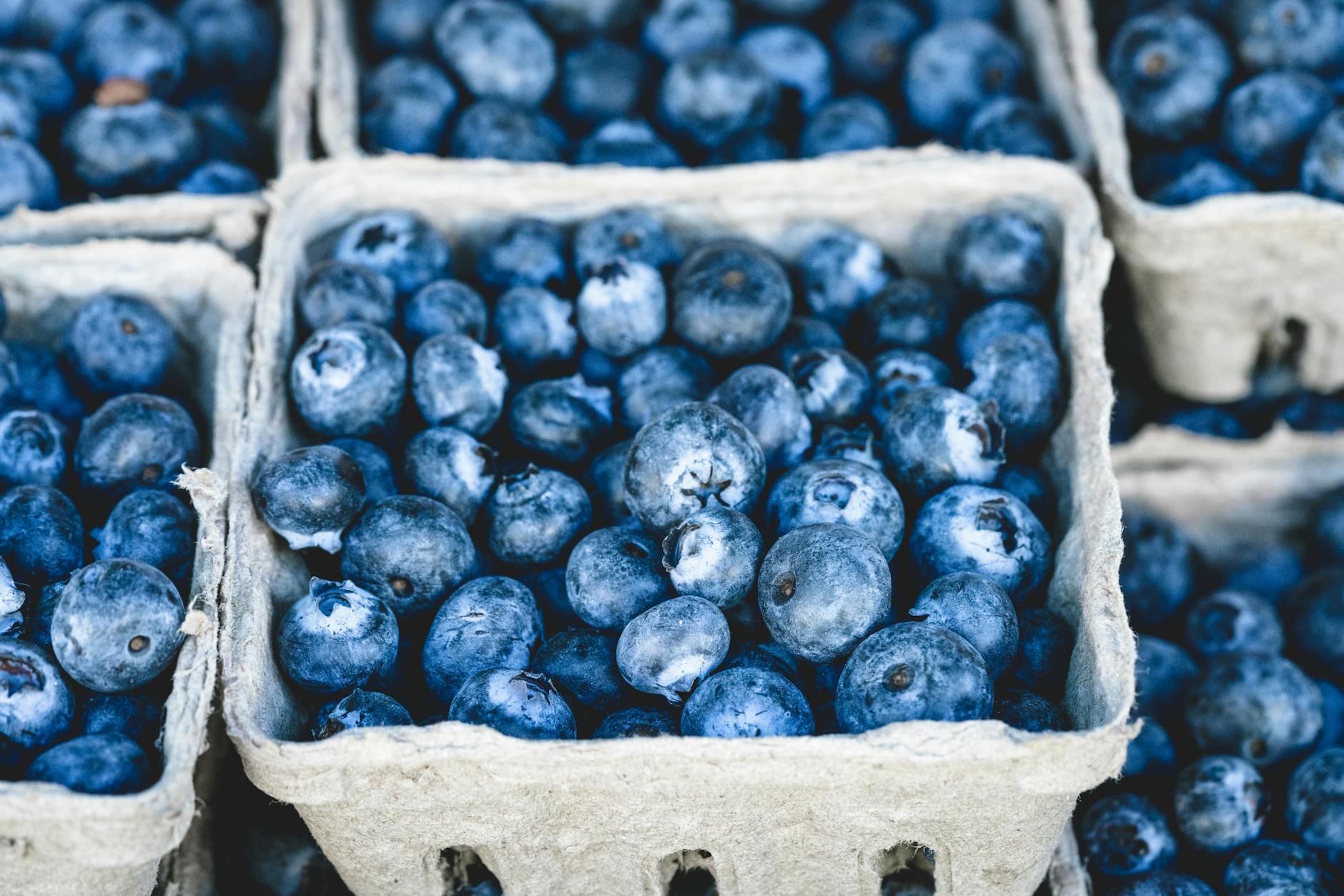
Tiny external structures in the wax coating of blueberries give them their blue colour, researchers at the University of Bristol can reveal.
This applies to lots of fruits that are the same colour including damsons, sloes and juniper berries.
In the study, published today in Science Advances, researchers show why blueberries are blue despite the dark red colour of the pigments in the fruit skin. Their blue colour is instead provided by a layer of wax that surrounds the fruit which is made up of miniature structures that scatter blue and UV light. This gives blueberries their blue appearance to humans and blue-UV to birds. The chromatic blue-UV reflectance arises from the interaction of the randomly arranged crystal structures of the epicuticular wax with light.

Rox Middleton, Research Fellow at Bristol’s School of Biological Sciences, explained: “The blue of blueberries can’t be ‘extracted’ by squishing – because it isn’t located in the pigmented juice that can be squeezed from the fruit. That was why we knew that there must be something strange about the colour.
“So we removed the wax and re-crystallised it on card and in doing so we were able to create a brand new blue-UV coating.”
The ultra-thin colorant is around two microns thick, and although less reflective, it’s visibly blue and reflects UV well, possibly paving the way for new colorant methods.
“It shows that nature has evolved to use a really neat trick, an ultrathin layer for an important colorant,” added Rox.
Most plants are coated in a thin layer of wax which has multiple functions, many of which scientists still don’t understand. They know that it can be very effective as a hydrophobic, self-cleaning coating, but it’s only now they realise how important the structure is for visible coloration.
Now the team plan to look at easier ways of recreating the coating and applying it. This could lead to a more sustainable, biocompatible and even edible UV and blue-reflective paint.
Sign up for the Daily Dose Newsletter and get every morning’s best science news from around the web delivered straight to your inbox? It’s easy like Sunday morning.
Furthermore these coatings could have the same multiple functions as natural biological ones that protect plants.
Rox added: “It was really interesting to find that there was an unknown coloration mechanism right under our noses, on popular fruits that we grow and eat all the time.
“It was even more exciting to be able to reproduce that colour by harvesting the wax to make a new blue coating that no-one’s seen before.
“Building all that functionality of this natural wax into artificially engineered materials is the dream!”
IMAGE CREDIT: veeterzy.
If you enjoy the content we create and would like to support us, please consider becoming a patron on Patreon! By joining our community, you’ll gain access to exclusive perks such as early access to our latest content, behind-the-scenes updates, and the ability to submit questions and suggest topics for us to cover. Your support will enable us to continue creating high-quality content and reach a wider audience.
Join us on Patreon today and let’s work together to create more amazing content! https://www.patreon.com/ScientificInquirer


Leave a Reply