A team of researchers from China, Australia, France, Spain, and Germany has revealed advanced material culture in East Asia by 45,000 years ago.
The new study was published in Nature Ecology & Evolution on Jan. 18.

The researchers examined a previously excavated archaeological collection from the Shiyu site, located in Shanxi Province.
“Our new study identified an Initial Upper Palaeolithic archaeological assemblage from the Shiyu site of North China dating to 45,000 years ago that includes blade technology, tanged and hafted projectile points, long-distance obsidian transfer, and the use of a perforated graphite disk,” said associate Prof. YANG Shixia, first and corresponding author of the study and a researcher at the Institute of Vertebrate Paleontology and Paleoanthropology (IVPP) of the Chinese Academy of Sciences (CAS).
Sign up for the Daily Dose Newsletter and get every morning’s best science news from around the web delivered straight to your inbox? It’s easy like Sunday morning.
This discovery uncovered a treasure trove of cultural and technological innovations. Together with the recovery of a now lost human cranial bone, it sheds light on the ancient migration of Homo sapiens into East Asia around 45,000 years ago.
The researchers dated three animal bone samples recovered during the original 1963 excavation, and these were shown to be humanly modified as indicated by cut marks. Radiocarbon methods precisely dated the main cultural layer of Shiyu to between 45,800 and 43,200 years ago.
Integrated scientific studies on the archaeological findings at Shiyu revealed an advanced material culture dating to 45,000 years ago. This includes Levallois points, tanged and hafted projectile points with evidence of impact fractures, long-distance transfers of obsidian from sources hundreds of kilometers away, a perforated graphite disk, and well-shaped bone points.
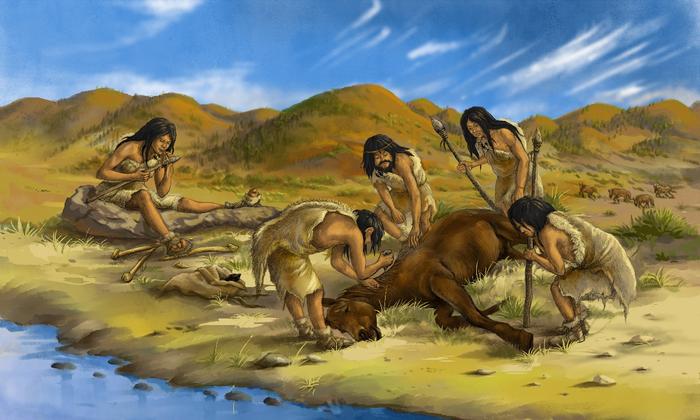
The results of the taphonomic analysis of the mammal fossils, combined with use-wear analysis of the stone tools, indicated that the Shiyu inhabitants were “horse hunters” equipped with tanged and hafted projectile points, thus having the ability to hunt and selectively cull adult equids.
Shiyu provides us with an opportunity to look into the life of the skillful hunters from northern China 45,000 years ago. The people inhabiting the region had a remarkably advanced toolkit, with a range of innovative tools from the Upper Palaeolithic, including end-scrapers, awls, and tools of former times, including Middle Palaeolithic Levallois points, various tanged tools, denticulates, and borers.
The unique set of stone tool artefacts, in combination with the shaped graphite disc and bone tools, shows that early peoples had a rich culture. The long-distance transport of obsidian from sources hundreds of kilometers away also indicates advanced and long-distance resource procurement strategies and migration abilities.
Shiyu reflects a process of cultural creolization—through contact between societies and relocated peoples—whereby inherited traits blended with novel innovations, thus complicating the traditional understanding of Homo sapiens‘ global expansion.
IMAGE CREDIT: GUO Xiaocong
If you enjoy the content we create and would like to support us, please consider becoming a patron on Patreon! By joining our community, you’ll gain access to exclusive perks such as early access to our latest content, behind-the-scenes updates, and the ability to submit questions and suggest topics for us to cover. Your support will enable us to continue creating high-quality content and reach a wider audience.
Join us on Patreon today and let’s work together to create more amazing content! https://www.patreon.com/ScientificInquirer





Leave a Reply to JuliaCancel reply