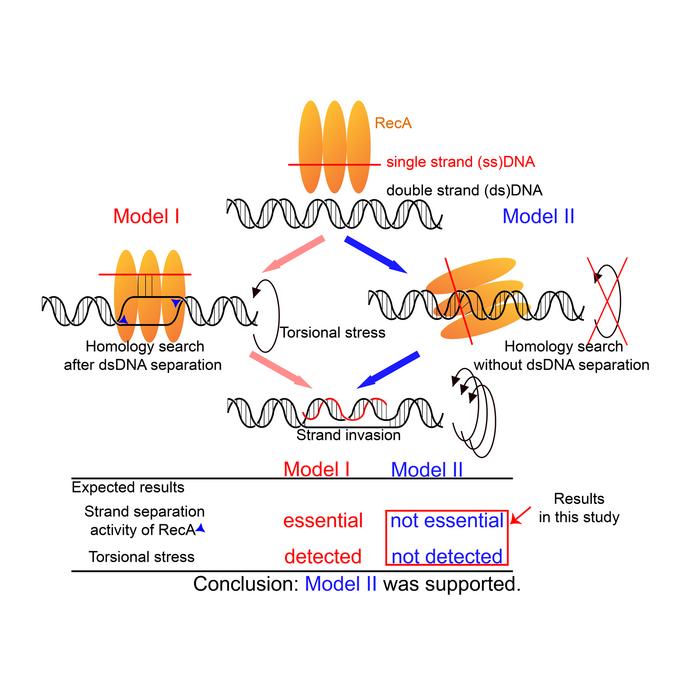
Researchers from Tokyo Metropolitan University have been studying DNA repair by homologous recombination, where the RecA protein repairs breaks in double-stranded DNA by incorporating a dangling single-strand end into intact double strands, and repairing the break based on the undamaged sequence. They discovered that RecA finds where to put the single strand into the double helix without unwinding it by even a single turn. Their findings promise new directions in cancer research.
Homologous recombination (HR) is a ubiquitous biochemical process shared across all living things, including animals, plants, fungi, and bacteria. As we go about our daily lives, our DNA is subjected to all kinds of environmental and internal stress, some of which can lead to breakage of both strands in the double helix. This can be disastrous, and lead to imminent cell death. Luckily, processes like HR are continuously repairing this damage.
During HR, one of the two exposed ends of the break in the helix falls away, revealing an exposed single-stranded end; this is known as resection. Then, a protein known as RecA (or some equivalent) binds to the exposed single strand and an intact double strand nearby. Next, the protein “searches” for the same sequence. When it finds the right place, it recombines the single strand into the double helix in a process known as strand invasion. The broken DNA strand is subsequently repaired using the existing DNA as a template. HR enables accurate repair of double-strand breaks, as well as the exchange of genetic information, making it a key part of biodiversity. But the exact biochemical picture of HR, including what happens when RecA carries both the single and double strands, is not yet clear.

A team led by Professor Kouji Hirota of Tokyo Metropolitan University has been studying DNA repair mechanisms like HR. In their most recent work, they sought to test two competing models for what happens when HR occurs. In one, RecA unwinds a section of the double strand during the “homology search,” where it tries to find the right place for strand invasion to occur. In the second, there is no unwinding after the binding of RecA; only when strand invasion takes place does any unwinding occur.
The team, in cooperation with a team from the Tokyo Metropolitan Institute of Medical Science, adopted two approaches to tackle which of these actually happens. In the first, they used a mutant of RecA which cannot separate the double strands i.e. cannot unwind the strand, to see whether this affected DNA repair. It turns out that this has minimal effect. In the second, they tried to measure how much torsion was created in the strand at different stages of the process. They found that the only torsion due to unwinding they could detect occurred after the homology search was complete i.e. when strand invasion occurred. For the first time, the team clearly showed that the second model was correct.
Detailed insights into homologous recombination are vital to understanding what happens when things go wrong. For example, factors implicated in breast cancer (BRCA1 and BRCA2) are also responsible for the correct loading of single-stranded DNA onto RAD51, the human version of RecA. This suggests that problems with HR might underlie high incidences of breast cancer in patients with hereditary defects in BRCA1 or BRCA2. The team hopes findings like theirs will lead to new directions for research into cancer.
IMAGE CREDIT: Tokyo Metropolitan University.
Sign up for the Daily Dose Newsletter and get the morning’s best science news from around the web delivered straight to your inbox? It’s easy like Sunday morning.


Leave a Reply