Last year, Typhoon Hinnamnor – which caused 36 fatalities – gained notoriety as the first super typhoon that developed at a high latitude as 25°N since Korea Meteorological Administration records began. This year in Osong, Chungcheongbuk-do, an unanticipated intense downpour, caused rivers to suddenly overflow, resulting in numerous casualties. Earth’s rising temperatures are triggering unprecedented typhoons, torrential rains, and other extreme weather events. Without reliable predictions of climate extremes prompted by global warming, mitigating the resultant damages remains a challenge.
Professor Seung-Ki Min and Dr. Minkyu Lee, from the Division of Environmental Science and Engineering at Pohang University of Science and Technology (POSTECH), have used a high-resolution climate model to conduct a pioneering quantitative analysis of the impact of global warming on typhoons making landfall on the Korean Peninsula. This research has been recently published in npj Climate and Atmospheric Science.
Notably, global warming is giving way to a surge in more powerful typhoons which maintain its intensity longer and thereby cause stronger damage. Accurate typhoon prediction and damage reduction necessitate better understanding of the global warming influences, for which climate model simulations with a km-scale resolution are eccential. However, studies quantifying the anthropogenic warming contribution to typhoons affecting Korea, especially research into the rainfall extremes accompanying typhoons, remain scant.

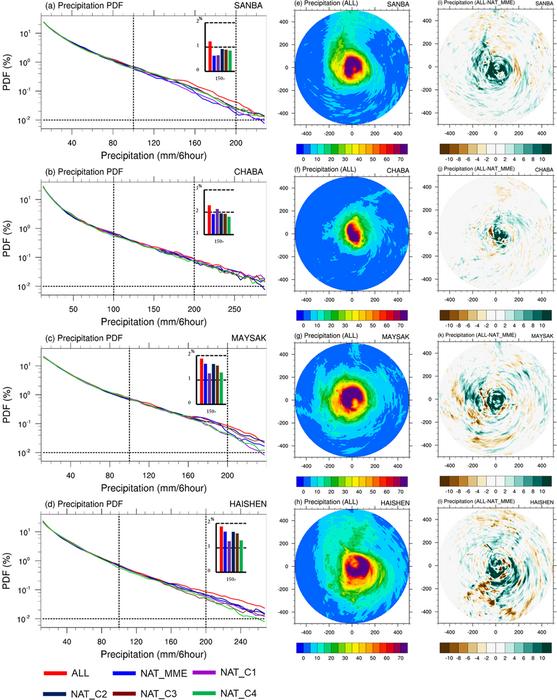
To overcome this, the research team designed a 3 km high-resolution regional climate model simulation to investigate the impact of global warming on typhoon intensity and extreme precipitation. Four extremely strong typhoons that made landfall on the Korean Peninsula between 2011 and 2020 were chosen for simulation under current climate condition and counterfactual condition without human-induced warming. To reduce the uncertainties in regional sea surface temperature changes due to global warming, they utilized diverse ocean warming patterns estimated from CMIP6 multiple climate models.
The findings show that accounting for global warming from human activities augmented overall typhoon intensity and precipitation. The research team observed that the impact of warming was pronounced more strongly at maximum typhoon intensity than the average intensity. This implies more frequent occurrences of powerful super typhoons over East Asia in the future. Additionally, the area exposed to extreme rainfall generated by typhoons expanded 16 to 37 percent due to warmer climate conditions. Further, the expansion of extreme precipitation area is attributed to the strengthening of upward motion near the typhoon center and the increase in atmospheric water vapor due to the ocean surface warming.
Professor Min explained, “Our results from high-resolution climate model simulations provide conclusive evidence that global warming has amplified the strength of recent typhoons making landfall on the Korean Peninsula. Continued escalation of global warming could lead to stronger typhoons and more extensive occurrences of rainfall extremes, demanding heightened sector-specific preparedness measures.”
This study received support from the Mid-Career Researcher Program of the National Research Foundation of Korea and the Korea Meteorological Administration Research and Development Program on Climate and Climate Change Monitoring and Prediction Information Application Technology.
IMAGE CREDIT: POSTECH.
Sign up for the Daily Dose Newsletter and get the morning’s best science news from around the web delivered straight to your inbox? It’s easy like Sunday morning.




Leave a Reply