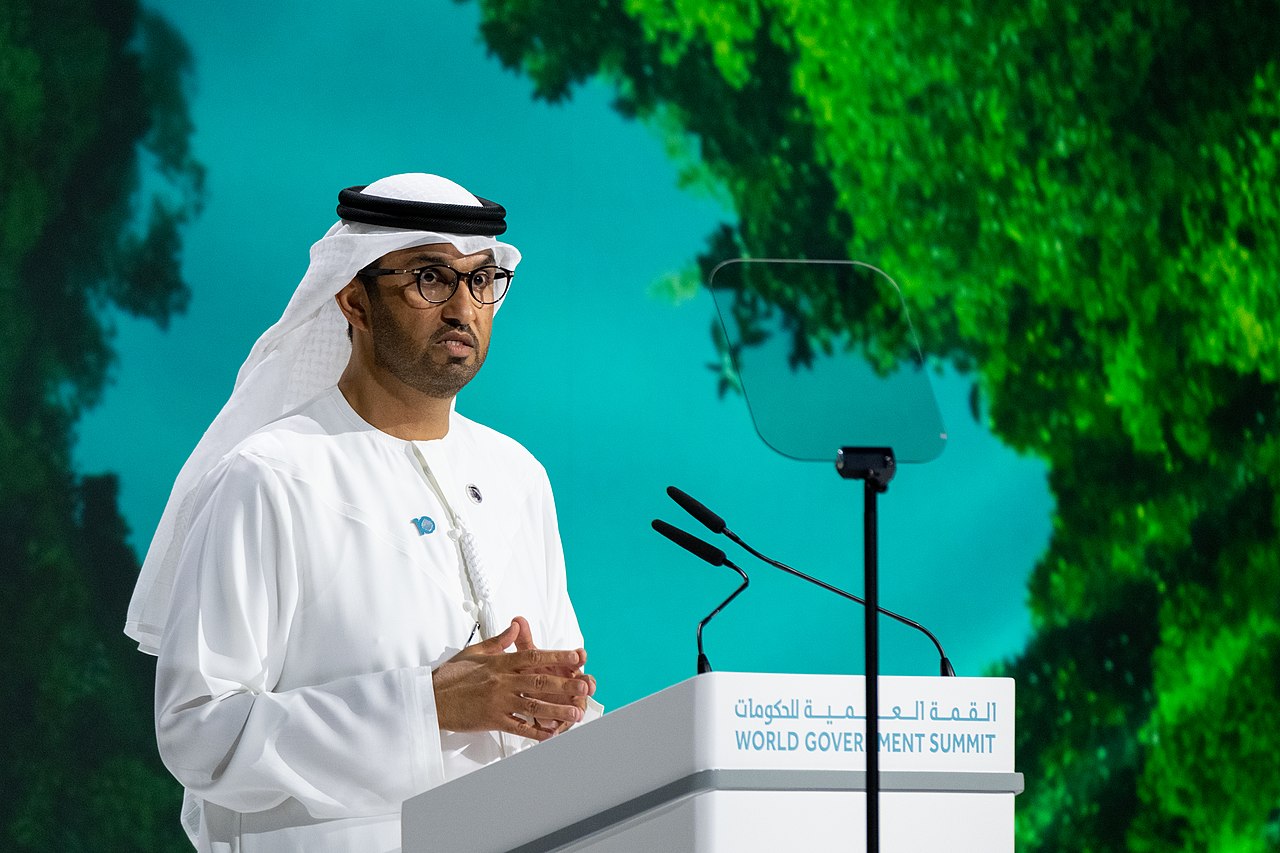
CAN YOU SAY ‘CONFLICT OF INTEREST’?
Sultan Al Jaber, president of the Cop28 climate summit and CEO of the UAE’s national oil company Adnoc, plans to continue investing in oil and gas production while guiding global efforts to transition from fossil fuels. He argues that Adnoc’s efficient extraction methods produce lower carbon emissions, and that the demand for fossil fuels will dictate their continued use. Al Jaber believes these investments align with the goal to limit global temperature rises to 1.5C above pre-industrial levels. Despite a $150bn investment in oil and gas over seven years, Al Jaber claims Adnoc is not maximizing its extraction potential and is focusing on decarbonizing current energy systems. His dual role raised concerns earlier in the year, but he gained praise at Cop28 for his leadership and commitment to a low-carbon transition, drawing on his 18-year experience in energy, including co-founding renewable energy company Masdar. The Cop28 agreement, calling for a transition from fossil fuels, was seen as a significant step despite criticism for insufficient action and financial support for developing countries. Climate campaigners, however, criticize Al Jaber’s continued investment in fossil fuels, arguing it contradicts the spirit of the Paris agreement and the Cop28 resolution. (The Guardian)
THE STORY BEHIND THE DECISION.
On February 10, 2022, Justice Samuel A. Alito Jr. circulated a 98-page draft opinion in Dobbs v. Jackson Women’s Health Organization, indicating a potential overturn of the constitutional right to abortion. This draft received rapid support from conservative Justices Gorsuch, Thomas, Barrett, and Kavanaugh, showing strong conservative alignment. Justice Barrett initially opposed hearing the Mississippi abortion case but later switched her stance. This and the swift backing for Alito’s draft suggest strategic pre-negotiations among conservative justices. The Supreme Court’s secretive deliberations were unveiled by The New York Times, revealing the internal dynamics and challenges Justice Alito faced, including hesitations from conservative justices and compromise efforts by Chief Justice Roberts and Justice Breyer. The decision, fundamentally altering Roe v. Wade, marked a significant shift, challenging norms and decision-making processes within the court. The leak of Alito’s draft to Politico was pivotal, solidifying the decision and overriding middle-ground attempts by Roberts and Breyer. The article also discusses the Supreme Court’s lifetime tenure and the political context following the deaths of Justices Scalia and Ginsburg. The Dobbs decision has major implications for abortion access in the U.S., bringing the issue back to the Supreme Court’s agenda. (New York Times)
If you’re enjoying the Daily Dose, sign up for the Daily Dose Newsletter and get the morning’s best science news from around the web delivered straight to your inbox? It’s easy like Sunday morning.
UNDERSTANDING THE BRAIN.
In 2011, a pivotal meeting led by neuroscientist Rafael Yuste proposed analyzing every brain neuron, leading to the $3 billion BRAIN Initiative. Recently, this initiative achieved a near-complete map of a mouse’s brain, significantly advancing our understanding of brain complexities. The project, tracing back to Santiago Ramón y Cajal’s 1888 work, utilized cutting-edge technologies like MERFISH, developed by Xiaowei Zhuang in 2015, for detailed cell analysis. This has led to the mapping of over four million cells in the mouse brain, a crucial step for modeling human brain functioning and diseases. These findings, essential for understanding disorders like autism and schizophrenia, are accessible via the Allen Brain Cell Atlas. The results include the “projectome,” detailing possible neuron connections and pathways. While mapping the human brain remains challenging due to its complexity, researchers like Óscar Marín are optimistic about future advancements in brain mapping, acknowledging the uniqueness of each human brain. (El Pais)
REBUILDING TRUST.
In November, Dr. Mandy K. Cohen, the new director of the CDC, visited Texas, shortly after a law barring Covid-19 vaccine mandates was passed. Her goal is to restore faith in public health and the CDC, a challenging task especially among Republicans, who show increasing distrust in scientists. Despite her agency’s warnings about low vaccination rates leading to severe disease, partisan divisions persist. Five months into her tenure, Dr. Cohen, appointed by President Biden, is engaged in a nationwide media tour to promote vaccination, visiting multiple cities and vaccination sites. She frequently emphasizes her role as a mother in communications, aiming to connect on a human level. Her approach reflects a broader effort to rebuild the CDC’s image and implement structural changes for better policy recommendations. This includes changing the CDC’s language, describing it as a “critical national security asset” to appeal to diverse audiences. Despite skepticism, Dr. Cohen’s calm and collected demeanor, along with her experience in public health, positions her to potentially navigate these challenges effectively. (New York Times)

AI CONTINUES TO WIN.
The card game Set has sparked a new AI-based method, FunSearch, which uses large language models (LLMs) to solve mathematical problems. This approach, detailed in Nature, advances the field of combinatorics by generating and testing solutions to problems inspired by Set. FunSearch represents a significant leap in AI’s application to mathematics, as it can produce solutions beyond what mathematicians and computer scientists previously knew. Developed by Google DeepMind’s team, FunSearch automatically formulates requests for a trained LLM to create short programs that solve mathematical problems. It then evaluates these solutions, discarding ineffective ones and refining the process. The system was tested on the ‘cap set problem’ derived from Set, where it improved the lower bound for a specific case, showcasing AI’s potential in enhancing human mathematical understanding. Unlike other AI applications where the process is opaque, FunSearch allows researchers to view and learn from the successful programs it creates, fostering a new model of human-machine collaboration in mathematics. (Nature)
AFTER THE TURING TEST.
Researchers have developed a new framework to evaluate AI intelligence, focusing on reasoning and introspection, unlike the Turing Test which primarily assesses an AI’s ability to mimic human responses. This novel method treats AI as a participant in a psychological study, comprising three steps: testing AI’s inference-making, assessing its understanding of its reasoning, and analyzing the cognitive elements in its source code. This approach addresses the limitations of the Turing Test, which doesn’t measure an AI’s logical thinking or self-reflective capabilities. For instance, AI programs like Google’s LaMDA and OpenAI’s ChatGPT may pass the Turing Test by mimicking human-like responses but still lack human-like reasoning. The new method aims to examine AI more comprehensively, treating it akin to a human subject undergoing psychological analysis. However, this framework, like the Turing Test, is subjective, depending on evaluators’ judgments. It is designed to encourage further discussion on how to analyze AI behavior more effectively. (Ars Technica)
THE FUTURE OF OpenAI.
OpenAI is exploring ways to control future superintelligent AI systems. Its Superalignment research team, established in July, is working on methods to guide smarter AI models. A recent paper from OpenAI presents experiments where a less capable AI model instructs a more advanced one, without significantly diminishing its abilities. This research aims to address the potential dangers of superhuman AI models and is seen as a crucial first step towards managing these advanced systems. Currently, AI models like GPT-4 are tuned using human feedback, but as AI grows more powerful, automating this supervision process becomes vital. The experiments conducted by OpenAI tested ways to minimize performance loss when a weaker model guides a stronger one. While these methods aren’t foolproof, they represent progress in the broader challenge of superalignment, the goal of ensuring superintelligent AIs act safely and as intended. OpenAI recognizes the need for external collaboration and is offering grants, in partnership with Eric Schmidt, to researchers working on AI alignment. The company is also planning a conference on superalignment. This initiative reflects growing concerns among AI experts about controlling AI as it approaches human-level capabilities. (Wired)
Thanks for reading. Let’s be careful out there.
WORDS: The Biology Guy.




Leave a Reply