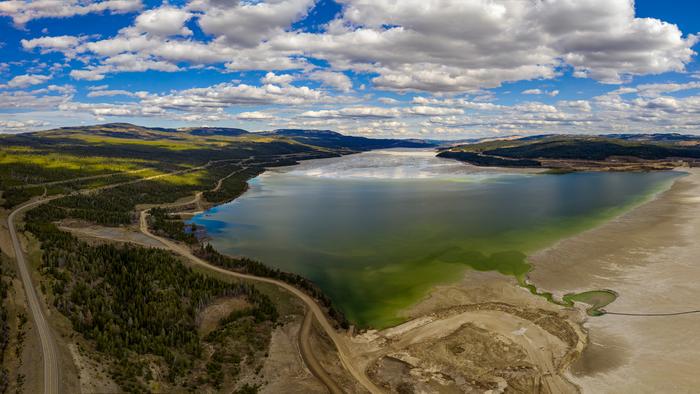
Nearly a third of the world’s mine tailings are stored within or near protected conservation areas, University of Queensland research has found.
A study led by UQ’s Bora Aska, from the Sustainable Minerals Institute and School of the Environment, said these waste facilities pose an enormous risk to some of earth’s most precious species and landscapes.

“Mine tailings contain the waste and residue that remains after mineral processing, and the storage facilities built to contain it are some of the world’s largest engineered structures,” Ms Aska said.
“We found of the 1,721 disclosed tailings facilities, nine per cent were within declared protected areas and 20 per cent were within five kilometres.
Sign up for the Daily Dose Newsletter and get every morning’s best science news from around the web delivered straight to your inbox? It’s easy like Sunday morning.
“Our findings suggest that mine wastes threaten biodiversity within protected areas all over the world, including eight active tailings storage dams in Australian protected areas, recognised by the International Union for the Conservation of Nature.”
The 2015 Samarco dam failure in Brazil killed 19 people when a giant wave of mining waste washed across villages, farmland, and waterways.
Four years later, 270 people were killed in another dam collapse near the town of Brumadinho in Brazil, destroying 133 hectares of Atlantic Forest and 70 hectares of Protected Areas downstream.
“Given the size of tailings facilities, we’re concerned about the future risks of failures on areas important to biodiversity and conservation of species,” Ms Aska said.
“To assess the risks, we analysed a database of global tailings facilities and compared it with spatial data on protected areas.”
Information was drawn from the disclosures of publicly listed companies as part of the Mining and Tailings Safety Initiative, set up after the Brumadinho disaster.
UQ’s Associate Professor Laura Sonter said managing mine wastes will become an increasingly complicated sustainability challenge.
“Total tailings production is predicted to increase significantly in the next 30 years due to the growing demand for energy transition metals and declining ore grades,” Dr Sonter said.
“Considering the current global distribution of tailings storage facilities and their failure rate, the consequences for biodiversity could be devastating.
“Luckily, the data needed to manage these risks is emerging, and opportunities exist to factor this knowledge into the design of new facilities and manage those already in place.
“We must work expediently toward completely mitigating negative impacts of mining wastes on people and the environment,” she said.
IMAGE CREDIT: Ferenc
If you enjoy the content we create and would like to support us, please consider becoming a patron on Patreon! By joining our community, you’ll gain access to exclusive perks such as early access to our latest content, behind-the-scenes updates, and the ability to submit questions and suggest topics for us to cover. Your support will enable us to continue creating high-quality content and reach a wider audience.
Join us on Patreon today and let’s work together to create more amazing content! https://www.patreon.com/ScientificInquirer


Leave a Reply